


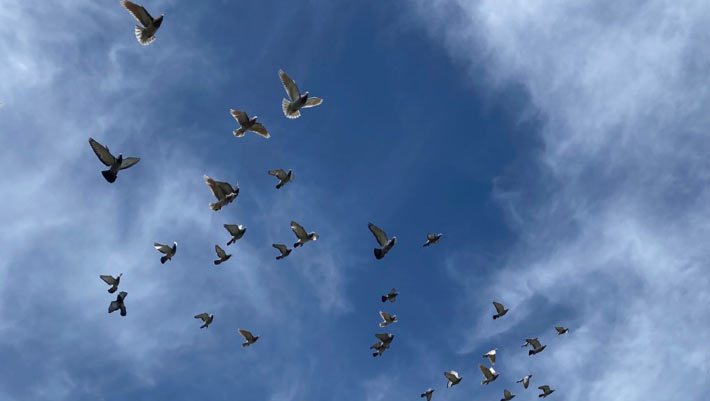
An international research team, spearheaded by scientists from the University of Bonn, University Hospital Bonn, and the Max Planck Institute for Animal Behavior, has discovered supermagnetic macrophages in the livers of carrier pigeons (Columba livia domestica). These macrophages are believed to play a crucial role in navigation when sunlight isn’t available, introducing a novel mechanism of magnetic reception in animals.
Lisowski et al. identified superparamagnetic macrophages in the livers of homing pigeons (Columba livia domestica) through multiple assays. Image credit: Spainguitar101 / CC BY-SA 4.0.
The ability to ascertain position and maintain a course toward a destination is vital for many species’ survival.
Field studies indicate that numerous animals utilize the Earth’s magnetic field for orientation, particularly when visual cues are lacking.
Birds are key models for investigating this ability. Migratory songbirds, for example, can sustain a magnetically adjusted flight direction for hundreds of kilometers, even during nocturnal or overcast travel.
Homing pigeons likely incorporate a blend of visual landmarks and environmental scents for navigation, in addition to magnetic information.
Birds employ either a solar or magnetic compass, which can function independently.
Despite extensive research, the mechanisms behind magnetic reception remain obscure and fiercely debated.
“We never anticipated that immune cells could function as sensors for magnetic fields,” says Professor Christian Kurz from Bonn University Hospital.
“Our findings unveil a previously unexplored mechanism of magnetic perception in animals.”
In this groundbreaking study, Professor Kurz and his team uncovered a specialized population of macrophages—present in the livers of carrier pigeons—that exhibit magnetic properties capable of responding to Earth’s geomagnetic field.
Following experimental macrophage removal, pigeons released in cloudy conditions entirely lost their homing abilities.
Conversely, pigeons released on sunny days found their way home successfully, even with depleted macrophages, indicating that this liver-based system is particularly effective in the absence of visual cues.
Professor Martin Wikelski, director of the Max Planck Institute for Animal Behavior, remarked: “What seems like ‘gut feeling’ in bird navigation may actually have a physical basis.”
The identified cells are superparamagnetic, acting like small magnets at low temperatures.
Researchers theorize these cells develop this property through normal processes: breaking down aging red blood cells and accumulating iron from hemoglobin, which is stored as ferritin.
While similar superparamagnetic macrophages have been found in mice and human spleens, their potential role in directional sensing had not been investigated until now.
In this experiment, 34 pigeons were trained on a 12-mile route from west to east. They were divided into two groups, one of which received treatment to deplete liver macrophages before being released in cloudy weather.
While all control birds returned home within 70 minutes, none of the macrophage-depleted pigeons found their way back that day, instead drifting aimlessly.
However, when the same depleted pigeons were retested under clear skies, they successfully returned home.
“We suspect that the liver and spleen are magnetic because they degrade red blood cells and store a significant quantity of iron,” noted Dr. Klivia Lisowski, a researcher at the University of Bonn and Bonn University Hospital.
Dr. Ulf Wiedwald from the University of Duisburg-Essen added: “The iron interacts with oxide nanoparticles, making the cells superparamagnetic and responsive to magnetic fields.”
“The strongest magnetic response was observed in liver tissue.”
The authors propose that liver macrophages, positioned near nerve fibers, communicate geomagnetic signals to the brain via the vagus nerve, establishing a known connection between peripheral organs and central processing.
The research suggests that this system may rely on many macrophages acting collectively rather than a solitary cell sensing the magnetic field.
If these findings are confirmed, they could drastically alter our understanding of magnetic reception across species.
“These discoveries provide concrete evidence of how the Earth’s magnetic field is perceived and relayed to the brain to guide movement,” stated Dr. Lisowski.
“This study links established biological processes like iron metabolism with the communication between the immune and nervous systems, offering clear answers to foundational questions about animal movement.”
“Animal navigation is among the most fascinating aspects of nature,” said Dr. Wikelski.
“If immune cells are indeed involved in direction sensing for birds, our comprehension of navigation would be fundamentally transformed.”
For more details, refer to the study published in the Journal on May 28, 2026, in Science.
_____
Clivia Lisowski et al. 2026. Homing pigeon navigation relies on superparamagnetic macrophages under cloudy conditions. Science 392 (6801): 985-991; doi: 10.1126/science.ady2486
Source: www.sci.news