


NASA Reveals the Cosmic Origin of a Mysterious “Treble Clef” Radio Structure
Astronomers using NASA’s Chandra X-ray Observatory have uncovered the likely cause of a remarkable radio structure shaped like a musical “treble clef.” The unusual formation appears to have been created by a supermassive black hole outburst followed by the collision of two galaxy clusters.
A cosmic treble clef hidden behind the Milky Way
The formation was especially difficult to study because it lies almost directly behind the plane of the Milky Way. Stars, gas, and dust in our home galaxy block much of the view from Earth. By using X-ray telescopes capable of detecting signals through this intervening material, researchers were able to identify the source of the unusual structure.
A study led by Andrea Botteon of Italy’s National Institute of Astrophysics (INAF) describes the findings. Read the research paper.
Two galaxy clusters are merging
NASA’s Chandra X-ray Observatory and Germany’s Extended Roentgen Survey using the Imaging Telescope Array, or eROSITA, detected diffuse, multimillion-degree gas at the location of the treble clef. This hot gas showed that the radio structure is hosted by a galaxy cluster.
The researchers determined that the system actually contains two galaxy clusters in the process of merging. Galaxy clusters are among the largest structures in the universe, containing hundreds of individual galaxies along with enormous reservoirs of superheated gas.
The resemblance to a treble clef is an example of pareidolia, a phenomenon in which people see familiar shapes in random patterns. The musical shape has no scientific significance, but it provides a striking way to visualize this distant cosmic event.
What the composite image reveals
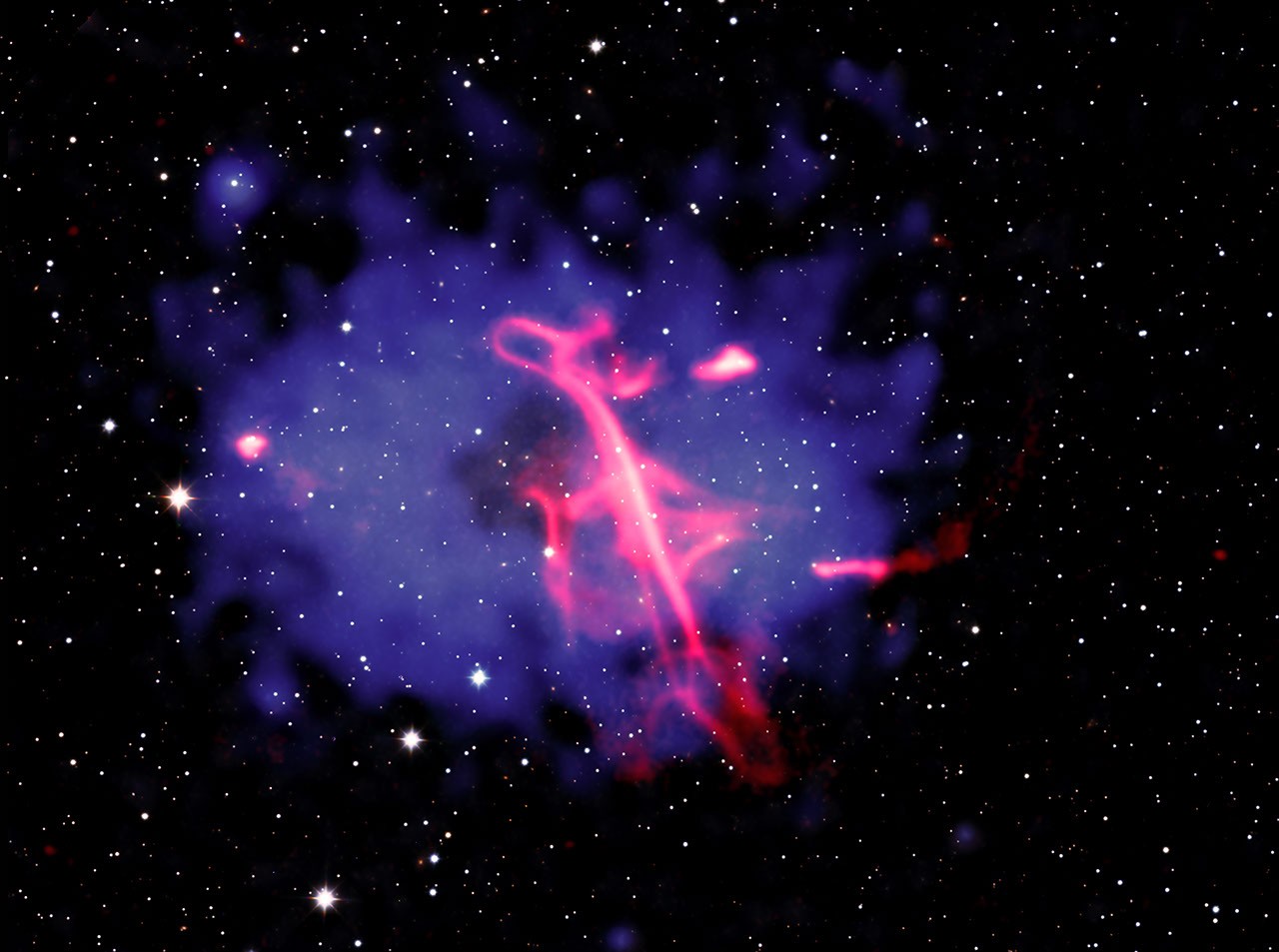
A new composite image combines observations from several telescopes. Blue represents millions-of-degrees gas detected in X-rays by Chandra and eROSITA. Some of the Chandra data were processed using special techniques to highlight important features.
Red radio data from the Low Frequency Array (LOFAR), Europe’s large radio telescope network, reveals the treble-clef-like structure. Infrared observations from the British Infrared Telescope appear mostly white.
The composite image shows a remarkable radio formation floating between two colliding galaxy clusters. Galaxies in the clusters, along with foreground and background stars and galaxies, appear as flecks of light against the darkness of space.
At the center is a large, oval blue-purple cloud with jagged edges. This cloud consists of multimillion-degree gas detected in X-rays by Chandra and eROSITA.
Within the purple field, tilted slightly to the left, the radio emission resembles a giant treble clef drawn in neon pink. Like the musical symbol, it has a strong vertical stroke and a flowing line that curves back and forth from top to bottom.
How the treble clef formed
The authors concluded that the radio formation was probably created in two stages. First, an earlier explosion from the supermassive black hole at the center of the galaxy cluster expelled a cloud of charged particles and a magnetic field at speeds close to the speed of light.
This created bright radio emission that gradually faded as the particles lost energy. Later, the collision between the two galaxy clusters compressed or reactivated the cloud, causing it to shine again at radio wavelengths.
Shock waves from the collision may also have helped re-energize the particles. The process is similar to a sonic boom produced by a supersonic jet, although it occurred on a vastly larger cosmic scale.
X-ray evidence of the cluster collision
To search for evidence of the collision, the researchers used a technique that measures how much the hot gas deviates from a symmetrical shape. Most of the gas appeared approximately elliptical. The researchers removed this symmetrical oval pattern from the original X-ray image to create a residual image.
The remaining X-ray emission was brightest on the left and right sides of the cluster and darkest near the center. Combining the original and residual X-ray images helped reveal the structure of the merging system.
The bright X-ray regions on either side of the cluster center suggest that the collision occurred along the left-to-right direction as seen in the image. Researchers believe the two clusters collided directly hundreds of millions of years ago and are now moving away from one another.
NASA’s Chandra mission
NASA’s Marshall Space Flight Center in Huntsville, Alabama, manages the Chandra program. The Smithsonian Astrophysical Observatory’s Chandra X-ray Center manages scientific operations from Cambridge, Massachusetts, and flight operations from Burlington, Massachusetts.
For more information about Chandra, please visit:
Source: science.nasa.gov