


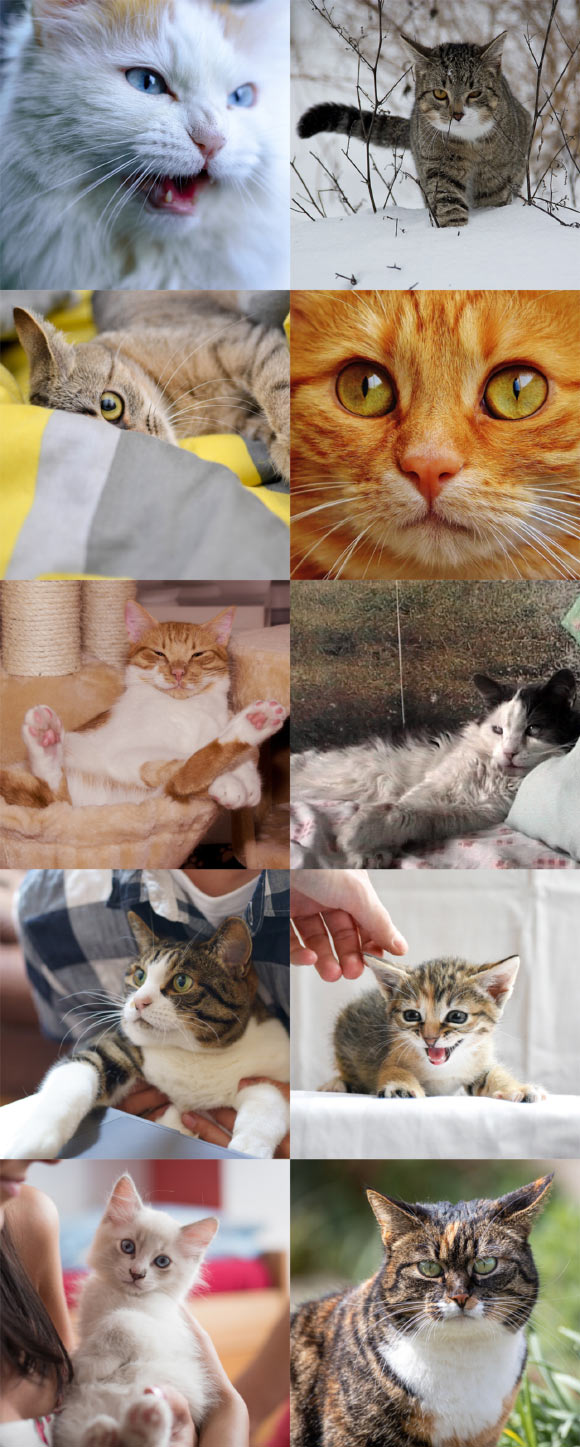
Domestic cats (Felis catus) exhibit similar patterns of brain atrophy and neurological decline as aging humans, making them a valuable model for studying dementia and the aging process.
Januel et al. analyzed 3,754 observations related to aging brain patterns and blood chemistry to align the ages of humans and cats. Image credits: Sci.News / Various Contributors.
Cats can have relatively long lifespans, with evidence suggesting their aging patterns may resemble those of humans.
According to AnAge, the maximum human lifespan is approximately 122.5 years, nearly twice that of great apes like chimpanzees, which live around 68 years.
Domestic cats, similarly to humans, can live up to 30 years, surpassing their wild counterparts such as the European wildcat (Felis silvestris), which averages 19 years.
With an estimated 600 million cats globally, their longevity and abundance inspire researchers to study interspecies aging similarities.
According to Auburn University researcher Christine Charbet and her team, “We specifically focused on age concordance between humans and cats throughout their lifespans.”
This study examined 3,754 data points collected from humans, cats, and various mammal species, including brain imaging, blood chemistry, disease patterns, and behavioral milestones.
Magnetic Resonance Imaging (MRI) tests revealed that both cats and humans undergo similar age-related structural changes in the brain, including shrinkage and enlarged ventricles, indicative of neurodegenerative processes.
“It was fascinating to observe that cats display a pattern of age-related brain atrophy akin to that seen in humans,” noted PhD candidate Briar Rigby Dames from the University of Bath.
“These findings underscore the potential of companion animals to provide insights into the aging process.”
Rather than relying solely on simplistic age ratios, researchers employed an advanced biological model based on quantifiable age-related changes.
This approach demonstrated that aging in both species does not occur at a constant pace, instead accelerating and decelerating throughout different life stages.
Through this model, it was determined that late-life aging patterns closely align, with 80 years in humans equating to 15 years in cats. Unlike many animals, domestic cats reach an age comparable to human old age.
Dr. Ryan Gibson, a veterinary neurologist at Auburn University, remarked, “An increase in cat owners seeking advanced brain imaging for illnesses provides a unique opportunity to study aging in animals alongside humans in real-world settings.”
“This enhanced accessibility fosters translational research that bridges scientific inquiry and healthcare, deepening our understanding of aging and neurological diseases benefiting both cats and humans.”
According to Rigby-Dames, “There is great potential to establish large-scale veterinary health databases for companion animals, mirroring human health databases like the UK Biobank.”
“Such resources could significantly improve our ability to study aging and disease through real-world clinical and owner-reported data collected across different species.”
These findings are published in the journal Biology Open.
_____
Capucine Januel et al. revealed that cat brains age similarly to humans, suggesting pet cats are becoming natural models for human aging. Biology Open 15 (6): bio062604; doi: 10.1242/bio.062604
Source: www.sci.news