


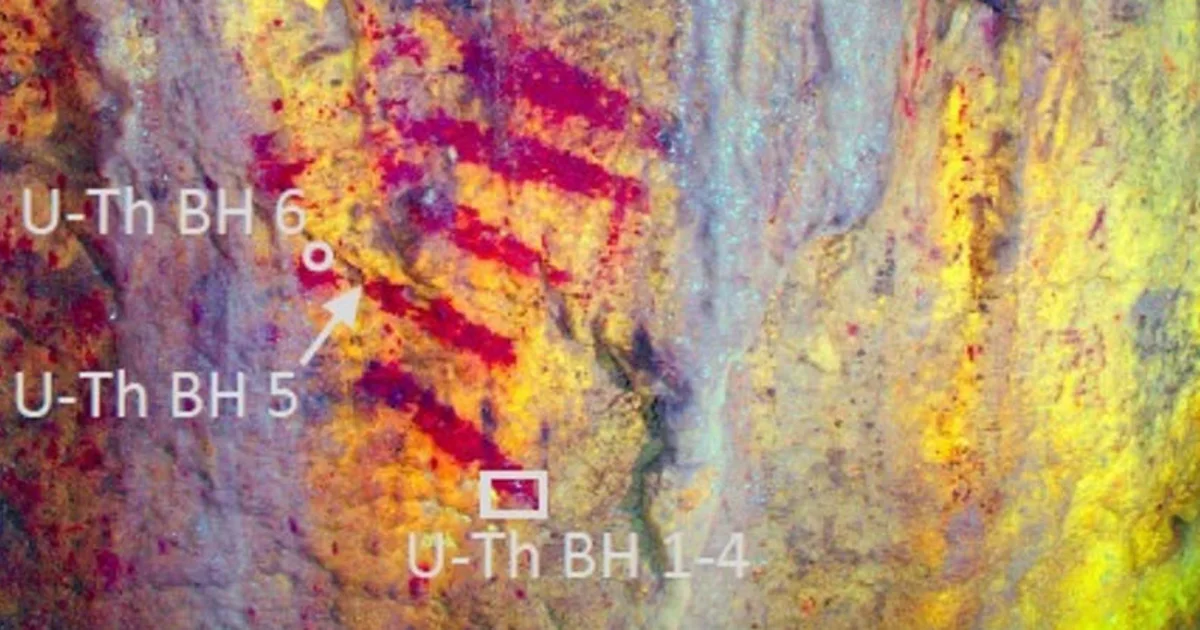
LONDON — Red stripes discovered on rocks in Wales, long dismissed as a natural occurrence, have been identified in a new study as the oldest known prehistoric art in Britain and northwestern Europe. These remarkable markings were created by human hands approximately 17,100 years ago.
Subscribe now to read this story without ads
Get unlimited access to ad-free articles and exclusive content.

An international team of scientists has thoroughly examined Bacon Hole, a cave near Mumbles in south Wales, focusing on a series of horizontal red stripe markings first discovered in 1912.
While initially identified as prehistoric art by Professors William Sollas and Henri Breuil, these stripes were later dismissed as mere natural mineral deposits, according to the study.
“This panel was overlooked and unrecognized, reducing it to an insignificant historical footnote within the archaeological community,” stated George Harold Nash, an archaeologist and prehistoric art expert who led the research.

Provided by George Harold Nash
More than 100 years later, the original interpretation has been validated.
A study published in the journal Quaternary by Nash and the interdisciplinary First Art team concluded, “It’s evident the pigmentation lines do not stem from natural processes, but were intentionally crafted by humans.”
This study asserts that the previously overlooked red stripes are the earliest known example of cave art in Britain and northwest Europe.
Nash expressed his joy upon the team’s discovery, describing it as “exhilarating and profoundly moving.”
“Standing before a painted panel discovered over a century ago, only to be forgotten and then re-acknowledged in its original context was truly extraordinary,” he wrote.
A collaborative team of scientists from China, Germany, Italy, Portugal, Spain, and Wales employed advanced dating techniques to analyze pigment samples and correlate these findings with cave observations.
The stripes of red pigment are uniformly spaced, indicating a “deliberate and structured pattern,” as highlighted by the study.

Provided by George Harold Nash
Evidence suggests the pigment was applied using fingers, aligning with Breuil and Sollas’s initial findings.
Nash emphasized that cave paintings across Europe are often linked to ritual practices, symbolic actions, and belief systems.
The full significance of these markings was largely overlooked for years, partly due to graffiti from a local fisherman created in 1894 on another cave wall complicating interpretations.
At the time these marks were made, approximately 17,100 years ago, the landscape was just emerging from an ice age, making it largely uninhabitable. Bacon Hole and other south Welsh caves would have been suitable habitats for hunter-gatherer tribes, according to the study authors.
“These caves held more than just shelter; they were culturally significant,” Nash noted. He added that while we can never fully grasp the motivations of Ice Age artists, “the positioning of artworks deep within caves suggests these sites had meanings beyond ordinary domestic life.”
Currently, Bacon Hole, a cave situated in a limestone cliff overlooking the Bristol Channel, is managed by the National Trust Wales, collaborating with the Bradshaw Foundation to support scientific research at the site.
The National Trust for Wales expressed ongoing support to classify Bacon Hall as a “scheduled monument,” emphasizing its significance.
Nash advocates for the highest level of legal protection for Bacon Hole, asserting, “Prehistoric art is an incredibly rare and delicate component of our archaeological heritage.”
“Once damaged or destroyed, it cannot be replaced,” he concluded.
Source: www.nbcnews.com