


New findings from the Relativistic Heavy Ion Collider (RHIC) STAR detector are challenging the traditional view of what gives protons one of their defining quantum properties. The results indicate that gluons—the particles that bind quarks together—may play a crucial role in carrying and preserving baryon number.
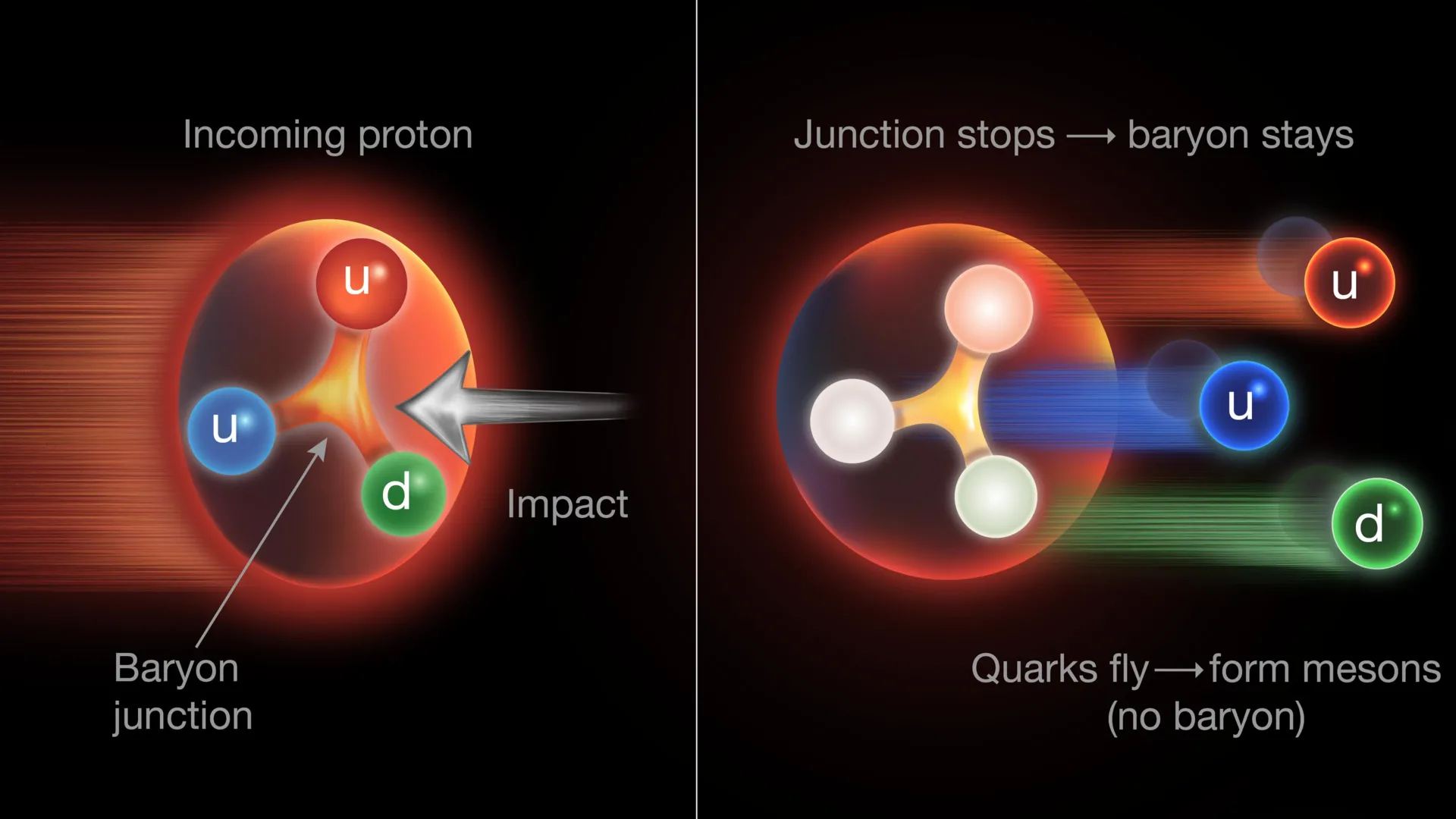
This evidence comes from high-energy particle collisions at RHIC, a U.S. Department of Energy (DOE) Office of Science user facility for nuclear physics research that operated at Brookhaven National Laboratory from 2000 until early 2026. The findings suggest that baryon number may be associated with a Y-shaped “junction” of gluons connecting the three valence quarks inside a proton. If confirmed, this discovery could challenge the long-standing assumption that baryon number belongs exclusively to quarks.
“Traditionally, scientists have thought that each of the three major ‘valence’ quarks inside a proton or neutron carries one-third of the baryon number,” said Zhangbu Xu, a professor at Kent State University who is based at Brookhaven Laboratory.
Gluon junctions may carry baryon number
Physicists first proposed baryon junctions, also known as gluon junctions, in the 1970s to explain how gluons connect valence quarks inside protons. In 1996, theoretical physicist Dmitri Kharzeev of Stony Brook University and Brookhaven National Laboratory proposed that these junctions could have a more fundamental role: the junction itself, rather than an individual valence quark, may carry the proton’s baryon number.
The STAR collaboration has now developed a method to test this possibility using data from several types of nuclear collisions at RHIC.
“Our results, based on data collected from different types of particle collisions at RHIC, suggest that baryon number is not simply carried by individual quarks,” Xu said. “Our findings strongly support the idea that baryon number, when arranged in this special configuration, may be more efficiently carried and transported by gluons—the particles that bind quarks together.”
Why baryon number matters
Understanding what carries baryon number is important far beyond the internal structure of the proton. In RHIC collisions, conservation of baryon number means that the total number of baryons—particles such as protons and neutrons, which contain three quarks—remains constant before and after a collision. The same conservation principle applies on a cosmic scale.
“Since the Big Bang, the total number of protons and neutrons has not changed over time,” said Nicole Lewis, a STAR physicist at Rice University who began the project as a postdoctoral fellow at Brookhaven Laboratory in 2020. “The reason for this conservation is not well understood. It is one of the great mysteries of the universe and is connected to why matter exists in greater abundance than antimatter.”
Baryon-number conservation also has direct consequences for the stability of matter. It helps explain why protons, which form the central component of atomic nuclei, appear to remain stable and do not decay under normal conditions.
“The lifetime of a proton is thought to be longer than the age of the universe,” Lewis said. “That extraordinary stability allows atomic nuclei to form and remain intact, making ordinary matter possible.”
The proton is more complex than the simple quark model
The possibility that gluons carry baryon number would overturn the simplified explanation commonly presented in textbooks. In that model, a proton has a baryon number of plus one, divided equally among its three valence quarks. Each quark is therefore assigned one-third of the proton’s baryon number, much like the proton’s electric charge is distributed among its constituent quarks.
However, real protons are far more complex than this basic model suggests.
“In the naive quark model, there are three quarks inside the proton and nothing else,” said Tommy Tsang, a former Kent State University postdoctoral fellow who is now at DOE’s Argonne National Laboratory. “But if you look closely, the proton is a highly complex object. It contains not only three valence quarks, but also many interacting gluons that bind those quarks together, as well as quark-antiquark pairs that continually emerge from the quantum vacuum.”
The theory that describes these interactions, quantum chromodynamics (QCD), has been highly successful in explaining the strong force between quarks and gluons. However, QCD-based models often require additional assumptions to reproduce some of the particle patterns observed when RHIC accelerates and collides atomic nuclei at nearly the speed of light.
An unexpected excess of baryons
One observation captured the STAR team’s attention: the detector repeatedly recorded more baryons than antibaryons emerging sideways from collisions—perpendicular to the direction of the incoming particle beam.
“The STAR detector consistently observes an excess of baryons emerging perpendicular to the collision beam,” Tsang said. “Because our collisions begin with matter, it is not surprising to produce more baryons than antibaryons, or more matter than antimatter.”
These extraordinarily energetic collisions transform vast amounts of energy into thousands of newly created particles. The puzzle was not simply that baryons outnumbered antibaryons, but that an unexpected excess appeared at intermediate velocities and away from the beamline.
If only valence quarks carried baryon number, all three valence quarks from a colliding proton would need to stop near the center of the detector to explain the excess of baryons moving perpendicular to the beam. Those quarks would then have to transform from matter into energy and back into matter, producing new baryons that move outward.
STAR researchers proposed another possible explanation.
Electric charge provides a test
The research team investigated the mystery by using another key property of valence quarks: electric charge. Scientists compared the net baryon number measured in different RHIC collision systems with the way electric charge was redistributed during those same events.
“Measuring the charge emitted perpendicular to the collision provides a direct way to estimate how many quarks are stopped and converted into new particles,” said Zebo Tang, a professor at the University of Science and Technology of China who led the student group responsible for analyzing the data and simulating the model.
The comparison revealed a significant discrepancy. Researchers observed approximately twice as many baryons as would be expected based on the electric charges associated with stopped quarks.
According to the QCD-based model, this means that too few quarks are stopped to account for all the baryons detected in the collisions.
That raised a central question: What carries the additional baryon number?
STAR physicists suggest that gluons—specifically, the three-pronged gluon junction connecting a proton’s valence quarks—could provide the answer.
How gluon junctions may transport baryon number
The proposed mechanism is linked to what happens when protons in colliding nuclei reach extremely high energies. According to the STAR team, the gluon structures or baryon junctions that bind quarks together may be more likely to stop during a collision than the three valence quarks themselves.
When a gluon junction stops, its energy can be converted into newly created baryons that move outward perpendicular to the beam. Meanwhile, the valence quarks that were connected by the junction may continue traveling forward along the beamline.
To understand why this may happen, it is important to consider how the proton’s internal structure changes as its energy increases.
“Baryon junctions continue to exist even as protons are accelerated to higher and higher energies,” said STAR physicist Prithwish Trivedi of Brookhaven Laboratory. “At high energies, however, the gluons inside the protons split and multiply.”
As the number of gluons increases, the proton’s momentum is distributed among more particles. Individual gluons, including those that form junctions, carry a smaller fraction of the proton’s total momentum. The valence quarks, by contrast, continue to carry much of the proton’s forward momentum.
As a result, relatively slow-moving, three-pronged gluon junctions may be more likely to stop and transform into new particles during a collision than the faster-moving valence quarks.
According to Trivedi, stopping one connected structure may be easier than stopping three separate quarks.
“In a collision, the baryon junctions are pushed backward, while the quarks continue moving forward,” he said.
How new particles form after the collision
Quarks and gluons cannot exist in isolation, so they rapidly combine with other particles after a collision.
In a simplified example, a quark that continues along the beamline may combine with an antiquark to form a meson, a particle made of two quarks. At the same time, the three-pronged gluon junction could act like a Y-shaped structure that draws in three newly created quarks from the quantum vacuum, forming new baryons.
Actual RHIC collisions are far more energetic and complex than this simplified example.
“We begin with a nucleus containing roughly 100 protons and 100 neutrons. The collision creates thousands of new particles, with about 99% of the original energy converted into those particles,” said Rongrong Ma, a physicist at Brookhaven Laboratory.
The STAR team found that collisions producing more particles also generated a larger surplus of intermediate-velocity baryons than predicted by a simple model in which only quarks carry baryon number.
According to the researchers, the fact that many of these baryons emerge perpendicular to the beamline provides strong evidence that baryon junctions exist and play an important role in transporting baryon number.
Rethinking the fundamental structure of matter
The findings suggest that one of the proton’s defining quantum properties may not reside solely in its three valence quarks. Instead, the gluon structure connecting those quarks may be central to how baryon number is transported during high-energy particle collisions.
“Our study challenges the long-held idea that baryon number is simply divided among three quarks and transported by them,” the researchers said. “This new perspective reshapes how we understand the structure of matter and deepens our knowledge of the fundamental particles that make up the universe.”
This research was supported by the DOE Office of Science, the U.S. National Science Foundation (NSF), and numerous international agencies and organizations cited in the scientific publication. The researchers also used the Open Science Grid, supported by NSF, along with computing resources at Brookhaven Laboratory’s Scientific Data and Computing Facility and the National Energy Research Scientific Computing Center (NERSC), a DOE Office of Science user facility at Lawrence Berkeley National Laboratory.
Source: www.sciencedaily.com