


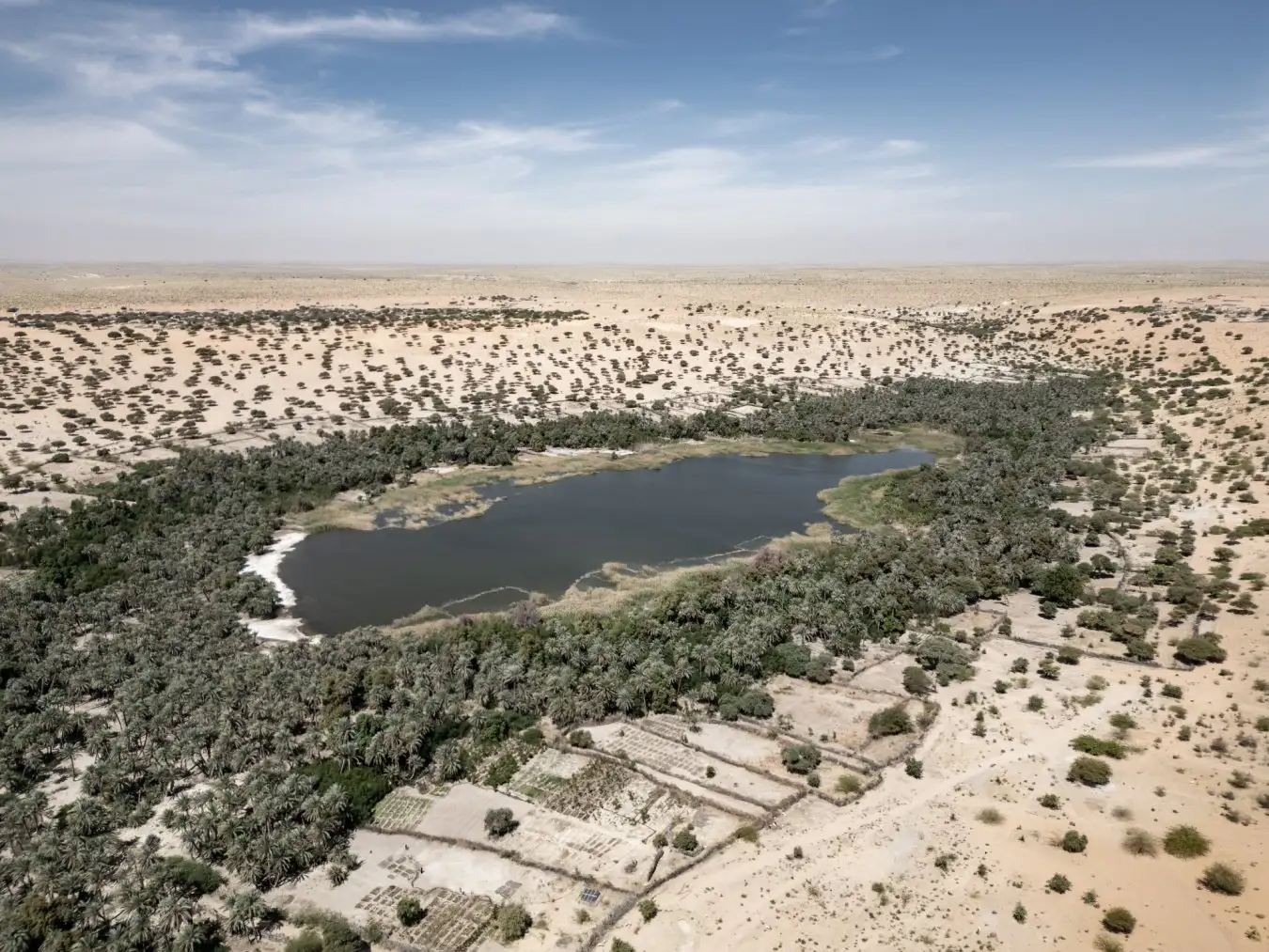
An Oasis on the Outskirts of Mao, Chad
Photography by Tommy Trenchard/Panos
Situated near the town of Mao in Chad, this oasis supports local farmers growing date palms and various crops in adjacent fields. However, the increasing temperatures driven by climate change pose significant threats to these vital oases, affecting both the local communities and wildlife reliant on these ecosystems.
This image is part of a compelling series captured by photographer Tommy Trenchard, exploring how fragile ecosystems are vanishing in a series titled “Saving an Oasis in the Sahara Desert.” As temperatures rise, flora surrounding the oasis is diminishing, while encroaching sand dunes threaten their existence. Local farmers, in places like Caou, Chad, are constructing barriers from palm fronds to protect their crops, as depicted in the image below.

Farmers Set Up Barricades Against Shifting Sand Dunes in Kaou, Chad
Photography by Tommy Trenchard/Panos
Mao and Kaou are situated in the Sahel, a semi-arid region south of the Sahara Desert, extending across Africa from Mauritania to Eritrea. In 2007, the African Union introduced the Great Wall Initiative to combat desertification in the Sahel.

Farmers Use Palm Leaf Barricades to Protect Their Oasis in Kaou
Photography by Tommy Trenchard/Panos
The Great Wall Initiative also aims to integrate sustainable practices such as solar-powered water pumps to aid irrigation in locations like Barkadoursou (shown below), near Mao, Chad. However, the initiative’s efficacy remains a topic of debate.

A Borehole Providing Crucial Water Support at Barkadoursou Oasis
Photography by Tommy Trenchard/Panos
Even with initiatives like constructing barriers and installing boreholes, questions remain regarding the future of these oases, particularly with rising temperatures threatening their very existence.
Topics:
Source: www.newscientist.com