


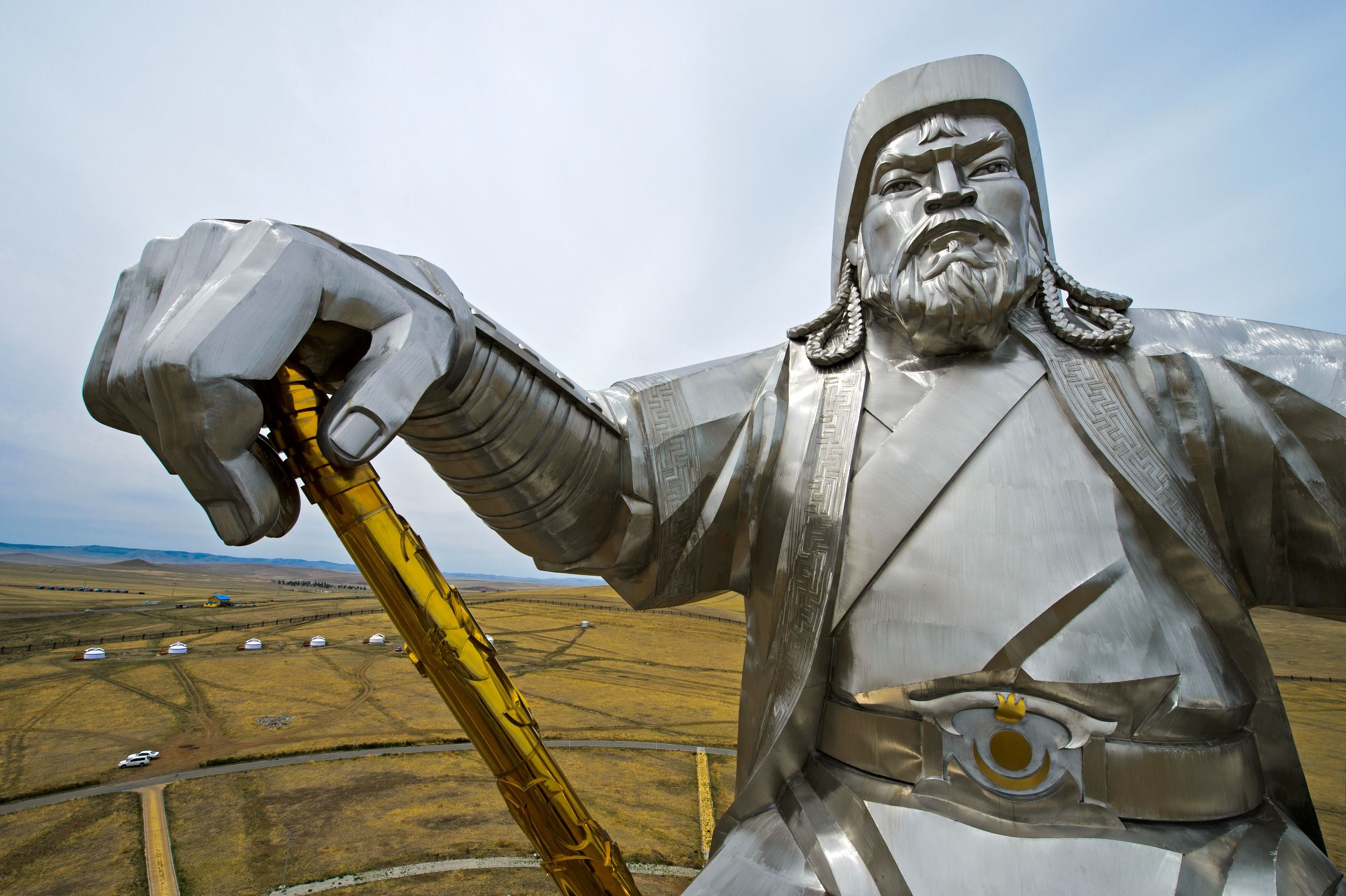
Genghis Khan’s Lost Tomb: The Search for the Mongol Ruler’s Final Resting Place
For nearly 800 years, the location of Genghis Khan’s tomb has remained one of history’s greatest mysteries. Legend says that his funeral was protected by mass killings, hidden by diverted rivers and erased by thousands of horses. Archaeologists and explorers are still searching for evidence of where the founder of the Mongol Empire was buried.
Who Was Genghis Khan?
Genghis Khan was arguably one of the most successful rulers in history. Born Temujin in Mongolia around 1162, he endured exile, enslavement and family conflict before becoming a powerful military leader.
His father, a tribal nobleman, was poisoned by a rival tribe when Temujin was nine. Afterward, conspirators exiled Temujin and his family to the steppe, apparently hoping they would starve. Historical accounts describe the young Temujin as sensitive, fearful of dogs and prone to crying. Yet he survived, escaped enslavement and eventually became a ruthless and determined commander.
As a young man, Temujin eliminated rivals from competing nomadic tribes. In 1206, he was crowned Genghis Khan, a title often translated as “Universal Ruler.” He was also called the “Disturber of the Universe.”
The Rise of the Mongol Empire
Genghis Khan’s warriors combined speed, horsemanship and archery with carefully planned military tactics. They could launch rapid attacks, pursue enemies across vast distances and conduct prolonged sieges against fortified cities.
One of the most notorious campaigns involved Merv, a desert oasis in modern-day Turkmenistan. Known for its gardens, libraries, silk and melons, Merv surrendered after only six days of siege. A massacre followed. One chronicler later wrote, “It was an unforgettable day when I shrieked and cried.”
Accounts claim that Genghis Khan ordered his army to count the dead after the city was destroyed. The reported total was 700,000 people, although historical accounts of the massacre vary.
Despite his brutality in war, Genghis Khan introduced policies that could benefit people living under Mongol rule. He allowed subjects to worship different gods, promoted free trade and supported diplomatic immunity during negotiations. He also outlawed torture during interrogations and created an international postal system.
Under his successors, the Mongol Empire spread technologies and institutions including the compass, abacus, printing press, paper money and systems of education. At its height under Genghis Khan, the empire stretched from Korea to the Caspian Sea and covered an area twice the size of the Roman Empire. His army numbered roughly 100,000 warriors.
“If anyone in history deserves a grand mausoleum, it’s him.”
Historian Jack Weatherford summarized Genghis Khan’s achievements by comparing him to an illiterate outsider who united a people, created an alphabet, established religious freedom, drafted laws and developed a new system of warfare. In Weatherford’s view, Alexander, Julius Caesar and Napoleon were not equal to Genghis Khan.
How Did Genghis Khan Die?
Modern sources reveal little about Genghis Khan’s death in 1227. The Mongols were unusually reluctant to discuss death, even though their conquests had caused enormous bloodshed. As a result, several stories about his final moments emerged.
One account says he died after falling from his horse. Other versions claim he was struck by lightning or wounded by an arrow during battle. Another sensational legend says that a conquered queen killed him with a hidden knife while he attempted to assault her.
The truth remains unknown. His longtime wife, Yesui, reportedly dressed his body in a white robe, wrapped it in white felt and secured the covering with golden straps. What happened next is the subject of some of history’s most dramatic burial legends.
The Legend of Genghis Khan’s Secret Funeral
According to legend, 1,000 soldiers carried Genghis Khan’s body on horseback to a secret burial site in the mountains. To conceal the route, the soldiers allegedly killed everyone they encountered during their 40-day journey, often shouting, “Go into the afterlife and serve your master!”
Some versions of the story say that animals were killed as well. Based on other Mongol burial practices, the body may have been placed deep underground, facing north to south with the head toward the east.
The burial may also have included valuable objects such as golden saddles, gold rings and pearls wrapped in silk. Legends claim that slaves, concubines and horses were buried with him. One particularly grim story says that live baby camels were buried nearby so their cries could serve as funeral music—or help grieving mothers return to the site.
After the burial, soldiers supposedly redirected a river or trampled the ground with 1,000 horses to erase all signs of the grave. They then killed people who crossed their path on the journey home. In the most extreme version of the story, the soldiers who carried out the massacre were themselves killed, and the people who killed them were also executed.
These accounts may be exaggerated, but they reflect the secrecy surrounding Genghis Khan’s burial. If the legends are true, the elaborate concealment helped keep his tomb hidden for centuries.
Where Is Genghis Khan’s Tomb?
Four countries—Mongolia, China, Kazakhstan and Russia—have claims connected to the location of Genghis Khan’s remains. The most widely discussed possibility is Burhan Khaldun, also known as the “Mountain of the Gods,” in northeastern Mongolia.
Genghis Khan was born near the region and regularly hunted there. He worshiped Tengri, the sky god, in the area and once took refuge on the mountain while escaping an enemy. According to tradition, he believed Burhan Khaldun would be an appropriate place for his final resting place.
The mountain’s importance was reinforced by later Mongol rulers, who declared the surrounding land forbidden and appointed the Darhad, a group of guards, to protect it. The Darhad reportedly killed anyone who approached the sacred area. In exchange, they paid no taxes and were exempt from military service.
The Darhad continued their watch for roughly 700 years, until the establishment of the communist People’s Republic of Mongolia in 1924.
The Soviet-Era Search for Genghis Khan’s Tomb
The Soviet-backed Mongolian government had a conflicted attitude toward Genghis Khan. Officials admired his military ruthlessness and the territory he conquered, but they feared that his memory could encourage Mongolian nationalism and resistance to communist rule.
Authorities banned public mention of Genghis Khan’s name and surrounded the Burhan Khaldun area with a 3,900-square-mile “high exclusion zone.” A tank base was placed at the entrance.
After Joseph Stalin’s death in 1953, restrictions were eased somewhat. In 1962, however, a Mongolian official attempted to commemorate Stalin’s 800th birthday with a postage stamp. The Moscow government ordered his arrest, and he was reportedly killed with an axe.
After the fall of the communist regime in 1992, the exclusion zone became a nature reserve. Some sections opened to the public, but the land near Burhan Khaldun remained difficult to explore.
Why the Tomb Is So Difficult to Find
Burhan Khaldun is one of the most isolated regions on Earth. Roads are scarce, and the population density is comparable to Greenland. Dense vegetation covers much of the landscape, while open areas are vulnerable to flash flooding.
Temperatures can reach 100 degrees Fahrenheit, or 38 degrees Celsius, in summer and fall to 50 degrees below zero Fahrenheit, or minus 46 degrees Celsius, in winter. Conditions are so severe that even yaks can die from the cold.
Explorers searching for the tomb have suffered snake bites and frostbite. Some have become stranded after their vehicles fell from cliffs. One man repeatedly crossed the mountain slopes for 40 years but died without finding the grave.
Satellite Archaeology Finds Ancient Sites—but Not the Tomb
In 2010, archaeologists tried a different approach. They published satellite images of the Burhan Khaldun region online and asked volunteers to search for depressions, raised areas and other landscape features that might indicate graves.
About 10,000 people spent approximately 30,000 hours examining more than 2,300 square miles, or 5,950 square kilometers, of satellite imagery. Volunteers identified more than 100 potential locations.
Although some sites were inaccessible because of difficult terrain, researchers examined 55 promising locations. The search revealed megaliths, Bronze Age tombs and ancient cities—but no trace of Genghis Khan.
One archaeologist compared the search to looking for a needle in a haystack without knowing what the needle looks like.
Genghis Khan’s Final Victory?
Genghis Khan’s tomb has never been conclusively identified. If the traditional accounts are even partly accurate, his burial site was protected by secrecy, violence and geography.
His armies scattered across Eurasia, and the remains of his victims have long since disappeared into the earth. Yet the resting place of the ruler who created one of history’s largest empires remains unknown.
That may be Genghis Khan’s final victory: after nearly eight centuries, the greatest warrior of the Mongol Empire may still be successfully hiding from the world.
Source: www.livescience.com