


The Intergovernmental Panel on Climate Change (IPCC) is facing a dispute over the timing of its next major assessment and an even more serious shortage of funds. Although some countries want the Seventh Assessment Report (AR7) completed by 2028, others say that deadline is too soon. Without more than CHF 20 million in additional funding, the organization may not have the resources to complete the report—or even continue operating beyond 2028.
The IPCC has survived crises before and may do so again.Credit: Pavlo Gonchar/SOPA Images/Sipa USA/Alamy
When the latest meeting of the IPCC in Addis Ababa concluded earlier this month, its outcome attracted negative media coverage. This is not the first time that the United Nations body, which serves as the world forum for climate scientists, has failed to agree on a timetable for its next comprehensive review of the science of global climate change.
Disagreement over the timetable
Many countries hope that AR7 will be published in 2028. That would allow it to inform the United Nations climate change conference known as the Global Stocktake, where countries will assess their progress towards meeting their climate commitments. Several countries, including some European countries and small island states, want the report to be released before the stocktake so that governments can adjust their pledges in response to the latest science.
A smaller group—including India, Iran, Kenya, Russia and Saudi Arabia—argues that 2028 is too soon. These countries say that some of the poorest nations lack the capacity to participate fully in the review process before the report is published. They also object to the dominance of research from institutions in high-income countries. For AR7, however, the IPCC says that 51% of authors and review editors are from developing countries and countries with economies in transition.
Preparing an IPCC assessment is a major undertaking. The Sixth Assessment Report, published in 2023, contained more than 7,500 pages and received approximately 200,000 comments from reviewers around the world.
A growing funding crisis
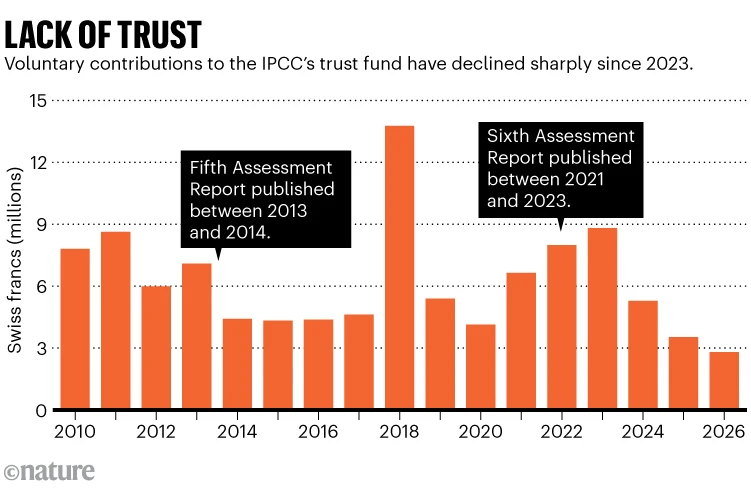
The IPCC faces an even more fundamental problem: a lack of money. For the first time in its history, the organization may not have enough funding to complete an assessment report. It relies on voluntary donations from governments and other United Nations agencies, but those contributions have declined since 2023.
Source: IPCC
The funding supports the review itself and helps scientists from the poorest countries attend conferences and participate in the process. Many of the countries seeking to postpone the report have made little or no contribution to the IPCC in recent years, although Russia is a notable exception. If contributions remain at current levels, only 5 million Swiss francs ($6 million) will be left in the IPCC’s accounts by the end of 2028—an amount sufficient only for an orderly wind-down of the organization.
There is a way forward. The IPCC needs more than CHF 20 million to continue its work through the end of 2029 and complete AR7. Governments should consider increasing their contributions immediately. Other donors, including philanthropists and non-governmental organizations, should consult the IPCC about how they can provide support.
Why the IPCC still matters
Some people question whether the IPCC is still necessary. They argue that climate research can be synthesized more quickly and that much is already known about climate change, its impacts and the measures needed to prevent dangerous consequences. Another United Nations report published last week confirmed that countries are not on track to limit global warming to 1.5°C above pre-industrial levels.
But these arguments overlook the value of the IPCC’s process. Its reports are prepared through extensive consultation, bringing together scientists from the richest and poorest countries so that perspectives from around the world are represented. The scientist-led process is designed to ensure that the quality of the evidence takes precedence over political considerations.
After scientists agree on the main text, governments participate in preparing a summary report and can decide whether and how to respond to the findings. They cannot change the text of the underlying assessment report.
A history of surviving crises
The IPCC has overcome serious crises before. The most significant came in 1995, when the second assessment report concluded that the “balance of the evidence” suggested that humans were causing global warming.
Representatives of some fossil-fuel-producing countries, along with oil and gas companies, challenged that conclusion. The organization’s scientists nevertheless stood by their findings, often at considerable personal cost. Most governments that supported the IPCC backed the scientists, and the crisis eventually passed.
The current crisis is more serious because it threatens the IPCC’s survival. Governments should work together to ensure that the organization is properly funded. One possible solution would be to replace the current ad hoc system of voluntary contributions with multiyear budget commitments, similar to those used to finance many other United Nations agencies. Support from non-governmental organizations should also be considered.
The IPCC must resolve the timing of its next assessment. But that dispute should not distract from the more urgent task: ensuring the organization’s survival.
Source: www.nature.com