


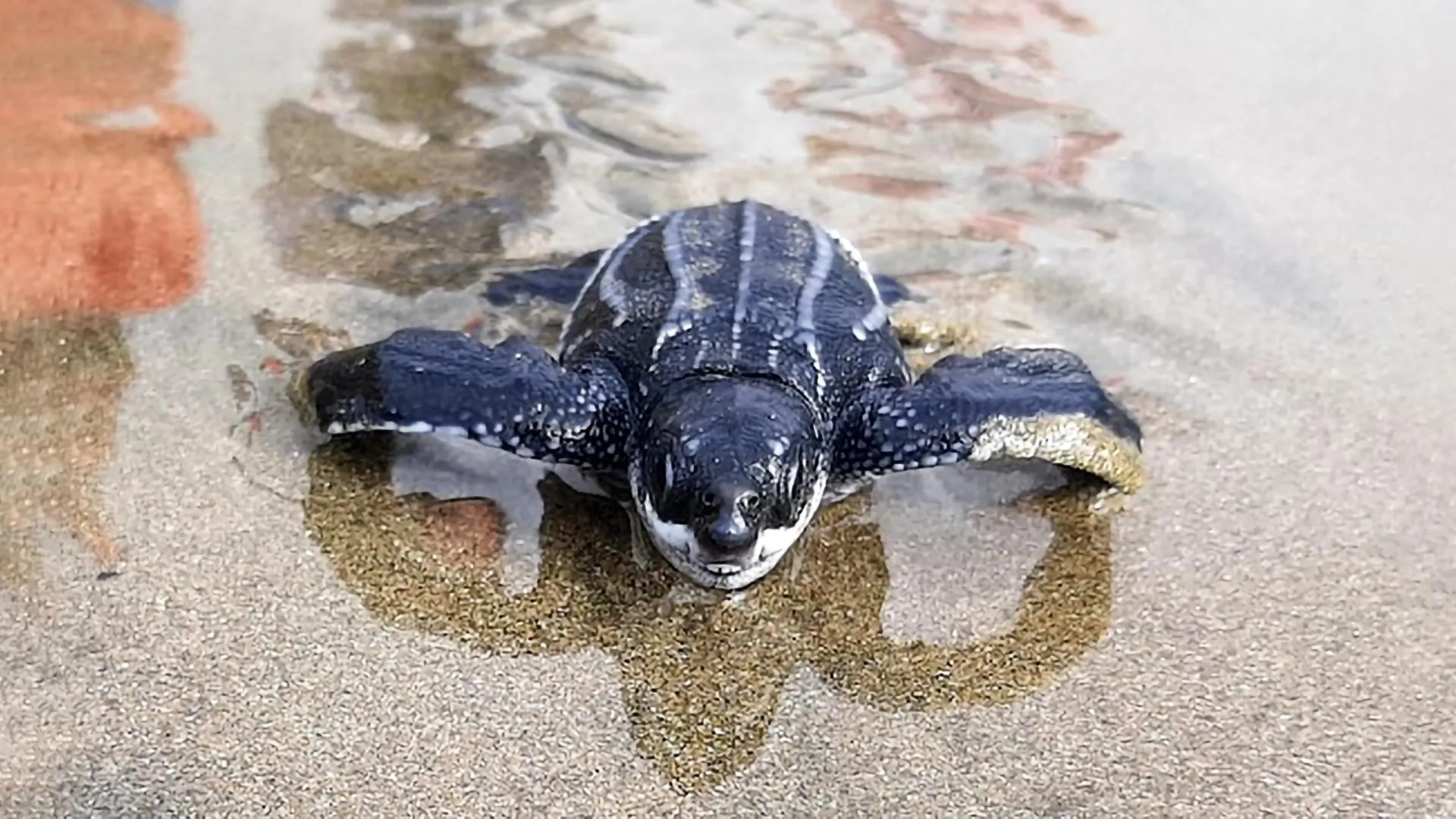
Ecuador’s coast recorded an unprecedented number of eastern Pacific leatherback turtle nests during the 2025–2026 nesting season, suggesting that the endangered turtles may be seeking cooler coastal conditions as ocean temperatures rise. The nesting beaches are more than 1,000 miles from the turtles’ traditional nesting grounds in Mexico and Costa Rica, and researchers found that nesting success in Ecuador was comparable to that in established areas farther north.
Cooler waters may offer a survival advantage
Researchers examined more than 45 years of historical data from Ecuador’s coastline in a study published in Chelonian Conservation and Biology. The records included sightings of adult reproductive females, nesting attempts, nest numbers, hatching success and stranded turtles. The team compared these observations with El Niño and La Niña events, which repeatedly raise and lower sea-surface temperatures.
During the past decade, leatherback activity and nesting along Ecuador’s coast have increased during La Niña events, when waters in the southeastern tropical Pacific become cooler. The researchers also found that the number of eggs laid per nest and the proportion that successfully hatched were similar to figures from established nesting areas farther north. Some nests in Ecuador produced more hatchlings than is normally observed, said Juan José Alaba, an adjunct professor in Simon Fraser University’s School of Resource and Environmental Management and the study’s lead co-author.
“Historically, observing female East Pacific leatherback turtles on the Ecuadorian coast has been a rare or unusual event, but this discovery suggests that leatherbacks have adapted their reproductive cycles to thrive and survive on the Ecuadorian coast,” Alaba said.
“This represents new hope for a subspecies of leatherback sea turtles that is at risk of extinction in the Eastern Pacific within 60 years. Against all odds, leatherbacks continue to move with nature, and represent hope for this and other sea turtle species even as they reach tipping points.”
The eastern Pacific leatherback is unusual among sea turtles because it can thrive in both warm and cold environments. The turtles migrate thousands of miles each year between tropical nesting beaches and feeding grounds in the subarctic Pacific, where jellyfish provide an abundant summer food source. Leatherbacks have also expanded their range off Canada’s west coast, including British Columbia, where more than 150 records were documented between 1931 and 2024.
A population at risk
Since the 1980s, the eastern Pacific leatherback population has declined by more than 90%. Natural environmental pressures, including warm El Niño events intensified by human-caused climate change, are contributing to the decline.
The turtles also face threats linked to human activity, including accidental capture in fishing gear, plastic pollution, collisions with ships, egg collection and the destruction of nesting sites.
Alaba said the population’s long-term survival will require continuous monitoring, coordinated conservation efforts, measures to reduce accidental catch in fisheries and careful management of Ecuador’s coastal areas to protect nesting beaches.
“Management and conservation efforts should be driven by close consultation and participation with local and traditional ecological knowledge, through community-based interventions in coastal areas,” he said.
A successful nesting season
On a moonlit night in January 2026, a female leatherback turtle named Bella by researchers emerged from the water at Playa de Crucita, Ecuador. As she searched for a suitable place to lay her eggs, artificial light from a nearby streetlight disoriented her. She crossed a rocky breakwater and eventually reached the sidewalk.
Unable to find a suitable nesting site, Bella returned to the sea without laying eggs. Two nights later, she appeared on a quieter beach, where she dug a nest, laid 47 eggs, covered them with sand and returned to the water. A few weeks later, 44 hatchlings emerged and headed toward the sea.
Researchers attached a tracking tag to Bella during her first nesting attempt and found that she nested four to five times in 2026 alone. One nest remained at its original location, while the others were relocated to the San Jacinto Hatchery.
By the end of the nesting season, 134 of Bella’s 146 eggs had hatched, producing an overall hatching success rate of 91.8%.
Source: www.sciencedaily.com