


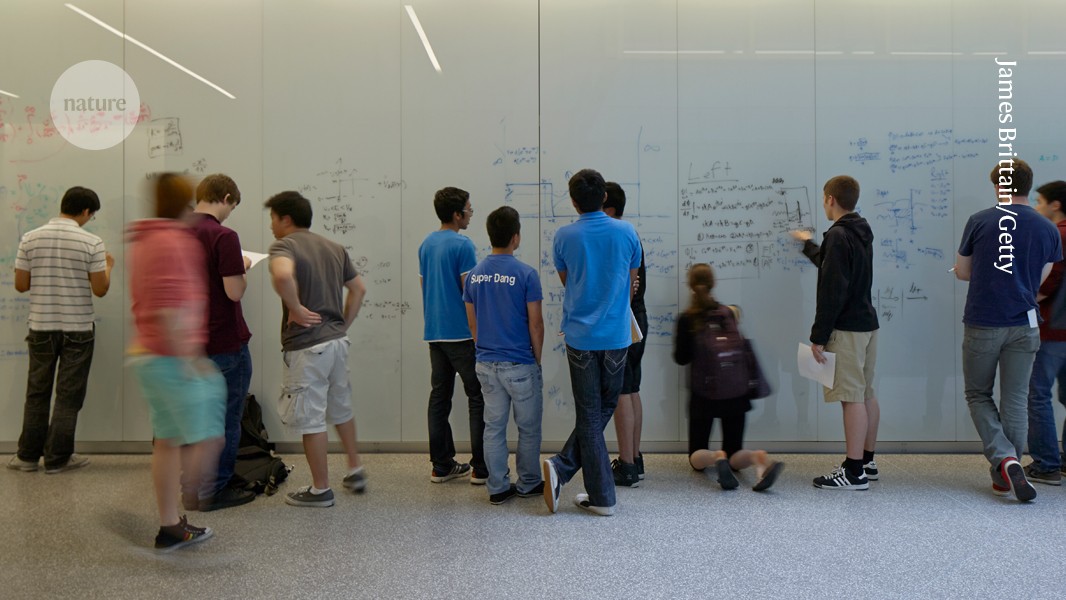
The Riemann Hypothesis has been a guidepost for generations of mathematicians. Credit: James Brittain/Getty
Artificial intelligence has produced a series of striking mathematical claims this year, including Anthropic’s reported complete proof of the Riemann Hypothesis. On the same day, however, mathematician Levent Alpöge published a separate, human-written proof that he developed with help from Anthropic’s large language model. A rival preprint followed a few hours later, meaning that two possible solutions to one of mathematics’ most famous open problems are now awaiting scrutiny.
In an announcement posted on November 20, Alpöge, a mathematician at a company in San Francisco, California, wrote: “Working with Claude, I believe we have discovered a proof of the Riemann hypothesis.” Claude is Anthropic’s large language model.
“If this can be fully verified, this is clearly a historic milestone in mathematics,” said number theorist James Maynard, a Fields Medal winner at the University of Oxford.
A few hours later, Ravi Vakil, a mathematician at Stanford University in California, posted a rival preprint. The paper was written by mathematician Alessandro Maria Masullo, who received his PhD from Stanford University in 2020 under the supervision of number theorist Brian Conrad.
Vakil described the release as a “rushed announcement”. He wrote that the hope had been for Conrad to work with Masullo for a year to refine the paper and publish it after more mathematicians had examined it. “It seems best to issue the current draft,” Vakil wrote.
If either or both solutions are confirmed, the result would be a remarkable 200th-anniversary gift for Bernhard Riemann, the German mathematician who was born 200 years ago this September. In the mid-1800s, Riemann formulated ideas about the distribution of prime numbers that led to the hypothesis bearing his name.
A problem about prime numbers
The Riemann Hypothesis concerns the Riemann zeta function, which encodes important information about the distribution of prime numbers. Riemann showed that the distribution of primes is connected to the zeros of the zeta function: points represented by z in the complex plane that satisfy the equation ζ(z) = 0.
He conjectured that, apart from certain obvious and uninteresting cases, all of these zeros lie on a particular vertical line in the plane. If true, the hypothesis would imply that prime numbers are distributed among the integers in the most random way possible.
The Riemann Hypothesis is one of seven Millennium Prize problems selected by the Clay Mathematics Institute, whose scientific headquarters are in Oxford, England. The institute offers a US$1 million prize for a valid solution to each problem. Mathematicians using AI tools announced earlier this year that they had solved another Millennium problem involving the Navier–Stokes equations.
Questions over the announcement
Alpöge’s four-page document contains an outline of the proposed proof. Andrew Granville, a number theorist at the University of Montreal in Canada, said Alpöge should have taken more time to prepare a clearer paper before announcing the result. The announcement came days after Anthropic’s initial public offering, which valued the company at US$1.5 trillion before its valuation fell on November 19.
“What he published was garbled,” Granville said, pointing to the timing of the document’s release and the company’s falling stock price.
“There is clearly some cynicism in relation to the timing, but that is incorrect,” Alpöge said in a written statement.
Anthropic did not immediately respond to Nature’s request for comment.
A new role for AI in mathematics?
Tristan Buckmaster, a mathematician at New York University who worked with Alpöge on another project involving the Navier–Stokes equations, said Alpöge deserved substantial credit for developing techniques that use large language models to produce mathematical results.
“Levent himself built this wonderful setup to do mathematics,” Buckmaster said. He added that Alpöge, a number theorist on leave from Harvard University in Cambridge, Massachusetts, had worked intensively on this and other problems for months, often with little sleep.
Maynard said he thought Alpöge’s proof might ultimately prove correct, even though it is currently presented partly as code that a Lean programming language system cannot understand.
“It’s obviously very complex at this point, and it’s going to take mathematicians a long time to understand,” Buckmaster said. Maynard agreed, adding: “If we can get the understanding it deserves, this will definitely be considered one of the absolute pinnacles of mathematical results.”
Source: www.nature.com