


BMW’s 2027 i7 receives a substantial mid-life update beneath its familiar luxury-sedan body. The revised electric flagship gains a larger 112.5 kWh battery, a new sixth-generation electric powertrain, more compact drive hardware and updated electronic architecture, although BMW has retained a 400-volt electrical system. The changes follow the technology introduced in BMW’s newer electric vehicles and are intended to improve efficiency, processing power and vehicle-control capabilities.
When BMW introduced the current 7 Series in 2022, it took a different approach from Mercedes-Benz, which offers the electric EQS alongside the conventionally powered S-Class. BMW made the powertrain a choice within the same flagship range: buyers could select a V8-powered model or the fully electric i7. Apart from details such as the absence of exhaust pipes and certain badges, the two versions share the same fundamental design.
BMW has since introduced newer electric models based on updated technology for the 5 Series and 3 Series, as well as their corresponding SUVs. The company has replaced battery packs built with prismatic cells with more energy-dense cylindrical cells. The electric motor remains an electrically excited synchronous motor, but its drive unit now incorporates a silicon-carbide inverter in a more compact package.
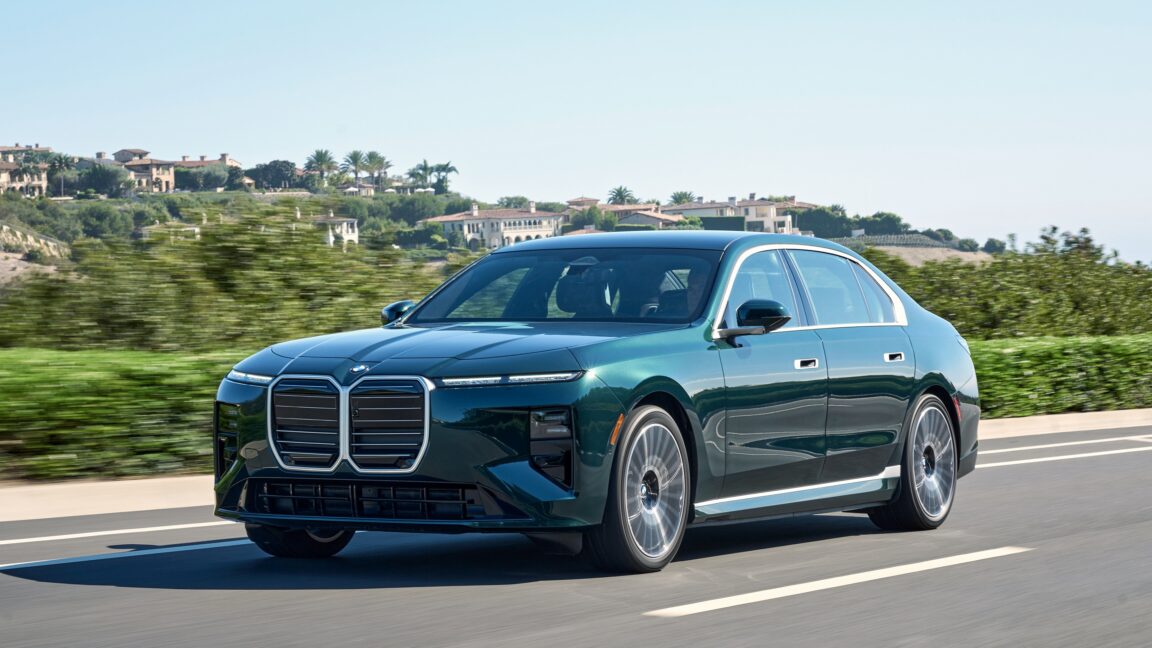
The sedan has a very high beltline. Credit: Daniel Kraus/BMW
The sixth-generation electric powertrain was developed for BMW’s clean-sheet Neue Klasse family. It also replaces the previous system’s dozens of individual, single-function electronic control units with a smaller number of powerful domain controllers. These computers are designed to manage the same functions with substantially greater processing power, expanded capabilities for chassis control and improved powertrain efficiency. They should also be easier to update.
That progression may have created a problem for the i7. A flagship model would normally be expected to lead the brand’s electric lineup in power, energy density and range efficiency. BMW’s board apparently reached a different conclusion, and the 7 Series mid-life update brought comprehensive changes beneath the i7’s exterior.
Sixth-generation electric power
Compared with the previous i7, the 2027 model has a larger battery pack. Net capacity rises from 101.7 kWh to 112.5 kWh. However, unlike the Neue Klasse and iX5 models recently driven, the updated i7 continues to use a 400-volt architecture.
BMW also offers a less powerful 50 xDrive and a more powerful M70 xDrive. The first-drive vehicle was the mid-range 60 xDrive, which produces a combined 544 horsepower (400 kW) and 549 pound-feet (745 Nm) of torque. Those figures are roughly equivalent to the pre-facelift i7.
Source: arstechnica.com