


The supplied source is a reference list rather than a full news article. Its 74 citations trace how researchers have studied learned ingestive behaviour, food and nutrient reward, dopamine signalling, gut–brain communication, amygdala and insular-cortex circuits, and the neural mechanisms that connect delayed post-ingestive feedback with later food choices. The bibliography includes work published from 1966 through 2026, ranging from classic conditioning studies to recent neural-circuit research and open-source imaging tools.
From learned food preferences to gut–brain signals
Early research examined how animals learn associations between flavours, nutrients and consequences. Garcia, Ervin and Koelling reported that learning could occur even after a prolonged delay between a stimulus and reinforcement in 1966. Holman’s 1969 study investigated the reinforcing effects of substances delivered directly to the stomach. Later work by Sclafani and colleagues showed that nutrients detected after ingestion can shape food intake and conditioned flavour preferences, even when taste signals are absent or altered.
Studies cited in the source investigated post-oral responses to glucose, fat and sugar analogues in rats and mice, including C57BL/6J mice. They identified roles for mechanisms such as the SGLT1 sugar transporter and the GPR40 and GPR120 fatty-acid sensors. Other experiments found that deleting the CD36 gene reduced fat preference and intake but did not eliminate post-oral fat conditioning.
Dopamine and the biology of food reward
Several references examine dopamine, a neurotransmitter involved in motivation, learning and reinforcement. The studies distinguish between dopamine’s different functions and time courses rather than treating the signal as a simple measure of pleasure. Research has linked dopamine neurons to Pavlovian conditioned stimuli, stimulus–reward learning and the pursuit of nutritional value.
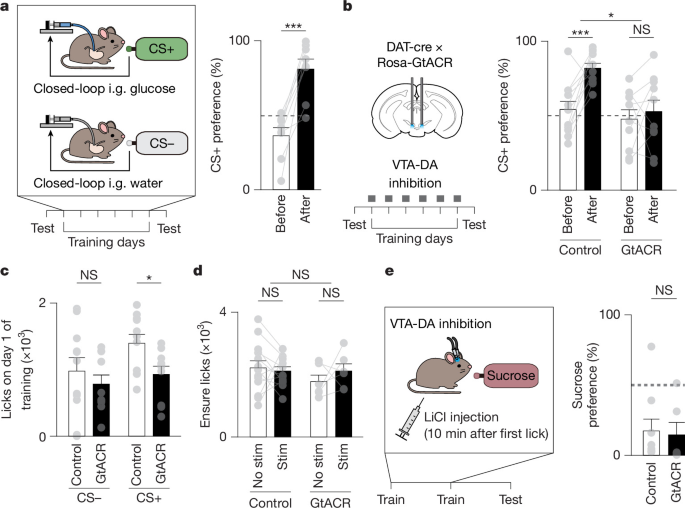
Experiments in rats found that dopamine D1-like receptors are important for acquiring nutrient-conditioned flavour preferences in regions including the nucleus accumbens, medial prefrontal cortex and amygdala. Other work examined dopamine release in the nucleus accumbens, dopamine projections from the ventral tegmental area, and the distinct effects of activating or inhibiting midbrain dopamine neurons on feeding.
More recent studies reported that dopamine projections to the basolateral amygdala help encode identity-specific reward memories. Research in humans has also suggested that eating recruits both orosensory and post-ingestive dopaminergic circuits, which can influence the desire to eat.
Neural circuits linking the gut and brain
The bibliography covers several pathways that carry information from the gastrointestinal tract to the brain. Studies examined vagus-mediated dopamine-neuron activity, genetically defined vagal sensory neurons, and neural circuits for gut-induced reward. Other work found that gut-derived signals can influence nutrient selection and fat intake even without normal taste-receptor signalling.
The cited research also addresses delayed feedback. Zimmerman and colleagues reported a neural mechanism for learning from delayed postingestive feedback in Nature in 2025. Related work examined gut-to-brain signals involved in thirst satiation and the way internal physiological states are represented in the insular cortex.
Amygdala, insular cortex and lateralised processing
Many of the references focus on the amygdala, a brain region involved in emotional associations, reward learning and aversion. The studies describe circuits that distinguish positive and negative associations, route information during memory retrieval and encode the value or identity of stimuli. Research has also examined the organisation and connectivity of the basolateral amygdala and the way midbrain dopamine input gates salient cues.
Other citations concern the insular cortex and possible differences between the brain’s left and right sides. The referenced studies include work on lateralised amygdala activation, pain processing, aversive visceral stimuli and asymmetric control of feeding by vagal sensory neurons. A 2021 study reported that intraperitoneal lithium chloride induced lateralised activation of the insular cortex in adult mice.
Methods and research tools
The source also documents the technical methods used to investigate these systems. These include genetically targeted neural tracing, optogenetic manipulation, calcium imaging, fluorescent GRAB sensors for monitoring dopamine activity in vivo, functional MRI, histological image analysis and brain-atlas registration.
Several cited tools are open source, including EZcalcium for calcium-imaging analysis, NoRMCorre for motion correction and CaImAn for scalable calcium-imaging data analysis. Other references describe methods for characterising swallowing in mice, measuring gastrointestinal conditions and quantifying features in rodent-brain histology.
Key references
- Zimmerman, C. A. et al. “A neural mechanism for learning from delayed postingestive feedback.” Nature 642, 700–709 (2025). Article
- de Araujo, I. E., Schatzker, M. & Small, D. M. “Rethinking food reward.” Annual Review of Psychology 71, 139–164 (2020). Article
- Han, W. et al. “A neural circuit for gut-induced reward.” Cell 175, 665–678 (2018). Article
- Fernandes, A. B. et al. “Postingestive modulation of food seeking depends on vagus-mediated dopamine neuron activity.” Neuron 106, 778–788 (2020). Article
- Grove, J. C. R. et al. “Dopamine subsystems that track internal states.” Nature 608, 374–380 (2022). Article
- Sias, A. C. et al. “Dopamine projections to the basolateral amygdala drive the encoding of identity-specific reward memories.” Nature Neuroscience 27, 728–736 (2024). Article
- Thanarajah, S. E. et al. “Food intake recruits orosensory and post-ingestive dopaminergic circuits to affect eating desire in humans.” Cell Metabolism 29, 695–706 (2019). Article
- Wang, L. et al. “The coding of valence and identity in the mammalian taste system.” Nature 558, 127–131 (2018). Article
- Bai, L. et al. “Genetic identification of vagal sensory neurons that control feeding.” Cell 179, 1129–1143.e23 (2019). Article
- Yagishita, S. et al. “A critical time window for dopamine actions on the structural plasticity of dendritic spines.” Science 345, 1616–1620 (2014). Article
The full source bibliography includes studies by Sclafani, Capaldi, Holman, Berke, Saunders, Richard, Margolis, Janak, Schultz, Azzara, Bodnar, Delamater, Touzani, Zukerman, Ackroff, Garcia, Koelling, Alhadeff, Hernandez, Hoebel, Ferreira, Tellez, Ren, Yeckel, de Araujo, McCutcheon, Zhuo, Janak, Tye, Baxter, Murray, LeDoux, Maren, Wassum, Izquierdo, Namburi, Beyeler, Krettek, Price, Hintiryan, Lutas, Koepsell, Abumrad, Poulin, Leshan, Flagel, Saddoris, Cacciapaglia, Wightman, Carelli, Han, Boekhoudt, Wei, Livneh, Baas, Aleman, Kahn, Allen, Bobnar, Kolber, Qian, Liu, Cao, Yang, Qiu, Wu, Cantu, Pnevmatikakis, Giovannucci, Boughter, Baird, Bryant, St John, Heck, Lever, McConnell, Basit, Murdan, Jenkinson, Bannister, Brady, Smith, Andersson, Skare, Ashburner, Amunts, Mohlberg, Bludau, Zilles and Yates, among others, with publication dates ranging from 1966 to 2026.
Source: www.nature.com