


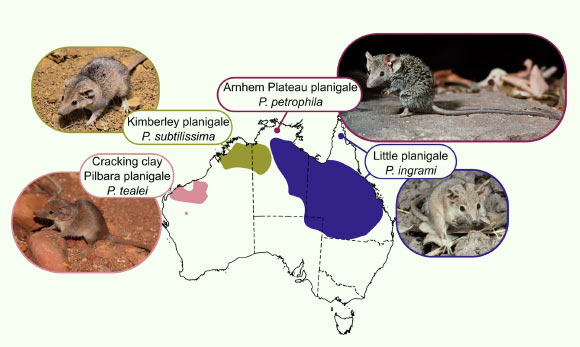
Australian scientists have discovered that what was once considered a single species of Planigale is actually composed of four distinct species, including a newly identified species found exclusively on the rocky slopes of Kakadu National Park.
Distribution of the four newly classified Planigale species. Pranigare Ingrami. Image credit: Umbrello et al., doi: 10.1093/zoolinnean/zlag082.
Planigales are small, insectivorous marsupials characterized by their flat skulls, enabling them to navigate through crevices in various terrestrial habitats across Australia and New Guinea. Currently, nine species of Planigale are recognized.
Among them, Pranigare Ingrami holds the title of the world’s smallest marsupial, averaging an adult weight of only 4.2 g and measuring approximately 5.7 cm in length.
A recent study by researchers from the Western Australian Museum and Queensland University of Technology, led by Dr. Lynette Umbrello, utilized genetic analysis and museum specimens to investigate the Pranigare Ingrami species complex, uncovering the new species Planigale Tea Ray and two unidentified strains.
By analyzing DNA samples from over 220 specimens alongside detailed measurements of skull and body proportions sourced from natural history museum collections, the team made significant classifications.
“This study exemplifies the use of museum collections to recognize species that are potentially extinct in the wild,” Dr. Umbrello noted.
“We carried out extensive genetic sampling and morphological analysis of Planigale specimens across Australian museum collections and integrated these datasets through a method called integrative taxonomy to uncover previously misclassified species.”
The researchers identified three unique strains within the Pranigare Ingrami complex.
“We confirmed that the Planigals from Kimberley, Western Australia, previously grouped with Pranigare Ingrami, actually represent a different species,” Dr. Umbrello explained.
“Additionally, the subspecies Planigale Ingrami Brunea has been reclassified back to its original classification.”
“Moreover, we have discovered a completely new species: Planigale Petrophila.”
Planigale Petrophila, commonly referred to as the Arnhem Plateau Planigale, is distinctive due to its preference for rocky cliffs, unlike most Planigales which inhabit cracking clay soils in lowland areas.
This new species is significantly larger and possesses the longest tail recorded for any Planigale, measuring over its body length.
“Planigale Petrophila is a medium-sized marsupial exhibiting a notably flat and extended skull, along with a long tail,” the scientists remarked.
“It features the longest documented tail of any known Planigale species, measuring between 8.05-9.19 cm, surpassing the 8 cm tail length of some males of Planigale novaeginiae from New Guinea.”
Only three specimens of Planigale Petrophila are currently known, all found within a 12 km radius in Kakadu National Park, with the last sighting in 2004.
The authors emphasize the critical need for conservation assessments given the significant decline in native mammal populations in Kakadu.
“Planigale Petrophila is certainly rare among Australian Planigales, with only three specimens discovered and restricted to a small area of rocky slopes in Kakadu National Park,” said Dr. Umbrello.
“Additionally, Planigale maculata has been identified in Kakadu, coinciding with the only overlapping known distribution of Planigale Petrophila, although it inhabits surrounding lowlands rather than rocky plateaus.”
“This species is unique due to its significantly longer tail compared to other Planigale species and larger body-to-skull ratios relative to its closest genetic relatives.”
The researchers conclude that the rarity of Planigale Petrophila poses potential threats that necessitate urgent research and conservation strategies,” stated Dr. Andrew Baker from Queensland University of Technology and Queensland Museum.
“Given its limited geographical area and the concerning decline of other northern Australian mammals, a comprehensive conservation assessment is urgently needed.”
“It’s vital to ensure correct classification and taxonomy for effective conservation management,” they added.
“This information is crucial for determining the conservation status of this newly identified species, especially amid the widespread declines of Kakadu’s native mammals.”
The study findings will be published in the Zoological Journal of the Linnean Society.
_____
Lynette S. Umbrello et al. 2026. Disentangling the Pranigare Ingrami species complex: Four species revealed using integrated taxonomy. Zoological Journal of the Linnean Society 207 (2): zlag082; doi: 10.1093/zoolinnean/zlag082
Source: www.sci.news