


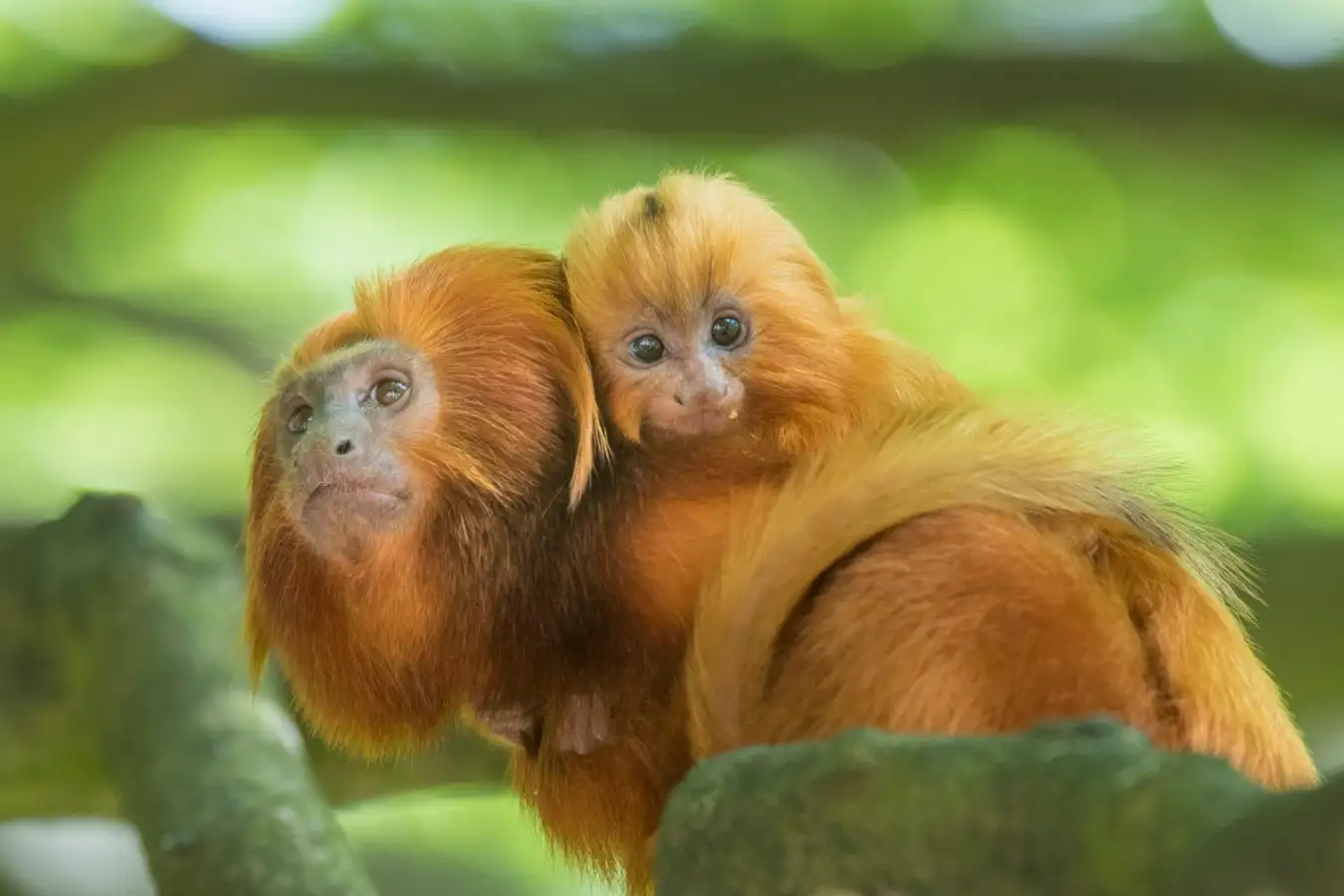

Golden Lion Tamarins: Pelvic Bones & Childbirth
Credit: Edwin Giesbarth/naturepl.com
Childbirth is a challenging experience for many species, with primates facing unique difficulties. A detailed study of primate anatomy reveals that several species struggle to deliver large-headed infants through narrow pelvises—a challenge that may trace back to our earliest primate ancestors over 50 million years ago.
For years, it was believed that human childbirth had distinct challenges due to our evolutionary pathway, initiating with bipedalism, which constricted pelvic space. Over time, as our ancestors’ brain sizes increased, so did the size of infants’ heads, exacerbating the issues surrounding childbirth.
Research by anthropologist Adolf Schulz in the 1940s suggested that other primates had a less strenuous experience. He concluded, after examining various primate species, that most infants fit comfortably within their mother’s pelvis.
However, recent insights from Nicole Torres Tamayo from University College London indicate Schulz’s analysis may have inaccuracies. “We originally applied human pelvic measurements indiscriminately across all primate species,” she states.
Schulz’s research pinpointed specific anatomical landmarks on the human pelvis, presuming these same points defined the width and depth of the primate birth canal. However, human pelvic shapes are distinct, leading to miscalculations when translating his landmarks to other primate species.
Torres-Tamayo and her team reevaluated the birth canal shapes across 29 primate species, analyzing the size and configuration of newborn skulls. They found several primates, particularly smaller species such as bushbabies and tamarins, whose infants’ head sizes were nearly double the width of their birth canals—creating significant birthing challenges.
“The magnitude of this discrepancy across so many primate species was unexpected,” noted Leah Betti, also at University College London.
Research indicates that birth complications may be rooted in primate ancestry, particularly given the diminutive size of early primate species, as highlighted by Betti.
“The extensive sample size is intriguing,” remarked Nicole Webb from the University of Zurich, Switzerland. “These species showcase a variety of anatomical forms and ecological niches, making the findings even more insightful.”
Different primates have adapted diverse solutions for these childbirth challenges. For instance, bushbabies and tamarins can dislocate their pelvic bones, temporarily enlarging their birth canal. This adaptation is not feasible for humans, as it would induce tremendous pain when walking.
Torres-Tamayo, Betti, and their collaborators also noted that larger primates, such as great apes, experienced significantly fewer childbirth complications due to their size—and thus, humans remain unique among great apes in facing birthing difficulties.
However, Webb cautions against grouping all primates together. She co-authored a 2024 study indicating that even chimpanzees face significant matches between the dimensions of their birth canals and infants’ head sizes. “This discrepancy underscores a potential need to reassess our assumptions regarding primate birthing challenges,” Webb concluded.
Topics:
Source: www.newscientist.com