


For the first time, researchers have successfully extracted ancient human DNA directly from cave walls. While their findings do not definitively link the preservation of ancient DNA to the creation of cave art, they confirm that traces of human DNA can persist on cave walls for thousands of years.
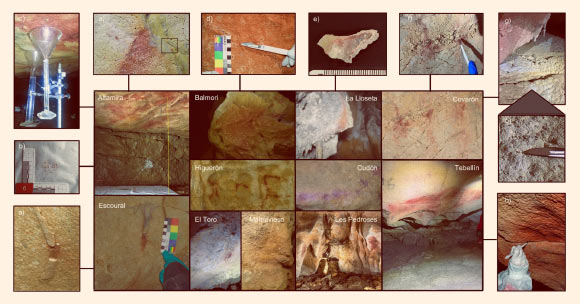
Representative rock art from 11 sites analyzed by Bossams Mesa et al. Image credit: Bossams Mesa et al., 10.1038/s41467-026-74234-2.
A significant challenge in human prehistory research is establishing connections between cultural artifacts and the groups that created them.
Recent advancements in ancient DNA research have begun to address this gap by analyzing DNA extracted from skeletons, sediments, and, more recently, artifacts themselves.
However, rock art – an essential expression of human culture – poses challenges for paleogenetics due to typically lacking direct contact with excavation site floors.
Consequently, ancient DNA analysis has yet to contribute to discussions on authorship, including whether Neanderthals, alongside early modern humans, created rock art.
“We understand that some of the art was applied to cave walls using techniques such as spraying or rubbing pigments onto the surface,” said Dr. Hipolito Collado Giraldo, an archaeologist and rock art expert in Extremadura, Spain.
“Given the sensitivity of contemporary ancient DNA analysis methods, we aimed to determine if such contact could leave DNA traces in rock art, potentially allowing us to obtain genetic profiles from the artists.”
Dr. Corrado Giraldo and his team from Germany, Spain, and Portugal investigated the DNA preservation of pigment samples taken from 24 rock art panels across 11 caves in Spain and Portugal.
The majority of paintings utilized red ocher, featuring simple marks (from nine locations), dots, hand stencils (Cave of Maltraviso, Spain), and figurative images (Cave of Altamira, Spain).
The researchers also analyzed unpainted sections of cave walls, as well as sediments, animal bones, and bird bone fragments believed to have been used as airbrushes for the pigments.
Notable results emerged from Escurial Cave in Portugal, where samples collected from colored calcite shells contained human genetic material, with no evidence of animal DNA.
Similar results were corroborated with uncolored wall samples from the same cave.
Considering that typical sediments and environmental sources usually hold DNA from multiple animals, the team concluded that the human DNA in Escurial Cave likely derived from direct contact, not surrounding soil or debris.
Samples from Escoural and three additional unpigmented wall samples from Covalón cave in Asturias, Spain, revealed a mix of human and animal DNA, indicating a less direct contact, perhaps from individuals carrying sediments on their hands and feet through the cave.
In Cobaron, genetic analysis of two wall samples connected their DNA to Western hunter-gatherer groups who lived in Europe approximately 5,200 to 16,700 years ago, with indications of female origin. One wall sample from Escoural Cave indicated a male source.
Although the researchers could not definitively date much of the recovered DNA, the patterns of chemical deterioration and the site’s archaeological history suggest the material is at least several thousand years old, particularly in Escoural, where it’s estimated to be at least 4,000 to 5,000 years old.
Despite extensive sampling, usable ancient human DNA was only retrieved from one of the 24 painted panels, with none derived from the airbrushing of Altamira’s bird bones, indicating that pigmented cave surfaces contain minimal detectable genetic material over such extensive time periods.
Consequently, the research could not determine precisely who created the art, including whether the DNA found near Escoural pigments originated from the artist or from unrelated human activity within the cave.
“Although we cannot definitively link the traces of ancient human DNA to rock art creation, this is the first evidence that human DNA can be preserved on cave walls for millennia,” stated Alba Bossams Mesa, a postdoctoral researcher at the Max Planck Institute for Evolutionary Anthropology.
“It’s exciting to contemplate the possibility of discovering a new means to study prehistoric human existence.”
“This study fundamentally alters our perception of ancient DNA locations,” remarked paleogeneticist Dr. Matthias Mayer from the Max Planck Institute for Evolutionary Anthropology.
“We were astonished to find ancient DNA recoverable not just from pigment samples but also from cave walls that lack visible evidence of prior human activity.”
“The human DNA preserved on cave walls is incredibly diverse,” Bossams-Mesa added.
“When preserved, it tells a compelling story. While these initial findings are encouraging, our priority is now to refine our methods and comprehend the conditions that may yield higher success rates.”
“This marks just the beginning. We now recognize cave walls as genetic archives of past human existence,” stated Dr. Meyer.
“Next, we aim to test numerous additional locations, art styles, and techniques as minimally invasive sampling permits, especially focusing on hand-painted stencils and figurative art in caves where genetic materials are well-preserved.”
“With further research, we may be able to identify the creators of some cave paintings and potentially unveil the faces or at least genetic identities of the artists behind them.”
A paper detailing these findings was published in the journal Nature Communications on June 23rd.
_____
A. Bossams Mesa et al. 2026. Investigating ancient human DNA left on cave walls and rock paintings. Nat Commune 17, 5561;doi: 10.1038/s41467-026-74234-2
Source: www.sci.news