


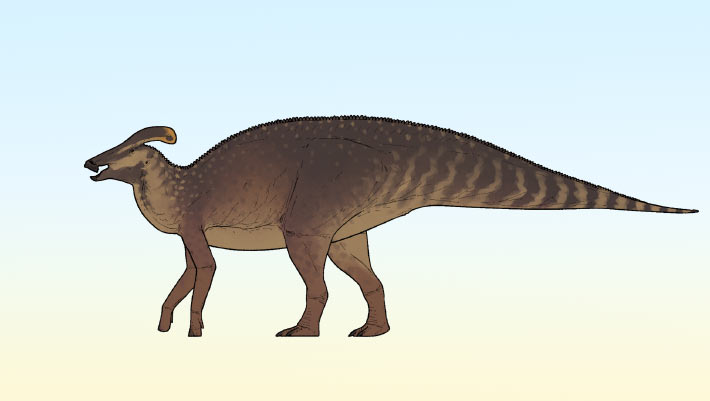
A newly discovered genus and species of lambeosaurid hadrosaurid dinosaur, known as Plesiolophus warnerensis, has been identified in southern Alberta, Canada, with origins tracing back to the Campanian period of the Cretaceous, approximately 77 million years ago.
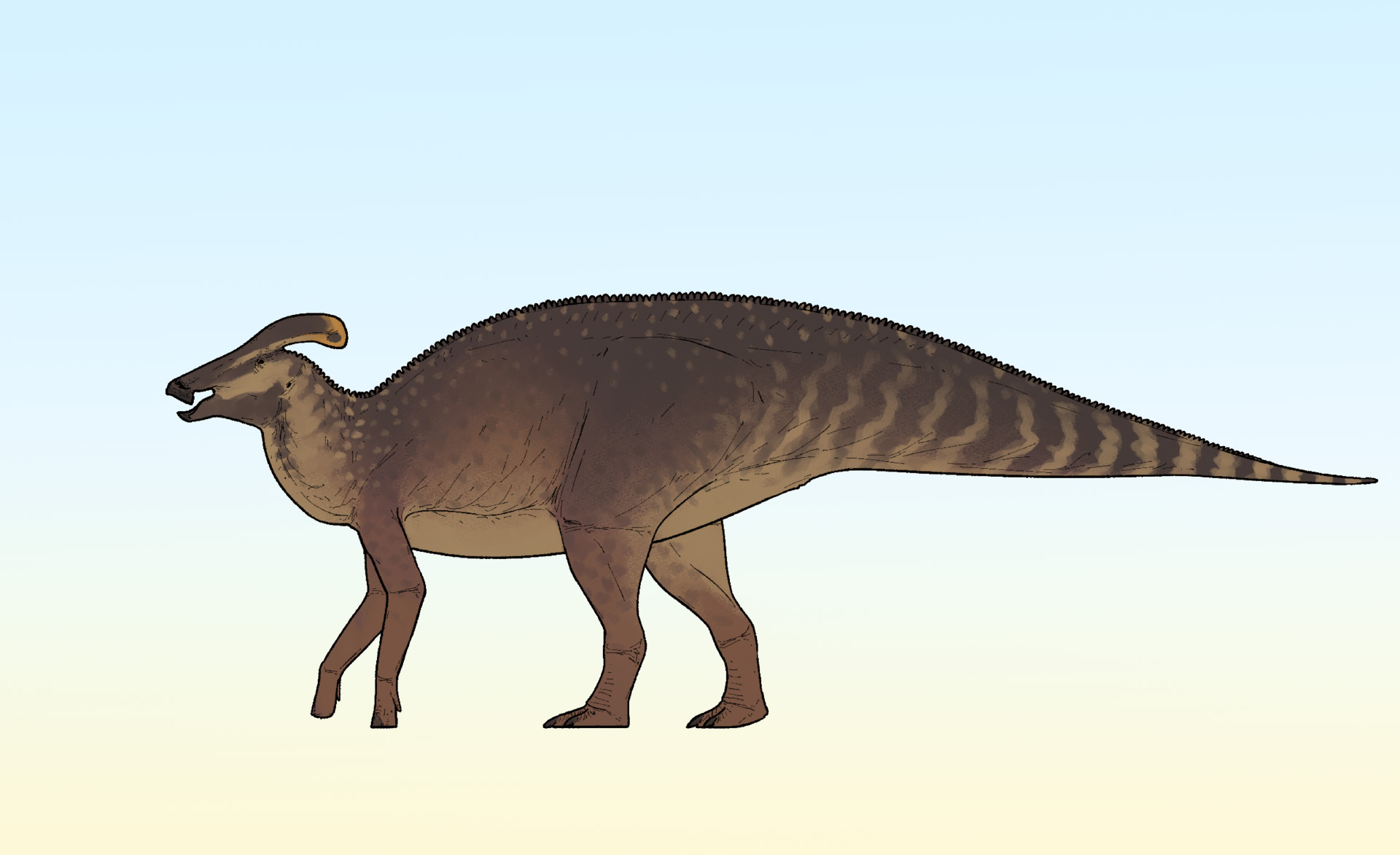
Reconstruction of the life of Plesiolophus warnerensis. Image credit: Connor Ashbridge / CC BY 4.0.
The hollow-crowned hadrosauroid dinosaurs belong to the clade Lambeosauridae. According to Carleton University paleontologist Bradley McFeeters, “These dinosaurs were widely distributed across the Northern Hemisphere toward the end of the Cretaceous period,” as detailed in their publication in the Canadian Geoscience Journal.
“The Lambeosaurinae likely originated in Asia, with early diverging members existing during the early Santonian period (86 to 84 million years ago),” notes McFeeters.
By the Early Middle Campanian (84 to 78 million years ago), more derived Lambeosaurinae had established themselves in western North America (Laramidia), reaching their peak diversity and abundance during the Late Campanian (up to 72 million years ago).
The new Lambeosaurinae species Plesiolophus warnerensis was identified from a fossilized skull’s roof and brain box, discovered by fossil hunter Wendy Sloboda near the Milk River Ridge Reservoir close to the village of Warner in southern Alberta.
This fossil was extracted from the Oldman Formation, a geological unit that surprisingly yields minimal diagnostic material from the ancestors of the region’s more diverse duck-billed dinosaurs.
“Plesiolophus warnerensis represents the first diagnostic specimen of an adult lambeosaur from this formation,” the paleontologists indicated in their findings.
Unlike later members of its lineage, Plesiolophus warnerensis retains certain ancestral traits while also exhibiting unique features associated with the clade that gave rise to iconic hadrosaurid dinosaurs like Parasaurolophus.
To ascertain the evolutionary position of the new species, researchers conducted a phylogenetic analysis, comparing it to 87 other dinosaur species. The analysis consistently positions it as one of the earliest members of the North American parasaurolophine lineage.
“While Plesiolophus warnerensis is characterized by a unique combination of features, it lacks strong autapomorphies, meaning it cannot be excluded as a potential ancestor of Parasaurolophus,” the researchers noted in the study.
“The morphology of this new taxon aligns with expectations for a representative of the earlier parasaurolophines, and its high morphological similarity to later, immature parasaurolophines reflects the heterochronic processes hypothesized to produce the exaggerated crests characteristic of this clade.”
_____
Bradley D. McPheeters et al. A new species of parasaurolophine dinosaur (Hadrosauridae: Lambeosaurinae) discovered from the Oldman Formation in southern Alberta. Canadian Geoscience Journal, published online on July 13, 2026. doi: 10.1139/cjes-2026-0013
Source: www.sci.news