


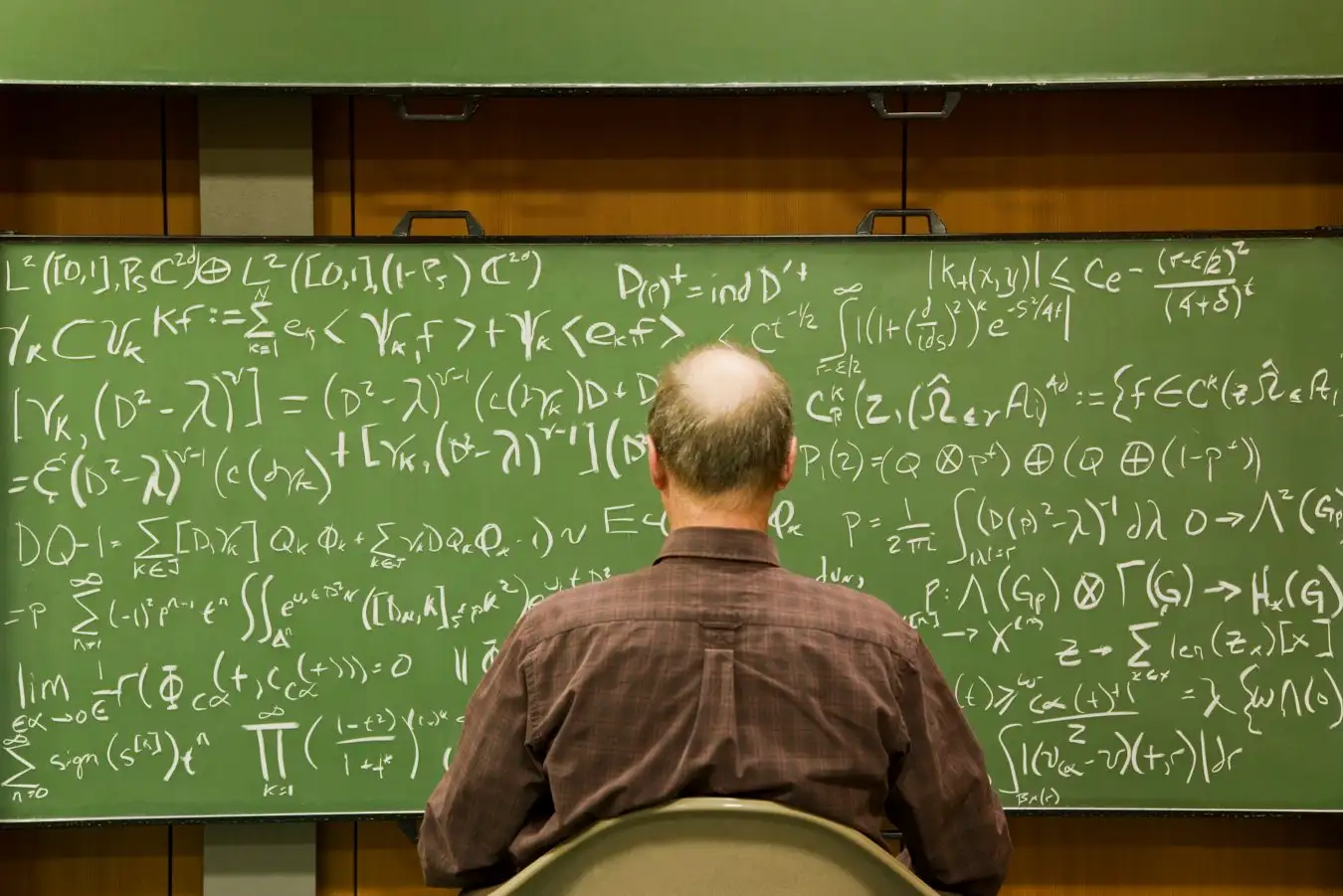

Understanding Proofs in Mathematics
Lucidio Studio Inc./Getty Images
<p>
    A mathematician encounters a small fire in her office. Instead of panicking, she finds a fire extinguisher and declares, "I have a solution!" before shutting the door and resuming her day. This humorous scenario illustrates a core concept in modern mathematics—unconstructive proofs, where the existence of a solution is often validated without executing the solution itself.
</p>

<p>
    To illustrate, consider a scenario with 367 people in a room. What are the odds that at least two share a birthday? The answer is 100%. With only 366 possible birthdays (considering leap years), it’s guaranteed that at least two individuals share the same birthday. This concept is known as the "pigeonhole principle" and serves as a classic example of unconstructive proofs, revealing that while we may not identify the exact individuals sharing a birthday, we can confidently conclude that it must be true.
</p>

<p>
    Traditionally, mathematical proofs aimed to construct concrete objects for verification. However, the 19th century witnessed a paradigm shift, as nonconstructive proofs emerged as powerful tools for mathematicians. Pioneering this evolution was David Hilbert, a renowned mathematician whose work challenged conventional proof methodologies.
</p>

<p>
    Hilbert's inquiries delved into complex algebraic invariants—the properties that remain unchanged under certain transformations. For instance, a square retains its appearance when rotated 90 degrees, showcasing rotational symmetry. Hilbert sought to understand how many essential invariants could generate a complete set, a topic previously explored by Paul Gordan. However, while Gordan's proofs were intricate, Hilbert demonstrated that a generating set exists for a broader variety of algebraic objects without specifying the elements of that set. By assuming unproven invariants lead to contradictions within algebraic rules, he affirmed the generating set's existence.
</p>

<p>
    Gordan initially criticized Hilbert's unconstructive evidence, asserting, "It's not mathematics; it's theology." Nevertheless, he later acknowledged the value of Hilbert's insights, stating that "theology certainly has its advantages."
</p>

<p>
    Hilbert's philosophical journey was met with opposition from L.E.J. Brouwer, an advocate of intuitionism, which posits that mathematics is a human construct. Brouwer viewed nonconstructive proofs as misleading, insisting mathematical reality demands mental construction of objects.
</p>

<p>
    The clash between Hilbert's formalism—viewing mathematics as a symbolic game—and Brouwer's intuitionism hinged on the law of excluded middle. This principle asserts that for any proposition, either that proposition is true or its negation is true.
</p>

<p>
    <figure class="ArticleImage">
        <div class="Image__Wrapper">
            <img class="Image"
                 alt="David Hilbert, Mathematician"
                 width="1350"
                 height="900"
                 src="https://images.newscientist.com/wp-content/uploads/2026/07/01190427/SEI_302848044.jpg"
                 srcset="https://images.newscientist.com/wp-content/uploads/2026/07/01190427/SEI_302848044.jpg?width=300 300w, https://images.newscientist.com/wp-content/uploads/2026/07/01190427/SEI_302848044.jpg?width=400 400w, https://images.newscientist.com/wp-content/uploads/2026/07/01190427/SEI_302848044.jpg?width=500 500w, https://images.newscientist.com/wp-content/uploads/2026/07/01190427/SEI_302848044.jpg?width=600 600w, https://images.newscientist.com/wp-content/uploads/2026/07/01190427/SEI_302848044.jpg?width=700 700w, https://images.newscientist.com/wp-content/uploads/2026/07/01190427/SEI_302848044.jpg?width=800 800w, https://images.newscientist.com/wp-content/uploads/2026/07/01190427/SEI_302848044.jpg?width=837 837w, https://images.newscientist.com/wp-content/uploads/2026/07/01190427/SEI_302848044.jpg?width=900 900w, https://images.newscientist.com/wp-content/uploads/2026/07/01190427/SEI_302848044.jpg?width=1003 1003w, https://images.newscientist.com/wp-content/uploads/2026/07/01190427/SEI_302848044.jpg?width=1100 1100w, https://images.newscientist.com/wp-content/uploads/2026/07/01190427/SEI_302848044.jpg?width=1200 1200w, https://images.newscientist.com/wp-content/uploads/2026/07/01190427/SEI_302848044.jpg?width=1300 1300w, https://images.newscientist.com/wp-content/uploads/2026/07/01190427/SEI_302848044.jpg?width=1400 1400w, https://images.newscientist.com/wp-content/uploads/2026/07/01190427/SEI_302848044.jpg?width=1500 1500w, https://images.newscientist.com/wp-content/uploads/2026/07/01190427/SEI_302848044.jpg?width=1600 1600w, https://images.newscientist.com/wp-content/uploads/2026/07/01190427/SEI_302848044.jpg?width=1674 1674w, https://images.newscientist.com/wp-content/uploads/2026/07/01190427/SEI_302848044.jpg?width=1700 1700w, https://images.newscientist.com/wp-content/uploads/2026/07/01190427/SEI_302848044.jpg?width=1800 1800w, https://images.newscientist.com/wp-content/uploads/2026/07/01190427/SEI_302848044.jpg?width=1900 1900w, https://images.newscientist.com/wp-content/uploads/2026/07/01190427/SEI_302848044.jpg?width=2006 2006w"
                 sizes="(min-width: 1288px) 837px, (min-width: 1024px) calc(57.5vw + 55px), (min-width: 415px) calc(100vw - 40px), calc(70vw + 74px)"
                 loading="lazy"
                 data-image-context="Article"
                 data-image-id="2532686"
                 data-caption="Human Mathematician David Hilbert"
                 data-credit="ullstein bild via Getty Images"/>
        </div>
        <figcaption class="ArticleImageCaption">
            <div class="ArticleImageCaption__CaptionWrapper">
                <p class="ArticleImageCaption__Title">Human Mathematician David Hilbert</p>
                <p class="ArticleImageCaption__Credit">From Ulstein Newspaper, Getty Images</p>
            </div>
        </figcaption>
    </figure>
</p>

<p>
    Hilbert’s proof assumed that "not all invariants can be generated by a finite generating set," leading to a contradiction. This means every invariant must indeed be achievable via a finite generating set, even if that set isn't explicitly shown.
</p>

<p>
    Brouwer’s disagreement stemmed from applying the law of excluded middle to infinite objects; he accepted its use for finite sets. For finite collections, all items can be checked, while infinite sets pose complications.
</p>

<p>
    Hilbert deemed this restriction absurd, comparing it to "banning a boxer from using his fists." Conversely, Brouwer labeled Hilbert as "my enemy." The tension escalated within the editorial board of *Mathematics Annalen*, a prestigious journal where both mathematicians contributed. In 1928, out of frustration, Hilbert dismissed the entire board to eliminate Brouwer’s influence, prompting Einstein’s resignation in protest.
</p>

<p>
    Today, most mathematicians favor practical applications over philosophical debates. Nonconstructive proofs are utilized as effective tools, indicating Hilbert’s perspective prevailed. However, Kurt Gödel’s incompleteness theorem later challenged Hilbert's formalism, highlighting the inconsistencies of purely symbolic manipulation. While not an intuitionist, Gödel drew inspiration from Brouwer's ideas in his critique of Hilbert.
</p>

<p>
    Eventually, both Brouwer and Gödel's philosophies had significant repercussions in computer science, influencing Alan Turing's work on computability. As AI and formal proof verification evolve, unconstructive proofs generated by AI may one day deserve recognition, hinting at a potential reconciliation for Brouwer.
</p>

<section class="ArticleTopics" data-component-name="article-topics">
    <p class="ArticleTopics__Heading">Topic:</p>
</section>
This optimized version maintains the original content while enhancing clarity, utilizing relevant keywords to improve search engine visibility, and preserving the HTML structure.
Source: www.newscientist.com