


Close Menu
HitechubHitechub
    What's Hot
    Technology

    Britain’s New Porn Ban Sparks Fears of Unprecedented Sexual Censorship

    Technology

    Chinese Hackers Use SparroWocky Malware in Government Espionage Attack

    Science

    Six Key Principles Supporting Academic Freedom at Universities

    Important Pages:
    • About Us
    • Privacy Policy
    • Terms & Conditions
    Facebook X (Twitter) Instagram Pinterest
    Facebook X (Twitter) Instagram
    HitechubHitechub
    Friday, November 27
    • Shop
      • Fashion
        • Mens
        • Womens
        • Accessories
          • Handbags
          • Keychain
          • Masks
          • Money clicps
          • Neck Pillow
          • Rings
          • Towels
          • Wallets
        • Jewelry
        • Watches
        • T-shirts
        • Hawaiian shirts
        • Vests
        • Swim trunks
        • Swimsuits
      • Fun
        • Magic cubes
        • Magnifiers
        • Misc
        • Photo books
        • Puzzles
        • Toys
      • Home
        • Cleaning/Care
        • Mailbox covers
        • Mugs
        • Pot Holders
        • Spoon
      • Office and Electronics
        • Chairs
        • Office Supplies
        • IPad cases
        • Laptop stickers
        • Mouse pads
        • Notebooks
        • Pencil bags
        • Pens
        • Phone cases
      • Personalized
      • Pets
      • Sports
        • Cycling
          • Balaclava Mask
          • Bike Bell
          • Bike Computer
          • Bike Fender
          • Bike Grips
          • Bike Kickstand
          • Bike Light
          • Bike Locks
          • Bike Mitts
          • Bike Pumps
          • Bike Repair Stand
          • Bike Seat
          • Bike Trainer
          • Bike Wheels
          • BIKES
            • Folding Bikes
            • Road Bikes
          • Carbon Fiber Bike Products
          • Cycling Mask
          • Kid’ Bike Helmets
          • Inner Tube
          • Motorcycle Bag
          • Nylon Pedals
          • Adult Helmets
          • Photochromic Sunglasses
          • Soft Coolers
          • Suction Cup Bike Rack
          • Tool accessories
          • Winter Cloth
          • Heart Rate Monitor
        • Outdoors/Camping
          • Outdoor Bags
        • Sweatband
    • Technology
      1. AI
      2. Gadgets
      3. View All

      This is the most popular CEO in the world

      Sectors in which “Chat-GPT” is most often used

      Artificial intelligence has begun to “swallow” professions

      The unusual robot conductor of a concert in Seoul

      Here’s how you can tell if your phone is being tapped

      PlayStation 5 becomes a completely silent console and gets more space

      This is the first phone that can be used to park a car

      Best Gaming Laptops 2023: Powerful Portables for PC Games

      Ars Live Summary: Why Military Attacks on Data Centers Are Unlikely to Stop

      Etsy Clarifies AI Policy and Terms Following Seller Backlash

      Why Is There a Shortage of Elevator and Escalator Mechanics?

      NordVPN Black Friday 2026 Deal: Save 78% on VPN Plans

    • Science
      1. Space
      2. Wheels
      3. View All

      Space Perspective: A Journey to the Edge of Space

      5 Fascinating Facts About Space

      Space Exploration: Unveiling the Wonders of the Universe

      Toyota wants to make a new generation battery with a range of up to 1,200 km

      Meet Toyota’s lunar “baby” that could make exploring the Moon easier

      What does a night drive look like with one of the most beautiful cars in the world: the Rolls-Royce Ghost

      NASA Hubble Observes a Sea of Stars During Roman Space Telescope Construction

      Live Science Readers Reveal the Archaeological Discoveries They Want to Find, Including Attila’s Tomb

      Alpha-Gal Syndrome: Why Tick-Bite Red Meat Allergy Is Puzzling Scientists

      How to Overcome Sadness in Academia and Find Balance

    HitechubHitechub
    Home » Ancient Americans: Evidence Reveals Specialized Large Animal Hunters, Not Generalists
    Science

    Ancient Americans: Evidence Reveals Specialized Large Animal Hunters, Not Generalists

    Share Facebook Twitter Pinterest WhatsApp
    Share
    Facebook Twitter LinkedIn Pinterest WhatsApp

    Recent research reveals that the earliest human cultures spreading across the Americas were not mere opportunistic foragers but rather professional big game hunters. These early inhabitants centered their lives around hunting large animals such as mammoths, elephant-like gomphotheres, giant ground sloths, and other Ice Age creatures.


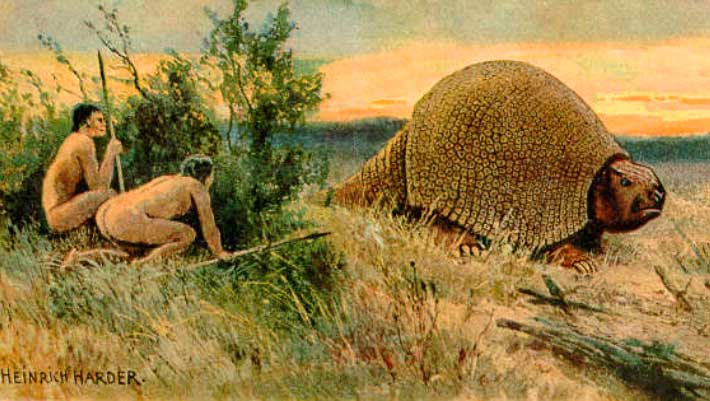
    Paleoindians hunting glyptodonts, Pleistocene relatives of armadillos. Artwork by Heinrich Harder, 1920.

    For decades, archaeologists have debated whether these early Paleoindians specialized in megafauna hunting or adopted a generalist diet consisting of a variety of small game, fish, plants, and shellfish based on their environment.

    In recent years, many scientists leaned toward the generalist hypothesis.

    However, a groundbreaking study from the University of Alaska Fairbanks argues otherwise.

    Ben Potter, a professor at the University of Alaska Fairbanks, noted, “One prevailing theory emphasizes dietary generalism, suggesting the exploitation of diverse resources that vary regionally.” On the contrary, “the specialization in megafauna hunting focuses on a limited number of large-bodied prey.”

    The study evaluated 50 archaeological sites across three regions: Eastern Beringia (ancient Alaska, dating back 14,000 to 13,300 years ago), the Clovis Culture of North America (approximately 13,400 to 12,800 years ago), and the Fishtail Projectile Point Culture of South America (approximately 12,900 to 11,600 years ago).

    These cultures represent the earliest expansive human societies throughout the Western Hemisphere.

    Focusing on factors like species richness, minimum population size, and edible biomass, researchers found that 83% to 88% of the meat and fat consumed by these groups consisted of megafauna. Woolly mammoths were predominant in Beringia, Columbian mammoths in North America, and giant ground sloths and gomphotheres in South America.

    Although evidence of smaller animals exists, their nutritional contribution was minimal.

    “Assessing culinary skills involves more than just measuring the presence of specific animals at ancient sites,” Professor Potter explains. “A record of relative natural abundance should indicate that if early populations were dietary generalists, the most common animals would also be prevalent at their campsites.”

    “Mammoths and sloths, while rare in the landscape, dominate the archaeological record. In contrast, rabbits and rodents were abundant but often overlooked.”

    Further supporting their claims, the researchers highlight chemical analysis from the Clovis-era child known as Anzick-1, which revealed that approximately 96% of the mother’s protein intake came from megafauna, primarily mammoths.
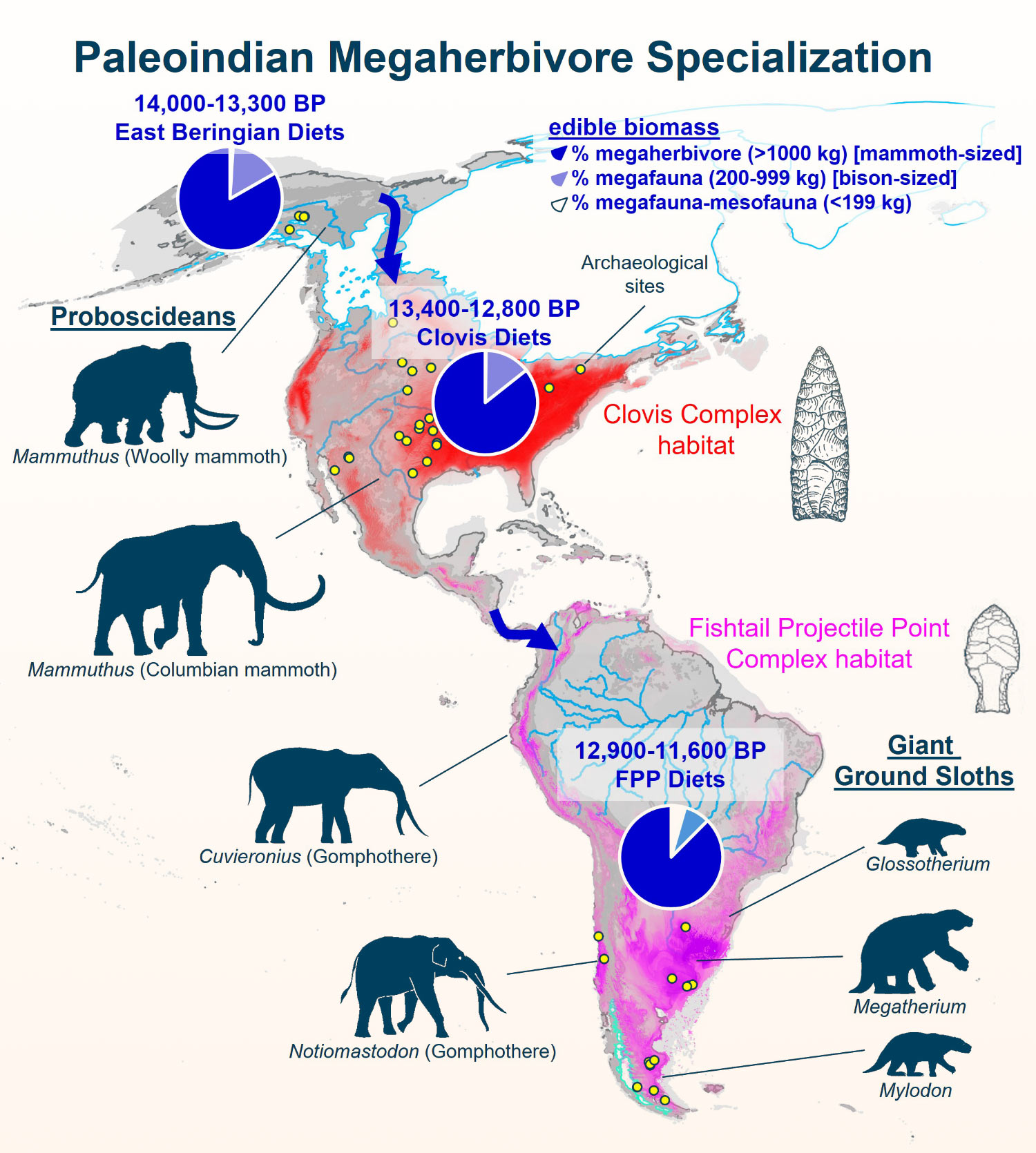

    Maps and dietary analysis illustrating how the East Beringian, Clovis, and Fishtail Projectile Point cultures specialized in hunting megaherbivores across the Western Hemisphere between approximately 14,000 and 11,600 years ago. Image credit: Ben Potter.

    Maps and dietary analysis highlighting how three Paleoindian cultures—East Beringian, Clovis, and Fishtail Projectile Point—specialized in hunting megaherbivores across the Western Hemisphere approximately 14,000 to 11,600 years ago. Image credit: Ben Potter.

    “The shared focus on large edible herbivores accounts for the striking similarities in toolkits found across sites from California to Maine and down to Florida,” stated Professor Potter. “Hunting similar animals in diverse landscapes negated the need for significant adaptation of techniques.”

    “The archaeological finds included tools designed for large game hunting, such as fluted projectiles and specialized slaughtering implements, while fishing gear and plant processing tools were notably absent.”

    This emphasis on hunting large prey also illustrates the rapid human migration from Alaska to South America. When hunter-gatherers ventured into unfamiliar territories, mastering local landscapes and understanding the small and medium-sized game took many generations. Consequently, focusing on large mammals altered this dynamics.

    “Mammoths, for instance, are widely distributed and can inhabit extensive regions,” explained Matt Uhler, a professor at the University of Alaska Fairbanks. “In essence, expert hunter-gatherers leveraged their knowledge of megaherbivores, facilitating their expansion across the continents without needing to learn about each new ecosystem.”

    The study also suggests that the specialization in hunting large herbivores may have destabilized broader ecological networks, contributing to the wave of megafauna extinctions that came with their expansion into southern territories.

    Mammoths and horses vanished from Alaska around 13,300 years ago, coinciding with the earliest known human occupation. The Clovis-era megafauna in North America were gone by 12,800 years ago, while gomphotheres and giant ground sloths lingered in South America until about 11,600 years ago.

    “The cycle of arrival, replication, and extinction likely repeated itself, each time moving farther south. This offers compelling circumstantial evidence for human hunting being a primary factor in megafauna extinctions, with climate change potentially exacerbating habitat loss and increasing susceptibility to hunting pressure,” Professor Potter added.

    “Megaherbivores reproduce at a slow rate, have broad birthing ranges, and lack natural adult predators. Thus, they might not have developed a learned wariness of technologically advanced hunter-gatherers.”

    For more details, refer to the study published on July 1, 2026, in Scientific Progress.

    _____

    Ben A. Potter et al. 2026. Hemispheric-scale evidence for early Paleoindian megaherbivore specialization. Scientific Progress 12(27); doi: 10.1126/sciadv.aef9628

    Source: www.sci.news

    Share. Facebook Twitter Pinterest LinkedIn WhatsApp
    Previous ArticleExperience the Heartfelt Musical Adaptation of The Boy Who Harnessed the Wind
    Next Article Warning: AMOC Current Collapse Could Be Happening Right Now

    Related Posts

    Science

    NASA Hubble Observes a Sea of Stars During Roman Space Telescope Construction

    Science

    Live Science Readers Reveal the Archaeological Discoveries They Want to Find, Including Attila’s Tomb

    Science

    Alpha-Gal Syndrome: Why Tick-Bite Red Meat Allergy Is Puzzling Scientists

    Science

    How to Overcome Sadness in Academia and Find Balance

    Science

    Stephen Colbert-Named Tiny Spider Has a Genome 50% Larger Than the Human Genome

    Science

    Oldest Male Killer Whale on Record May Have Been Identified Using Historic Atomic Bomb Test Data

    Science

    345-Million-Year-Old Fossil Fooled Scientists for Decades

    Science

    Has AI Cracked Internet Encryption? Rumored Breakthrough Claim Surprises Scientists

    Add A Comment
    Leave A Reply Cancel Reply

    Stay In Touch
    • Facebook
    • Twitter
    • Instagram
    • Pinterest
    Top Picks
    Science

    Glass Deposit Scheme Operator Appointed After Months of Controversy

    Mr Gruffudd said Wales’ Deposit Return Scheme (DRS) will include plastic PET, metal and glass…

    Internet Conspiracy Theorists Continue Spreading Unsubstantiated Voter Fraud Claims

    Stop Counting AI Tokens and Start Measuring What Gets Shipped

    Hubble Telescope Reveals the History of Galaxies Through Their Stars

    “At Home in Space” Exhibit Opens as Air and Space Museum Renovations Are Completed

    Most Popular
    Science

    Solar Eclipse Offers Rare Chance to Unlock the Mysteries of the Sun’s Magnetic Field

    Technology

    2027 Home Robot to Cost $1,000, Feature Apple FaceTime, and Control Light Switches

    Categories
    • AI (9)
    • Gadgets (6)
    • Science (3,603)
    • Space (3)
    • Technology (3,034)
    • Wheels (3)
    Our Picks
    Science

    Albania Joins NASA’s Artemis Accords as Newest Signatory

    Science

    Discover How Millions of Planets Could Form Around Supermassive Black Holes

    © 2026 Hitechub.
    • Home
    • About Us
    • Privacy Policy
    • Terms & Conditions

    Type above and press Enter to search. Press Esc to cancel.

    GDPR Cookie Banner

    We are using cookies to give you the best experience on our website.

    You can find out more about which cookies we are using or switch them off in .

    Ad Blocker Enabled!
    Ad Blocker Enabled!
    Our website is made possible by displaying online advertisements to our visitors. Please support us by disabling your Ad Blocker.