


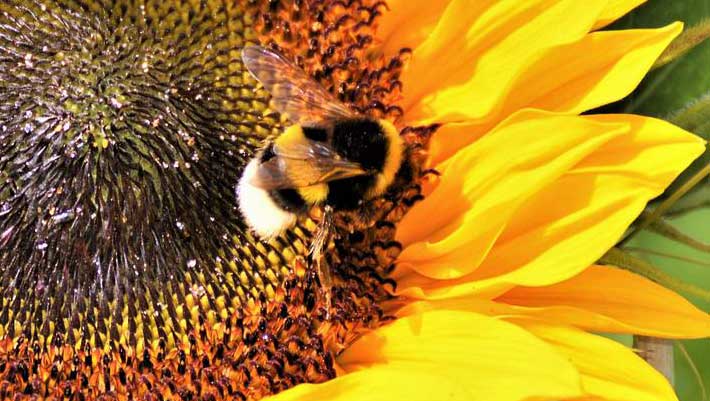
In a groundbreaking slow-motion video study, the buff-tailed bumblebee (Western bumblebee) exhibits distinct behaviors in response to sweet and bitter tastes, resembling mammalian expressions of pleasure and aversion. This adds compelling evidence to the ongoing debate about insect consciousness.
Zhou et al. reveal that buff-tailed bumblebees (Western bumblebee) display orofacial responses reflective of emotional appraisals rather than just feeding reflexes. Image credit: Ralphs Fotos.
Professor Andrew Barron from Macquarie University stated, “This discovery transforms our understanding of the internal lives of insects.”
“Facial expressions provide a critical window into an animal’s internal state,” he added.
“There’s always been a conflict between viewing insects as living beings versus seeing them as mere machines.”
“This research marks another step toward demonstrating that bees possess an inner psychological life.”
In their study, Professor Barron and his team examined 18 colonies of buff-tailed bumblebees.
They isolated individual bees in observation tubes and trained them to find and consume small droplets of 20% sugar water positioned just out of reach of their antennae.
Bees quickly learned to extend their mouthparts (proboscis) to consume the sugar droplets.
The researchers recorded the movements of the bees’ faces and mouthparts after they ingested test droplets containing various solutions: concentrated and diluted sugar water, plain water, salt water, or the bitter compound quinine.
The bees displayed noticeably different orofacial behaviors after consuming sweet liquids compared to bitter and salty ones.
The protrusion of the glossa (tongue) post-consumption resembled “licking lips” following the sugar solution, akin to human reactions after tasting bitter or salty substances.
Professor Fei Peng of Southern Medical University noted, “While many people accept that insects can sense, learn, and make decisions, they are often hesitant to acknowledge that insects can perceive pleasure or displeasure.”
“Our findings support that insight.”
“Though we cannot definitively know what bees experience, we can observe behaviors that mimic emotional responses,” adds Professor Barron.
“Significantly, we now have actionable insights into their inner lives for further experimentation.”
“This impact extends beyond bees to all insects,” he emphasized.
“There are no substantial structural differences between bees and flies’ brains, prompting broader ethical considerations regarding our treatment of insects.”
“Although honey bee brains are tiny—less than a milligram—they potentially support a form of internal life.”
“This study moves closer to understanding how brain function relates to subjective experience.”
“We anticipate future research will illuminate how bees’ mental lives emerge from neural mechanisms, bridging the gap between mind and body.”
For more detail, check the study published on July 6th in Proceedings of the National Academy of Sciences.
_____
Zhou Yonghe et al. 2026. Bumblebee orofacial responses to taste provide evidence for emotional appraisal. PNAS 123 (28): e2529114123; doi: 10.1073/pnas.2529114123
Source: www.sci.news