


For decades, the discovery of stone spearheads alongside the bones of macrocephalians (mammoths, mastodons, gomphoteles) has been a pivotal moment in archaeology. This finding has been interpreted as evidence that the Clovis people, recognized as America’s first well-documented culture, were mega-game hunters contributing to the extinction of these great beasts approximately 13,000 years ago. However, recent studies suggest that these conclusions lack verification and that the evidence may support a completely different narrative.
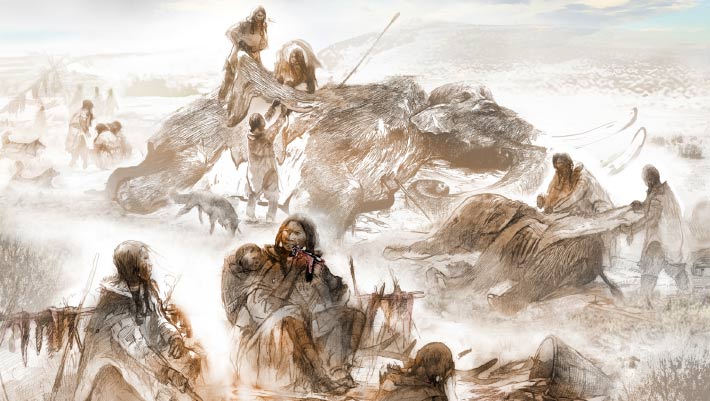
An artist’s reconstruction of Clovis life 13,000 years ago shows the Anzick 1 infant eating mammoth meat with his mother near the hearth. Another individual is crafting tools, such as a dart launch point or an atlatl, with a large slaughterhouse visible nearby. Image credit: Eric Carlson / Ben Potter / Jim Chatters.
According to Metin Ellen from Kent State University and colleagues, “Fifteen well-documented Late Pleistocene sites in North America have yielded Clovis points associated with macropod remains.”
Commonly, archaeologists interpret these areas as evidence that the Clovis people hunted these large animals, citing this evidence to argue that humans contributed to their extinction.
However, Ellen and his team assert that the hypothesis has not been rigorously tested, failing to consider the possibility that Clovis gatherers may have been scavengers rather than hunters. This perspective could explain the presence of artifacts alongside proboscidean remains in certain locations.
The study reviewed all 15 sites where Clovis tools were discovered alongside mammoth, mastodon, and gomphoteles fossils. The findings revealed that none of the sites provided evidence excluding scavenging practices, and archaeologists rarely attempt to rule these out.
This is an instance of equifinality, where different processes may leave similar traces. Evidence of broken spearheads, butchered carcasses, and cut bones can result from either hunting or scavenging.
Clovis points can break while hunting in ways indistinguishable from damage resulting from using them as tools, and wear patterns previously considered “direct evidence” of hunting can also arise from contact with the ground or mishandling.
Notably, no Clovis point or fragment has been found embedded in a long skull, unlike some large Eurasian sites where spear tips remain lodged in the bones of animals dating back tens of thousands of years.
An isotopic analysis in 2024 of the Clovis-era infant known as the “Anzick Child” from Montana revealed that the mother’s diet placed her near the top of the food chain, resembling that of extinct hypercarnivorous cats, suggesting a diet rich in mammoth meat.
Dr. Ellen and his colleagues argue that this finding lacks biological significance for humans, who cannot safely consume that much protein. A more plausible explanation could be the mother’s consumption of maggots from decaying carcasses, which are known to have high nitrogen levels.
Importantly, the researchers are not dismissing the possibility that Clovis peoples hunted mammoths; rather, they assert that current evidence cannot differentiate between hunting and scavenging at specific sites, undermining the claim that Clovis hunters caused the extinction of Ice Age megafauna.
“Currently, we cannot definitively distinguish between hunting and scavenging activities,” Dr. Ellen noted. “While Clovis gatherers likely hunted mammoths, it would be unusual for them not to have scavenged as well, given that most human populations historically have,” added Dr. David Meltzer from Southern Methodist University.
“Scavenging could also clarify the high δ15N values recently reported for Anzick calves, possibly linked to the mother’s consumption of maggots instead of mammoth meat,” he explained.
If predation and archaeological equivalence fail to conclusively support the idea of proboscidean killings at Clovis sites, then claims of overkill are also called into question, Dr. Ellen emphasized.
In conclusion, despite longstanding beliefs among some archaeologists, there is currently no definitive scientific evidence supporting the role of humans in the extinction of late Pleistocene proboscidians in North America.
For further reading, see the study published on July 1 in the Journal of Archaeological Science: Report.
_____
Metin I. Ellen and others. Did the Clovis foragers hunt large animals, scavenge their carrion, or both? And can we tell the difference? Journal of Archaeological Science: Report, published on July 1, 2026. doi: 10.1016/j.jasrep.2026.105896
Source: www.sci.news