


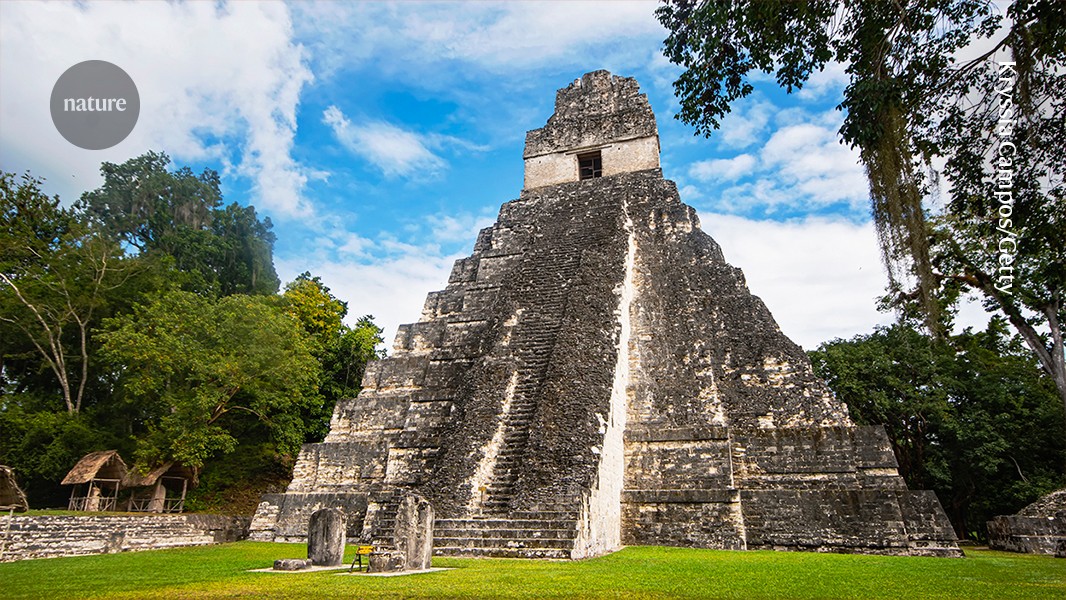
The ancient Mayan temple of Tikal in Guatemala is located about a day’s walk from Xultun, where researchers recently uncovered a mathematical formula inscribed on the wall.Credit: Kryssia Campos/Getty
In a groundbreaking discovery, the name of a significant Mayan mathematician and astronomer has emerged from a mathematical formula etched into the ruins of Xultun, Guatemala. Researchers propose that Saku Tarn Wax, also known as the “white-breasted fox,” stands as a scholar on par with historical mathematical greats.
A recent study published on July 14 in the journal Ancient1 by archaeologist Heather Hurst from Skidmore College, along with her team, details the analysis of mathematical artifacts discovered in the Shultun room, excavated in 2011.2.
The room’s walls are adorned with intricate figures and hieroglyphs, showcasing mathematical calculations based on the astronomical calendar employed by the Maya to time key events such as royal inaugurations. Hurst and her colleagues suggest this room was likely a workshop for scribes creating legal documents around the mid-eighth century. advertisement.
The researchers focused on a specific set of hieroglyphs known as Text 19. According to Hurst, this group of calculations illustrates the interplay between various calendar systems in a manner previously unseen in Mayan literature. “It’s like a mathematical flex. Someone was proclaiming, ‘This pattern is so remarkable, it needs to be recorded,’ akin to a ‘Boom! Mic drop!’ moment,” Hurst notes.
“This discovery highlights the intellectual prowess of the Maya, showcasing them as innovative and curious individuals who engaged in mathematics not just for utility but for the sheer joy of it,” said Eric Heller, an archaeologist from the University of Southern California Dornseif.
Identity Revealed
Text 19 consists of a small L-shaped arrangement of 11 hieroglyphs, measuring approximately 10 centimeters in height. Hurst and her team found that the first nine hieroglyphs encode crucial Mayan calendar and astronomical cycles.
This formula demonstrates how a period of 2,920 days can be divided according to Mayan calendar units. This cycle is significant as it correlates with five Venusian cycles (equating to 584 days each) and eight solar years (each containing 365 days). However, the Text 19 calculations represent 2,920 days as follows: winal (a month of 20 days), tzolkin (260-day sacred calendar), tun (year of 360 days), and a Martian year of 780 days.
“It’s thoroughly complex math,” Hurst explains. The hieroglyphs depict only part of the date, complicating their interpretation. “They utilize abbreviated shorthand, where the first half of the notation is presented while the latter half is implied.”

Text 19 displays the formula as a glyph.Credit: Photo by G. Ware, courtesy of San Bartolo-Xultun Regional Archaeological Project
Until this finding, the identity of the mathematician behind these calculations was shrouded in mystery. Hurst and her colleagues uncovered a phrase meaning “say so” in the penultimate hieroglyph of Text 19, followed by the name Sak Tarn Wax in the final glyph, indicating the author is taking credit for this remarkable calculation. “The absence of a prefix identifies this as a male name,” she explains.
Gerardo Aldana, an anthropologist at the University of California, Santa Barbara, emphasized the significance of the author’s identification, suggesting it reflects the high regard for mathematicians within ancient Mayan culture, akin to the respect afforded to artists.
Rivaling the Greats
Source: www.nature.com