


The Vikram Sarabhai rocket, named after the pioneering father of India’s space program, is designed to carry a payload of up to 350kg, according to Skyroute co-founder and CEO Pawan Kumar Chandana in an interview with the BBC.
Chandana emphasized that access to space is a significant bottleneck, noting that satellite operators often wait for months or even years for launch opportunities. Skyroute aims to revolutionize this process.
Skyroute plans to reduce the lengthy wait times for satellite launches by providing dedicated missions tailored for small payloads.
Instead of sharing space on larger rockets that adhere to a set schedule, customers will have the flexibility to book launches at their convenience, akin to using a taxi rather than waiting for a train.
“If you simply want to visit a friend’s house, you wouldn’t need a train. You’d call a taxi, like an Uber. What we offer is a taxi service to space, allowing for travel to specific orbits for satellite placement or station visits,” Chandana explained.
Should the venture succeed, Skyroute’s model would mirror that of Rocket Lab, a U.S. company known for its small launch vehicles.
If everything goes as planned, India’s test launch mission, titled Agman (meaning ‘arrival’ in Sanskrit), is set to send six payloads into orbit.
These payloads will include scientific instruments like robotic arms for space debris removal, Earth observation cameras, and satellites, several of which are sourced from German companies.
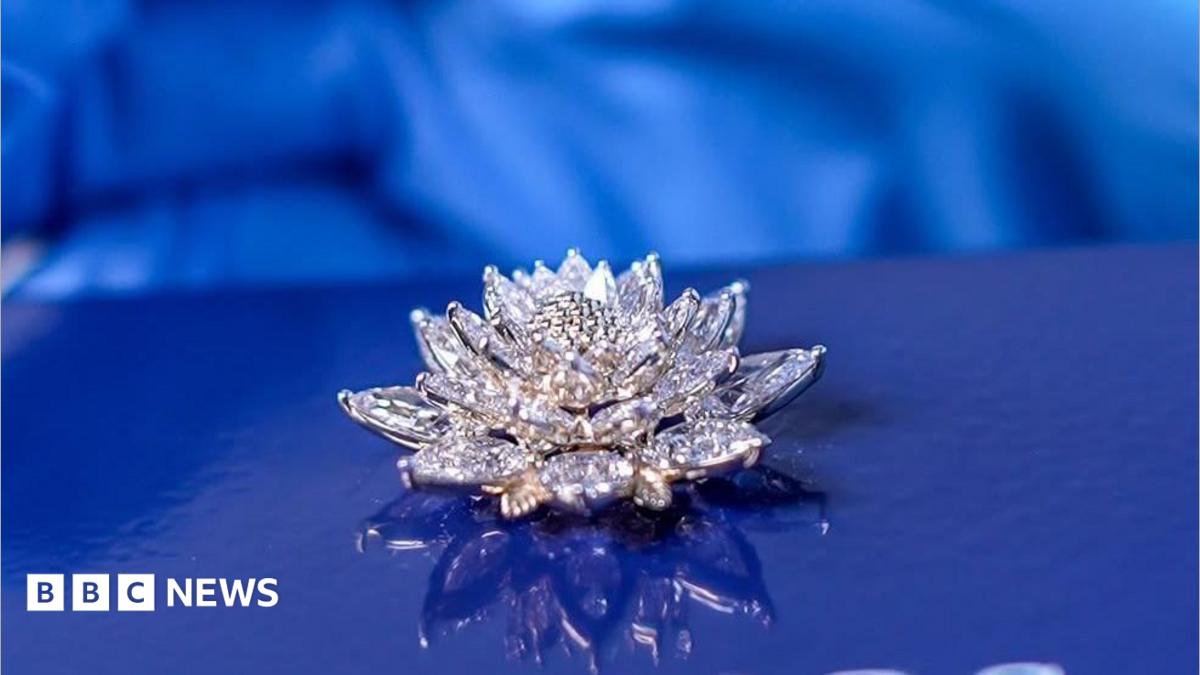
Among the payloads are two particularly significant items generating excitement in India: a small gold locket featuring a lotus flower crafted from lab-grown diamonds, adorned with micro-carvings of three renowned Indian scientists.
These intricate sculptures, each smaller than a grain of rice, honor Vikram Sarabhai, Nobel Prize-winning physicist CV Raman, and former Indian President and aerospace engineer APJ Abdul Kalam.
“Our existence is rooted in India’s space program, and we owe a great deal to the visionaries before us. This project is our tribute to three remarkable scientists who have influenced the trajectory of India’s space initiatives,” Chandana stated.
The Diamond Lotus, named Cosmic Bloom and developed by Cosmos Diamonds, serves as an artistic homage to the universe while celebrating Indian creativity, resonating with the lyrics “Like diamonds in the sky” from the beloved children’s song “Twinkle, Twinkle, Little Star.”
Source: www.bbc.co.uk