


University of Toronto Engineers Create Nanoparticles That Detect Trace Chemicals With Exceptional Sensitivity
Engineers at the University of Toronto have developed a new type of dye-sensitized nanoparticle that can detect extremely low concentrations of chemicals while distinguishing between molecules with similar shapes.
These tiny particles produce a measurable light signal when they attach to the chemicals they are designed to detect. They absorb low-energy photons and convert them into higher-energy photons, generating a bright optical signal.
The technology could eventually support applications in pharmaceutical manufacturing and environmental monitoring. Drug manufacturers could use the particles to identify unwanted impurities, while environmental researchers could investigate trace chemical contaminants in groundwater.
Nanoparticles Convert Infrared Light Into a Bright Green Signal
Organic molecules called fluorophores have been used for decades to absorb light and convert it into colorful luminescence. However, conventional fluorophores convert higher-energy photons into lower-energy photons.
“For fluorophores, the excitation frequency must be higher than the emission frequency,” said Professor Cai Huang, senior author of the paper published in the Journal of the American Chemical Society. “What makes our dye-sensitized nanoparticles special is that the fluorophore can upconvert, meaning it can absorb lower-energy photons and emit higher-energy photons.”
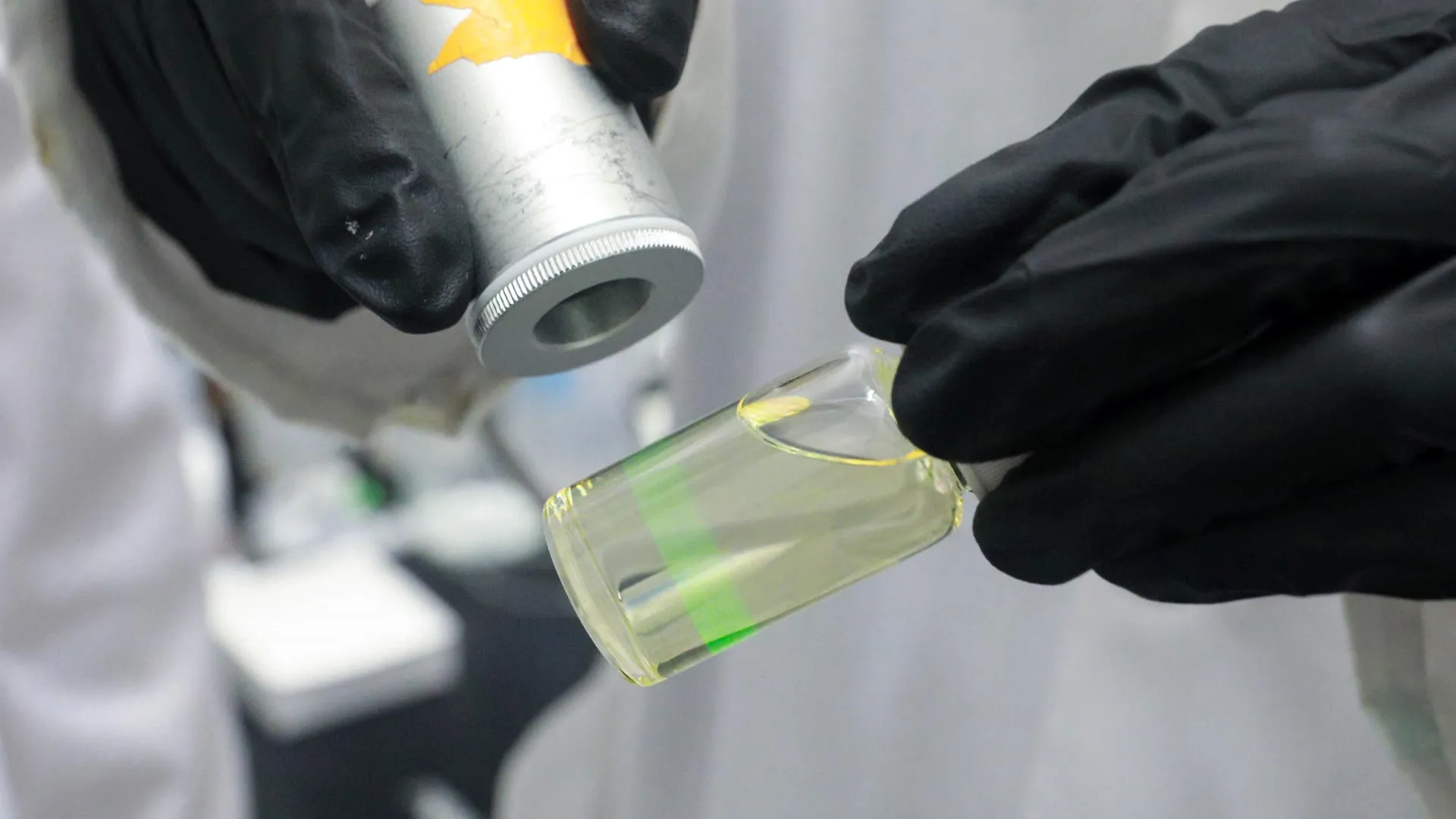
When activated with near-infrared light, which can be produced using low-cost lasers, the nanoparticles emit a bright green glow.
This process, known as upconversion, gives the particles an important sensing advantage. Because the light used to activate the nanoparticles has a different frequency from the light they emit, researchers can more easily distinguish the signal from background light produced by the sample.
Huang compares the effect to looking at the night sky.
“It’s like the difference between stargazing at night and stargazing during the day,” he said.
“Stars shine with the same brightness all the time, but during the day the sun is so powerful that it overwhelms the stars. By shifting the excitation frequency lower, the autofluorescence background in the sample we’re analyzing goes to zero, but the emissive nanoprobes continue to shine. This is like turning off the sun, so we can see the stars better.”
The Challenge of Making Upconversion Nanoparticles Brighter
The particles use ytterbium and erbium ions, members of the lanthanide family of chemical elements, to carry out the upconversion process.
Early versions of these sensing nanoparticles were generally made as flat, hexagonal structures. Ytterbium and erbium ions were dispersed throughout a host material made from sodium, yttrium and fluorine. The researchers compare this design to chocolate chips embedded in a cookie, with organic dye molecules covering the outside like icing.
When infrared light reaches a nanoparticle, the dye first captures the incoming energy. That energy is transferred to ytterbium ions, which act as repeaters, and then passed to erbium ions. The erbium ions perform the upconversion step, releasing the stored energy as green light.
However, increasing the concentration of ytterbium has historically created a major drawback.
“If you pack the ytterbium atoms too tightly, they start absorbing not only the energy coming in, but also the energy going out,” said Jiaze Wu, a doctoral student in Huang’s lab and lead author of the study.
“This is called reverse energy transfer. It means that the energy that would have been emitted by the erbium ions as green light is instead bounced off the ytterbium relay and never reaches the surface.”
Layered Nanoparticle Design Creates a One-Way Energy Path
To overcome this limitation, Wu, Huang and their colleagues redesigned both the composition and structure of the nanoparticles.
Instead of using a host matrix made from sodium, yttrium and fluorine, the researchers created a new matrix using lithium, lutetium and fluorine.
They also changed the particles from a flat, hexagonal shape to a three-dimensional, diamond-shaped structure. Each particle contains multiple regions: a dense core surrounded by an inner shell and an outer shell.
“We were able to create a nice gradient, where the concentration of embedded ytterbium ions gets thicker as we pass through each layer, with the core being the densest,” Wu said.
“This arrangement allowed us to pack in more ytterbium. In our particle, the incoming light energy flows almost entirely in one direction, inward toward the erbium ions.”
The researchers used computer modeling rather than relying only on trial and error. They simulated dozens of possible chemical formulations and particle shapes before producing the most promising design in the laboratory.
“We used Monte Carlo simulations and density functional theory to simulate how energy interacts between different parts of the nanoparticle, down to the atomic and even subatomic level,” said Weixian Ben, an undergraduate student who led the computational work.
“We thus showed that this core-shell-shell structure can indeed act as a unidirectional energy tunnel for incident light.”
New Nanoparticles Are Up to 150 Times Brighter
The resulting nanoparticles produce a significantly stronger signal than earlier designs.
According to Wu, their emitted light is about 150 times brighter than that of upconversion nanoparticles that are not dye-sensitized. Under the same excitation conditions, the particles are approximately 50 times brighter than some of the most highly optimized conventional structures reported to date.
The increased brightness directly improves sensitivity. Each nanoparticle generates a strong optical signal, meaning that even a very small number of particles attached to a target molecule can produce enough light for detection.
The sensors can also distinguish between structural isomers. These molecules contain the same types and numbers of atoms, but the atoms are arranged differently. Such subtle structural differences can be especially important in chemistry and pharmaceutical manufacturing.
Detecting the Wrong Molecule in a Pharmaceutical Batch
“Let’s say you’re making a drug molecule. The manufacturing process is working fine, except 10% of the batch is the wrong structural isomer,” Wu said.
“This is a big problem; it can make the drug less effective, or worse, cause side effects that are absolutely undesirable. Current processes for detecting this rely on very expensive analytical tests, but with these nanoparticles we can do it using low-cost lasers and very small amounts of sample.”
The combination of high sensitivity and molecular selectivity could make the technology valuable for identifying impurities that are difficult or expensive to detect using traditional methods.
The same approach could also be applied to environmental monitoring, where researchers often need to detect extremely small amounts of pollutants in much larger volumes of water.
Researchers Move Toward Commercial Applications
The technology remains at the proof-of-concept stage. Before the nanoparticles can be widely adopted, researchers must develop practical methods for manufacturing them in large quantities.
Huang said that work is already underway.
“We think it’s possible, but it requires a very long roadmap,” Huang said.
“In the meantime, this model serves as a proof of concept. Using this technique, we can generate very high-performance upconversion nanoparticles that can be customized to the molecules we want to detect. This is something completely new.”
Source: www.sciencedaily.com