


The AI in Security Operations Center (SOC) market is evolving at a rapid pace, outpacing the current methods for evaluating AI solutions.
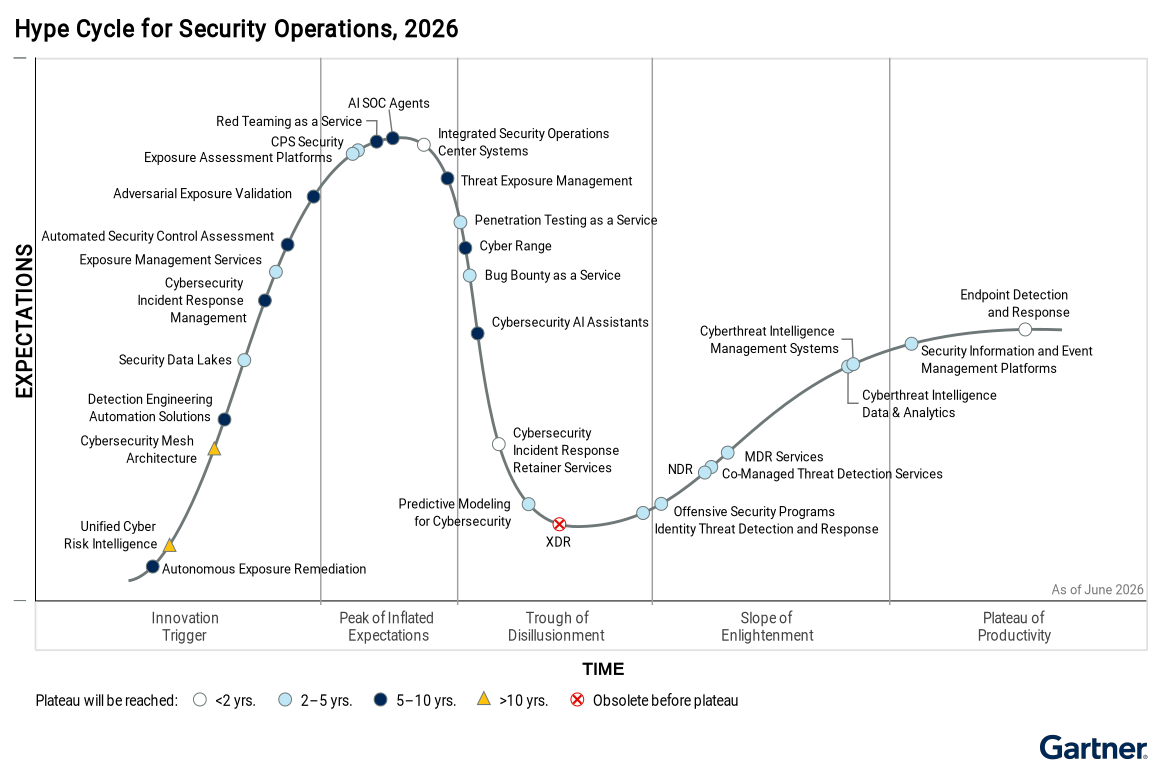
Last year, Gartner positioned AI SOC agents in the innovation trigger stage with adoption rates in single digits.
Recently, the 2026 Gartner Hype Cycle for Security Operations has indicated these technologies are approaching heightened expectations.
Many AI SOC vendors showcase impressive, sci-fi-like demos that promise clean alerts and rapid verdicts, but the reality is often different.
When these tools transition from curated demos to real-world scenarios, their accuracy frequently diminishes. Although this technology holds potential and some teams report significant benefits, there’s a notable gap between proof of concept and operational effectiveness across many organizations.
According to our guide, data suggests that 80% to 95% of enterprise AI projects fail in production.
To bridge this gap, Prophet Security, a leading AI SOC platform recognized by Rising in Cyber 2026, has teamed up with former Gartner analysts Oliver Rochford and Prateek Bhajanka to develop a comprehensive, vendor-neutral guide for assessing AI in your SOC.
You can download your copy here.
What Should We Be Evaluating?
Consider these crucial questions early in the process: Are you acquiring tools, capabilities, or new organizational strategies for your security efforts? Before initiating a proof of concept, clarify your expectations.
From Bayesian spam filters to SOAR systems, automation isn’t new in SecOps. Generative AI and large-scale language models apply to various tasks, from detection engineering to alert triage.
This wide applicability emphasizes the necessity for alignment between the product’s operating model and your team’s workflow, placing it at the core of the evaluation process.
This Gartner report offers cybersecurity leaders vital questions and practical approaches to evaluate AI SOC solutions, ensuring they enhance the efficiency and operational outcomes of threat detection, investigation, and response (TDIR) programs.
1. Can AI Make Reliable Decisions in Your Environment?
The foremost question is whether AI can produce accurate decisions across the various scenarios and attack surfaces that SOCs regularly encounter.
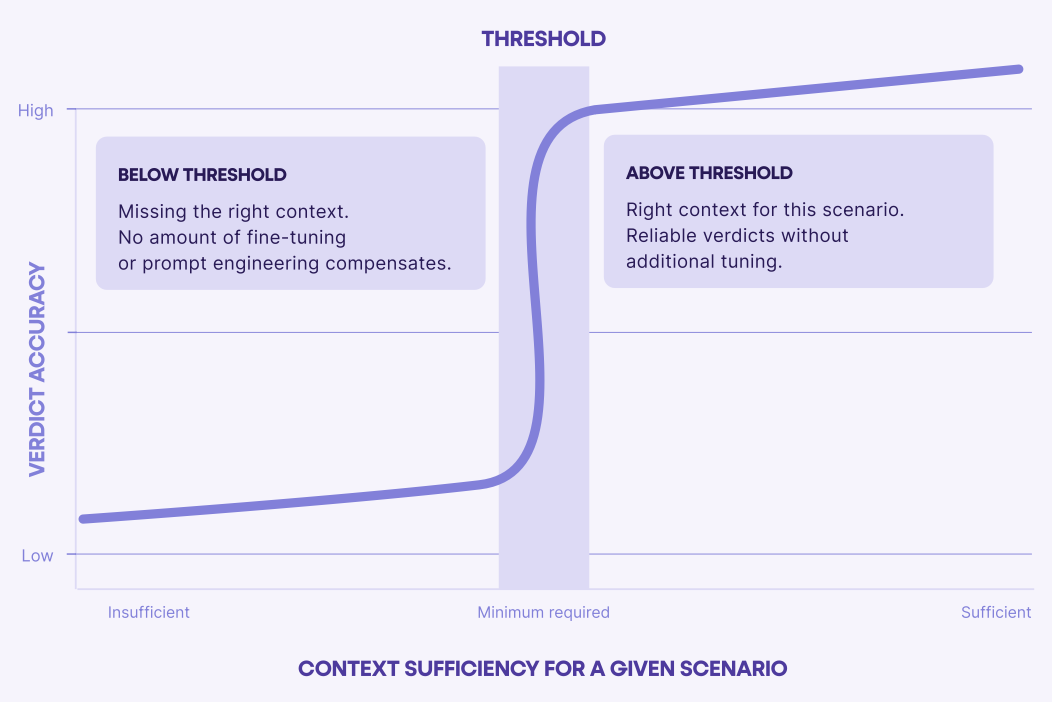
Interestingly enough, dumping more data into the model doesn’t guarantee improved decision quality over time. Below a certain threshold, no amount of tuning can compensate for this; beyond this point, the model can generate reliable decisions without further adjustments.
The data that enhances quality past this boundary typically includes identity, asset, and organizational context, allowing AI to differentiate between attackers and legitimate users.
This aspect significantly influences testing methodologies. A phishing alert can be prioritized using email metadata. However, for investigations involving privilege escalation and lateral movement, you’ll require detailed context such as identity data, asset inventory, and behavioral baselines.
If your proof of concept only examines scenarios needing basic discovery and telemetry, you’re merely testing easy cases without gaining insights into the more complex situations.
2. Does Your Operating Model Fit Your Team’s Workflow?
A common pitfall in AI SOC deployments is the misalignment between a product’s operating model and the ways teams work.
Tasks handled by one individual may depend on AI to perform activities that others can’t, often prioritizing cost and scope. On the other hand, larger teams require AI to enhance human capabilities, necessitating parallel testing and a redesigned operational structure.
The most straightforward test here is evaluating human-AI equivalence. Operate your system alongside analysts for several weeks to establish a baseline before implementing AI, treating analyst overrides as critical data rather than mere noise.
A concerning sign is when assessments result in analysts simply accepting the AI’s conclusions instead of forming their own.
This scenario underscores the underlying risks. All AI SOC platforms make preset decisions before the analyst’s involvement—what to prioritize, suppress, or investigate.
The more upstream these decisions are made, the less visible they become, making it harder to address them. When AI automates all investigations, human involvement may feel redundant.
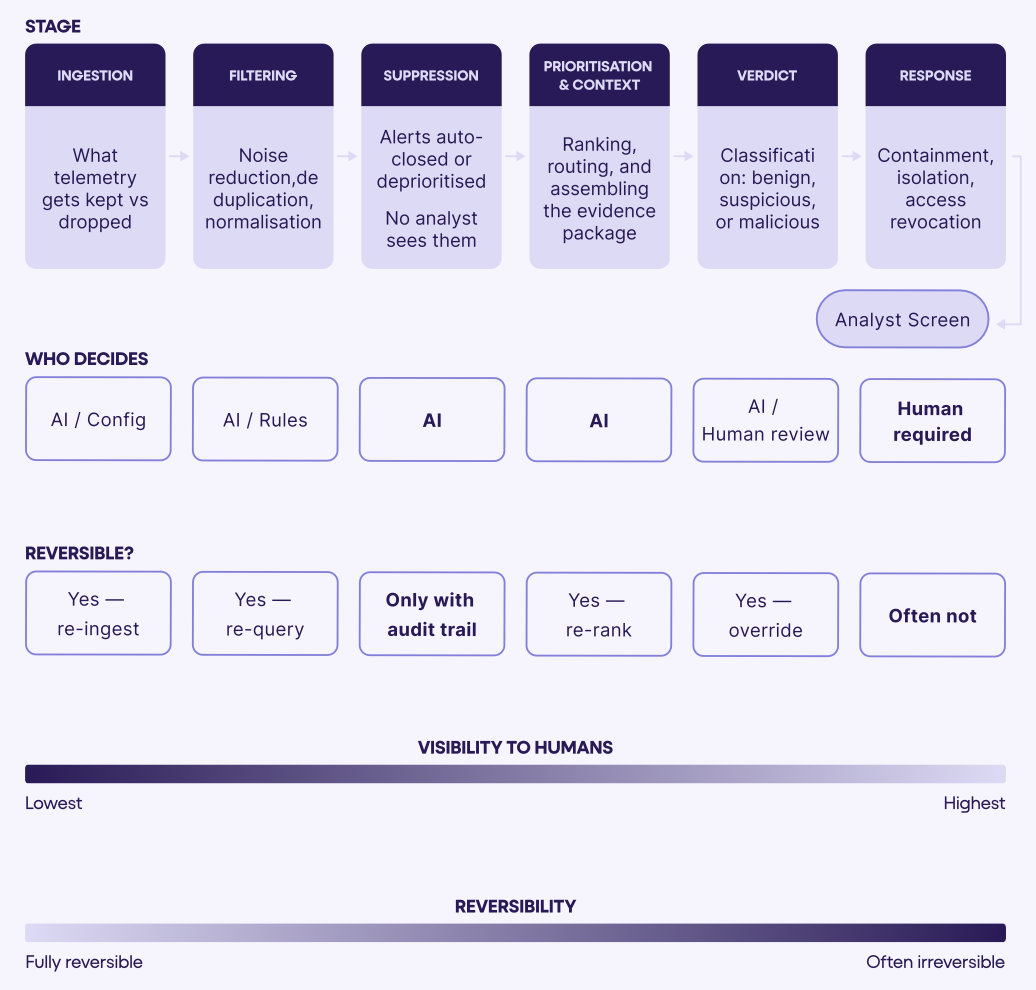
This highlights the significance of explainability and depth of investigation. Analysts can only trust and audit a decision if they understand the rationale behind it.
3. Will AI Maintain Reliability Over Time?
A product that works effectively day one could experience silent degradation over time. This framework component evaluates durability and is often overlooked in short proof of concepts.
This guide flags essential areas for thorough testing, including adversarial robustness, model drift, adaptability to changing environments, and vendor lock-in.
A balance must exist between a vendor’s current offerings and their future projections, alongside their proven track record. Customer referrals can help clarify the landscape between hype and reality.
4. What Insights Should Practitioners Have Gained Earlier?
The guide concludes with insights from practitioners who have implemented AI in production SOCs.
Rapid workforce changes are imminent. One company’s CISO discovered that roles focused on phishing triage and DMARC verification were automated in just weeks, leaving the team scrambling to define new positions.
To address this, establish new roles like Detection Engineering, threat hunting, and AI monitoring prior to deployment rather than reacting post-implementation.
The greatest benefit observed stemmed not from speed but from broadened analytical capabilities.
AI enables exploration of previously neglected areas, leading to detection expansions rather than merely faster alert prioritization.
One team revived a detection rule previously deemed impractical, effectively correlating low-severity findings without manual workload—thanks to AI.
This shift also transforms detection engineering productivity, making experimental detection feasible as AI manages false positives, which typically hinder full-time analysts.
Remember, “inconclusive” is a valid outcome. Systems that only provide binary decisions can mask uncertainty instead of addressing it. For critical decisions, aim for a three-state classification (i.e., benign, suspicious, and malicious) with clear escalation pathways.
Big Picture
There’s no reason to fear technology at its peak potential. Practitioners must simply manage expectations around vendor hype and the actual capabilities of technology in production.
Engage, ask for references, examine case studies, and conduct your own evaluations. Both former Gartner analysts and Prophet Security acknowledge that different organizations have unique needs—sometimes requiring a service, a product, or both.
The guide emphasizes a hybrid human-AI model, with AI addressing triage and investigation tasks, while humans oversee containment, escalation, and irreversible actions.
Prophet Security is an agent-based AI SOC platform that leverages transparent, evidence-backed reasoning for autonomous investigation of alerts, escalating decisions when human intervention is necessary.
This company designed its AI SOC Analyst using the principles outlined in the guide, allowing analysts to review comprehensive investigations rather than merely accepting scores based on trust.
Download The Hype-Free CISO’s Guide to Testing an AI SOC Solution to access the complete four-part framework, including scenario context maps, red flag checklists, and a comprehensive evaluation checklist for your proof of concept.
Get the guide here to receive the full framework, checklists, and critical vendor questions.
Sponsored and authored by Prophet Security.
Source: www.bleepingcomputer.com