


This article is fully accessible through your institution.
Hello Nature Readers! Want to receive this informative briefing directly in your inbox every day? Sign up here.
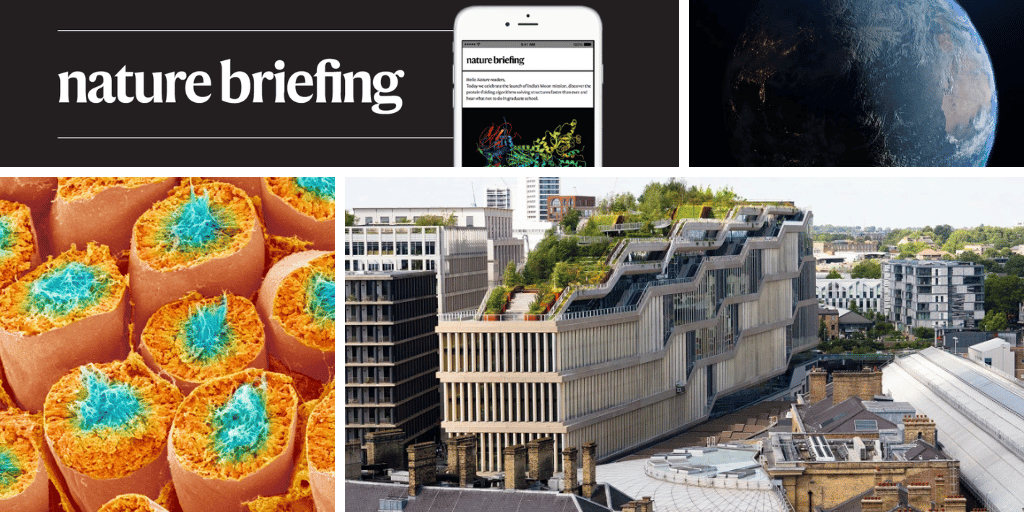
Developing sperm cells (blue, artificial color) fill the center of the seminiferous tubules (orange) that form the human testes.
Credit: Susumu Nishinaga/Science Photo Library
Sixteen years ago, a revolutionary transplant using a frozen tissue sample from one of his testicles, taken when he was just 10 years old, restored a man’s ability to produce sperm. These samples were preserved before chemotherapy, which posed a threat to his fertility. While it’s uncertain if the sperm from the transplanted tissue can successfully fertilize an egg and lead to a healthy baby, scientists believe this breakthrough could herald a new era in fertility treatments.
Nature | 5 minute read
Reference: medRxiv preprint (Not peer-reviewed)
Earlier this month, the U.S. government unveiled a plan to deploy a massive mirror into orbit that will reflect sunlight to previously shadowed regions of the Earth. This marks the beginning of a project involving 50,000 mirrored satellites. Reflect Orbital, the startup behind this initiative, asserts that this “artificial sunlight” could enhance agricultural output, assist in disaster relief, and enable solar panels to generate power at night. However, many astronomers express concerns that the reflective beam may disrupt sensitive telescopes and worsen light pollution.
Nature | 5 minute read
The UK government has announced its plans moving forward, intending to reduce overseas development funds by 40% by 2027 to augment defense spending. Programs in impoverished nations like Malawi, Mozambique, Kenya, and Tanzania will face the most severe impacts. “Some of the UK’s long-standing development partnerships will see cuts of up to 92%,” stated Sarah Champion MP, chair of the cross-party committee monitoring international development. “The consequences of these decisions could be dire.”
Features and Impressions
A postdoctoral researcher seeking industry employment reflects on the opaque, layered interview processes in large scientific companies. Insights from career coaches or hiring managers can provide crucial clarity. The primary advice is to understand whom you’ll be engaging with at each stage and tailor your responses based on insights gained from initial discussions with recruiters. Above all, thorough preparation, including extensive company research and assembling relevant anecdotes to demonstrate your skills, is vital.
Nature | 9 min read
At a 1976 American Legion convention in Philadelphia, a mysterious disease affected 182 individuals, resulting in 29 deaths. This was traced back to Legionella pneumophila, the bacteria responsible for Legionnaires’ disease. The recent current Legionnaires’ disease outbreak in New York City highlights that “Legionellosis is a disease of the built environment,” according to environmental journalist Brett Walton. “All fog-inducing systems, whether a cooling tower, shower, hot tub, or decorative fountain, pose a challenge for prevention.”
Blue Circle | Photo Blue Circle 8 minutes read & New York Times | 3 minute read
This Week’s Image

Researchers captured authentic images of epaulette orioles (jaundice kayanensis) (center) and tasked Google Gemini AI to enhance them. The outcome yielded a convincing image of a Red-billed Blackbird (Agelaius Phoeniceus) (right). The AI tool also produced a completely AI-generated red-winged blackbird (left). These images highlight the proliferation of bird photos, some mistakenly classified as other species, flooding citizen science platforms due to AI misinterpretations. (Guardian | 7 min read)
Reference: Natural Ecology and Evolution correspondence (Click here for a larger version of the image) (Alexander C. Lees) Others/Natural Ecology and Evolution (Photo: David Theobald))
On Friday, Leaf Penguinson found solace in the stunning landscapes of Paratikul (Paradise Valley) in Finland. Did you spot the penguin? When you’re ready, click here for the answer.
Thank you for reading,
Flora Graham, Editor-in-Chief, Nature Briefing
Contributed by Jacob Smith
• Nature Briefing: Careers — insights, advice, and award-winning journalism designed to enhance your work life.
• Nature Briefing: Microbiology – exploring microorganisms, the most numerous life forms on Earth and their roles in health, environment, and food systems.
• Nature Briefing: The Anthropocene — addressing Climate Change, Biodiversity, Sustainability, and Geoengineering.
• Nature Briefing: AI and Robotics — 100% authentically human-written content.
• Nature Briefing: Cancer — a weekly newsletter tailored for cancer researchers.
• Nature Briefing: Translational Research — focused on biotechnology, drug discovery, and the pharmaceutical industry.
Source: www.nature.com