


Recent research from planetary scientists reveals groundbreaking evidence that bursts of high-energy particles from the sun can significantly warm Mars’ lower atmosphere during massive dust storms. This discovery highlights an unexpected link between space weather phenomena and the Martian climate.
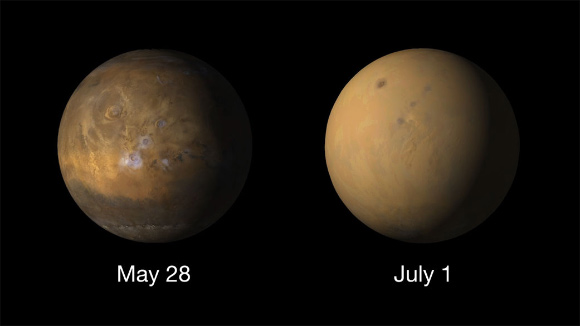
Images taken by the Mars Color Imager (MARCI) aboard NASA’s Mars Reconnaissance Orbiter show Mars before (left) and during (right) a dust storm in June 2018. Image credit: NASA / JPL-Caltech / University of Arizona.
“Solar energetic particle (SEP) events occur when highly energetic charged particles are expelled into space during solar flares or coronal mass ejections (CMEs),” explained Lana Williams, an astronomer at Lancaster University, alongside her research team.
“Mars experiences greater exposure to these particles due to its thin atmosphere and the lack of a strong global magnetic field, which is present on Earth.”
“Previous studies indicated that SEPs can influence Mars’ upper atmosphere, leading to ionization, auroras, and disrupted radio communications,” she added.
“Despite this, the impact on Mars’ lower atmosphere, where significant weather events occur, remains largely unexplored.”
“Dust storms naturally warm sections of Mars’ atmosphere by absorbing sunlight,” the researchers noted.
“However, the unusual heating pattern observed during this complex event cannot be solely attributed to the sandstorm,” they continued.
In their study, Williams and her colleagues analyzed five SEP events on Mars to evaluate whether prolonged SEPs could raise temperatures in the lower atmosphere.
While four SEP events showed no discernible effects, the fifth event, which took place in June 2018, coincided with the rapid expansion of a global dust storm that also marked the end of NASA’s Opportunity rover mission.
It was during this particular event that notable signs of low-level atmospheric heating were recorded.
“We anticipated that these high-energy particles could affect the temperature of Mars’ lower atmosphere; however, in four out of the five events surveyed, we found no definitive signs of heating,” Williams remarked.
“The only exception arose during the global sandstorm event.”
Utilizing data from NASA’s Mars Atmosphere and Volatile Evolution (MAVEN) spacecraft and ESA’s Trace Gas Explorer, the researchers compared their findings with expected temperature profiles derived from the Mars climate database.
They examined temperature variations before, during, and after five long-term SEP occurrences.
“Sandstorms weren’t part of our original research parameters, so their occurrence alongside the heating was unexpected,” Williams stated.
This indicates that the Martian atmosphere and weather may react to overlapping events rather than each thermal source acting in isolation.
The researchers are set to present their findings at the upcoming National Astronomical Conference 2026 (NAM2026) in Birmingham, England.
_____
Lana Williams and colleagues. Do solar particle events impact the heating of Mars’ atmosphere? NAM2026
Source: www.sci.news