


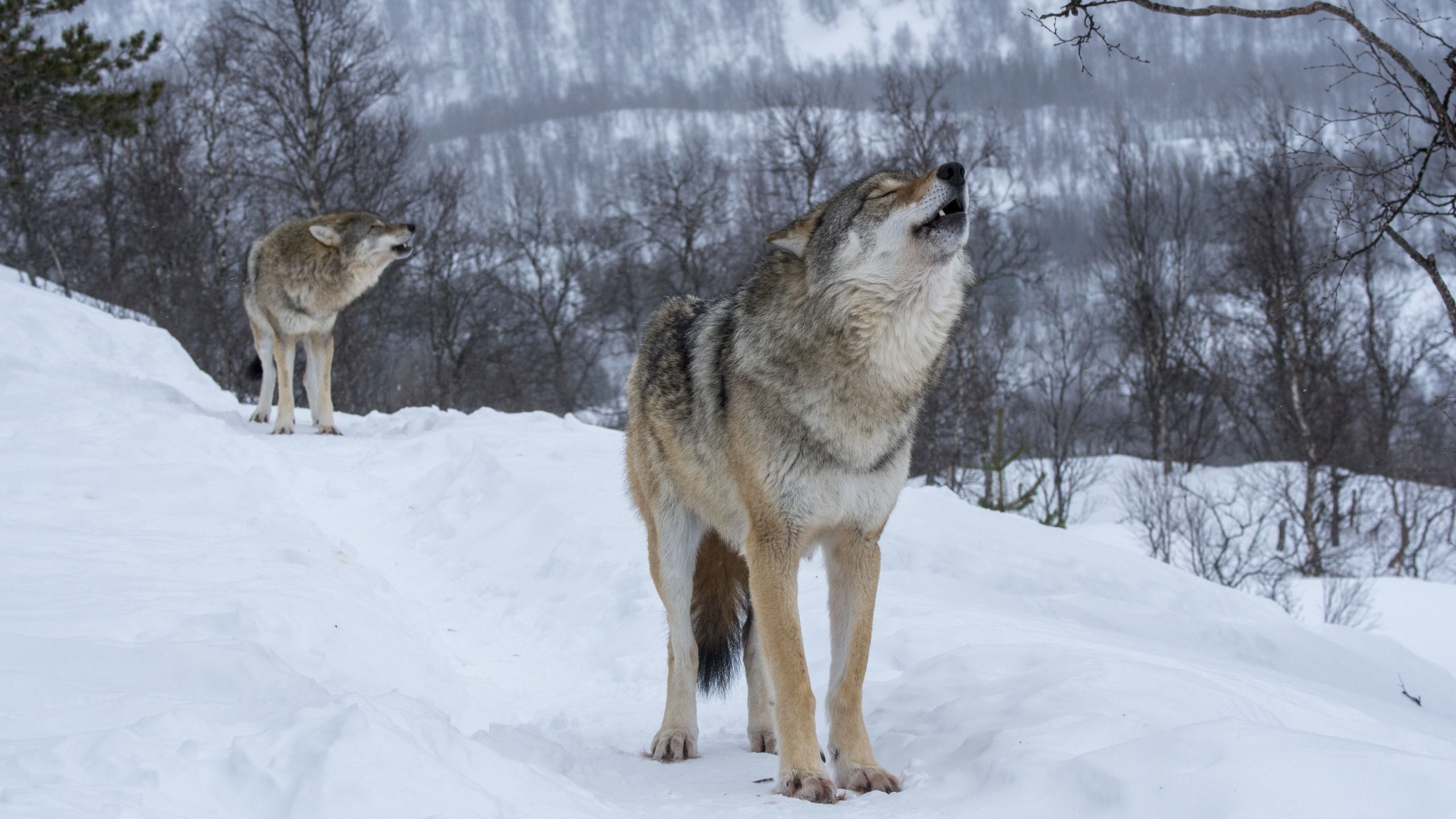
Wolves howl primarily to communicate across long distances and maintain their social networks, rather than because they are responding to the moon. Their howls can help separated pack members reconnect, reinforce social bonds, advertise territory and, potentially, attract mates. The sound also varies among wolf species, subspecies and dog breeds, suggesting that howling may carry detailed information about the animal producing it.
Why wolves howl
Wolves can howl alone or in groups. “If a lone wolf howls, it’s probably because they’ve separated from the pack and want to reconnect,” Aric Kershenbaum, a zoologist from the University of Cambridge, told Live Science.
Pack members can become widely dispersed, so howling gives them a way to find one another when they need to hunt together, care for young or respond to a threat to their territory. Lone wolves that have separated from their pack may also howl as “a way to find new flocks and mates,” Kershenbaum said.
When a pack howls together, the sound may advertise its territory and deter neighboring packs. “Our data shows that packs bark more often in the center of their territory. They also bark more when there are puppies around or when there is a hunting carcass,” Tamas Farago, an animal behaviorist and bioacoustician at Eötvös Loránd University in Budapest, Hungary, told Live Science. “We’re trying to find a way to do this,” he said, referring to the possibility that group howling has a repellent effect on neighboring packs.
However, most group howls are social rather than aggressive. “Most choral howls are social, meaning they howl together to build what is technically called social cohesion,” Kershenbaum said. Farago said wolves “feel good when they’re safe and surrounded by their pack mates,” adding that collective howling can put the pack in the same mood. Such howling is common before the animals leave to hunt.
Howling can also trigger more howling. “Individual wolves have a very strong tendency to respond when they hear howls,” Farago said. But a lone wolf that accidentally enters a neighboring pack’s territory and hears the pack howling may not respond. In that situation, “it will be obvious that it is an intruder there,” he said.
A long-distance signal
A wolf’s howl can be heard up to 10 miles (16 kilometers) away in open terrain, according to the Wolf Conservation Center in South Salem, New York.
Farago said the combination of low- and high-frequency sounds in a howl helps it travel through vegetation. Even if some of the low-frequency sound is dampened by plants, the high-frequency components can remain and convey information about the wolf that produced the howl.
Image credit: Roberta Ryan
How wolf howls differ
Wolf howls vary among species and subspecies. A 2016 survey by Kershenbaum and colleagues found that 13 species and subspecies of wolves, jackals, coyotes and dogs have howling dialects. These dialects are characterized by different types of howls and different patterns of regularity, depending on the species or subspecies.
For example, the wolf’s repertoire mainly consists of a low, flat howl, while red wolves (Canis rufus) most often use a high, looping howl.
Domestic dogs descended from gray wolves (Canis lupus), and their howls may differ from those of wolves. The differences vary considerably by breed. A 2023 study by Kershenbaum, Farago and colleagues found that ancient dog breeds more closely related to wolves howled more frequently, while modern dog breeds barked more often.
What information does a howl carry?
One question researchers still want to answer is whether a howl sounds different depending on its purpose. “The problem is, when wolves are howling, most of the time we don’t know what they’re doing at that time. Either they’re too far away or it’s nighttime,” Kershenbaum said.
“Generally, howls produced in different emotional states probably sound different,” Kershenbaum said. For example, a wolf that feels threatened during a territorial fight may vary the pitch of its howl differently from a relaxed wolf. However, he said, this remains an active area of research.
Do wolves howl at the moon?
The belief that wolves howl at the moon is a myth. “It’s a myth, unfortunately,” Kershenbaum said. “There doesn’t seem to be any correlation between them at all.”
He suggested that before electric lighting became widespread, people were more likely to be outdoors when the moon was bright. They may simply have heard wolves howling at those times, creating the association between the animals and the moon.
What do you know about the animal kingdom? Test your knowledge with our animal quiz.
Topics: life’s little mysteries
Source: www.livescience.com