


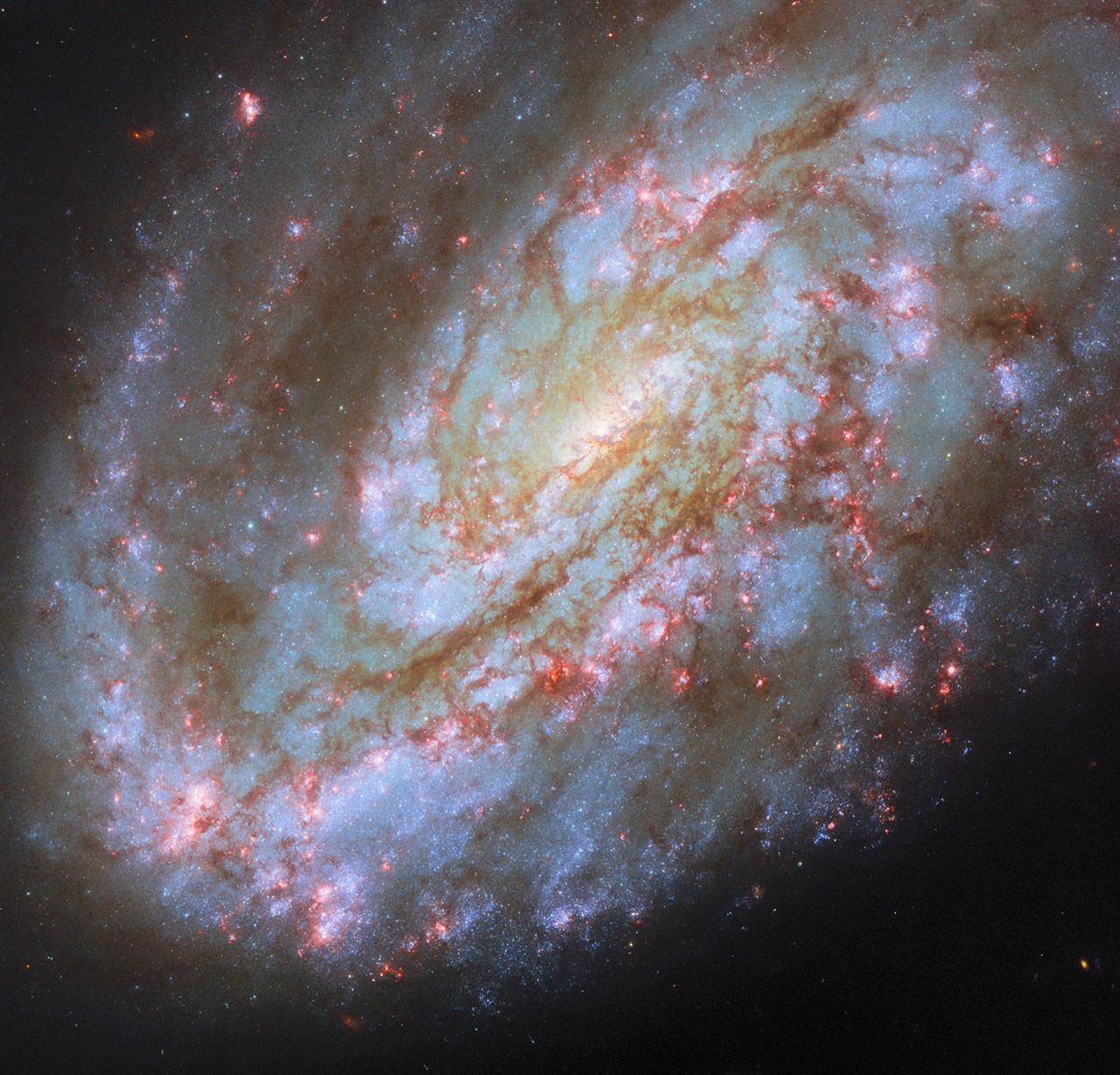
This stunning image from the NASA/ESA Hubble Space Telescope showcases NGC 4654, a captivating spiral galaxy in the constellation Virgo. Classified as an “intermediate spiral galaxy,” NGC 4654 lies 72 million light-years from Earth in the expansive Virgo Cluster. Its unique structure features a weak bar at its center, placing it between classical spiral galaxies with and without bar structures.
NGC 4654 displays a notable asymmetry; one side has a rounded edge while the other features a prominent gaseous tail extending beyond the image’s borders. This tail is the result of ram pressure stripping, a phenomenon occurring as galaxies traverse space. NGC 4654’s rapid movement through the hot intracluster medium of the Virgo Cluster generates significant “ram pressure,” compressing its leading edge and dragging gas behind, resulting in its elongated tail.
The star distribution within NGC 4654 is equally uneven, a rarity for spiral galaxies. Its leading spiral arm is abundant in stars and gas, while the opposite arm is significantly star-depleted, contributing to its lopsided shape. Astronomers suggest that the gravity of nearby galaxy NGC 4639 has played a role in this asymmetry. A close interaction approximately 500 million years ago likely stripped NGC 4654 of gas on one side, inhibiting star formation and enhancing its unique spiral morphology.
Typically, galaxies experiencing ram pressure stripping see a decline in star formation rates due to the loss of cold gas necessary for star creation. Surprisingly, NGC 4654 continues to form stars at a remarkable rate, producing nearly two solar masses annually—comparable to other galaxies of similar size. Recent data from Hubble indicate active star formation within NGC 4654, as the red light emitted by energetic gas clouds reveals vibrant regions of newborn stars. The bright pink bubbles spanning its front spiral arm, weak bar, and disk edges are areas where these young stars reside.
The data for this image originates from two observation programs (#15654 and #17502) aimed at understanding the connection between gas movements in galaxies and star formation. By investigating prominent galaxies like NGC 4654, researchers hope to unravel how gas migrates, the conditions for star formation, and the influence of new stars on surrounding gas.
Text credit: ESA/Hubble
Media Contact:
Claire Andreoli
NASA’s Goddard Space Flight Center, Greenbelt, Maryland
[email protected]
Source: science.nasa.gov