


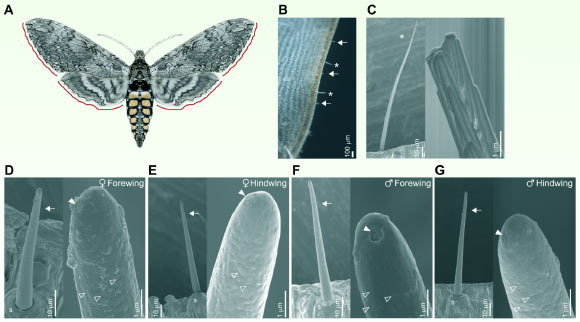
Scientists at the Max Planck Institute for Chemical Ecology have discovered that moth wings contain odor-sensing receptors. The finding suggests that tobacco hawkmoths use their wings — in addition to their antennae — to detect chemical signals while flying.
Reda Ismaieel et al. examined the ability of tobacco hawkmoth wings to detect odors. Image credit: Reda Ismaieel et al., doi: 10.1242/jeb.252047.
“The tobacco hawkmoth (Manduca sexta) was recently found to have receptor proteins in its wings that may detect different smells and tastes,” said Dr. Sonja Bisch-Knaden, lead author of a study published in the Journal of Experimental Biology.
“However, receptor proteins are only the first step in the sensory process that converts chemical signals into nerve impulses and ultimately produces the sense of smell.”
“We knew that tobacco hawkmoth wings would need specialized odor-sensitive hairs, distributed along the wing margins, to detect scents. Therefore, we searched for these essential sensory structures.”
The researchers carefully trimmed the edges of tobacco hawkmoth wings, coated the tissue with a fine mist of gold and examined the samples using a scanning electron microscope.
Among the long, slender hairs that detect touch, the scientists found shorter, thicker hairs with porous surfaces. These structures are characteristic of odor sensors, indicating that they may help the moth detect chemical cues.
The team also extracted mRNA from the moth wings. Messenger RNA, or mRNA, contains the instructions cells use to produce receptor proteins that recognize specific odors and tastes.
After months of detailed analysis, the researchers identified mRNA linked to 33 taste and odor receptors. Fifteen of these receptors were expressed along the wing margins, where the specialized sensory hairs were found.
By comparing the wing receptor proteins with receptors whose functions are known in other insects, the researchers concluded that tobacco hawkmoth wings may detect bitter compounds and amines — chemicals that can smell like rotting fish to humans.
To test the wing’s ability to detect odors, the scientists connected a moth wing to an electrical circuit and exposed it to puffs of different chemicals. The tested scents ranged from foul-smelling pyridine and fruity methyl hexanoate to the strong floral aroma of Datura flowers.
Surprisingly, the wing responded to only two of the tested odors: pyrrolidine and piperidine. Both are pungent amines found in nightshade plants, including the plants on which tobacco hawkmoths prefer to lay their eggs.
When the researchers cut away the wing edges and repeated the experiment, the wings continued to respond to the unpleasant amine odors.
“This suggests that the moth has specialized sensory hairs across its wings, rather than only along the margins, that can detect these odors,” Dr. Bisch-Knaden said.
_____
Ahmed Reda Ismaieel et al. 2026. Noses on the wing: the olfactory capacity of hawkmoth wings. J Exp Biol 229 (14): jeb252047; doi: 10.1242/jeb.252047
Source: www.sci.news