


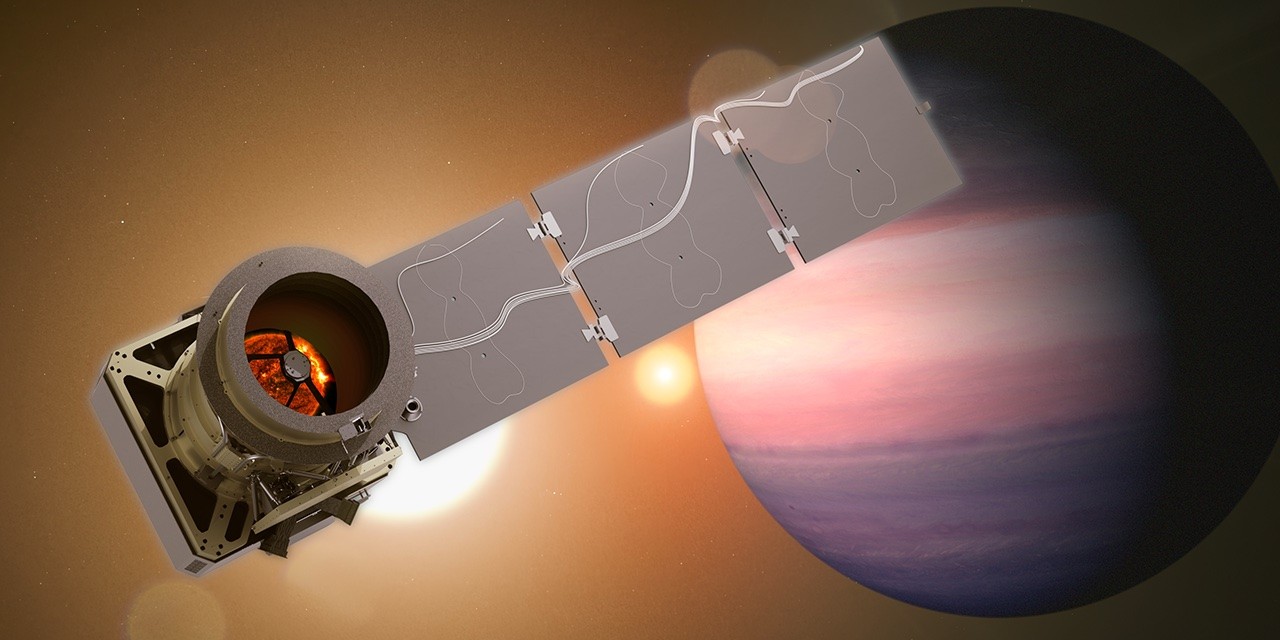
NASA’s Pandora Exoplanet Mission Begins Studying Alien Atmospheres
NASA’s Pandora exoplanet mission, the first satellite launched through the agency’s Astrophysics Pioneer Program, has begun making detailed observations of worlds beyond our solar system and the stars they orbit. During its primary mission, Pandora will study the atmospheric composition of at least 20 exoplanets, searching for signs of haze, clouds, and water.
“Pandora’s data will help fill a major gap in our knowledge about exoplanets and their host stars,” said Elisa Quintana, Pandora’s principal investigator at NASA’s Goddard Space Flight Center in Greenbelt, Maryland. “We are not yet certain how starlight affects measurements of an exoplanet’s atmosphere. Pandora was designed to help scientists separate signals from stars and planets more accurately.”
Understanding Exoplanet Atmospheres
The results from NASA’s Pandora mission will help scientists interpret observations from the James Webb Space Telescope and future observatories designed to search for potentially habitable worlds. Pandora’s near-infrared detector is also based on a backup instrument originally developed for Webb.
“The spacecraft is healthy, and all instruments are functioning as expected,” said Jordan Carburn, Pandora’s deputy project manager at Lawrence Livermore National Laboratory in California. “Our team’s hard work throughout the commissioning process has paid off, and we can now begin the science mission with confidence.”
Pandora launched into low Earth orbit on January 11 as an ambitious SmallSat funded by NASA’s Astrophysics Pioneer Program. The Pioneer program supports fast-paced, relatively low-cost missions designed to address important questions in astrophysics while accepting a higher-than-usual tolerance for mission risk.
What Makes the Pandora Mission Unique?
Pandora’s telescope is an all-aluminum instrument measuring approximately 18 inches (45 centimeters) in diameter. It will observe exoplanets and their host stars simultaneously in visible and infrared light. The spacecraft can also monitor its targets for much longer periods than large, highly scheduled observatories such as the James Webb Space Telescope typically can.
Astronomers can study an exoplanet’s atmosphere when the planet passes in front of its host star from Earth’s perspective. This event, known as a transit, allows some of the star’s light to pass through the planet’s atmosphere before reaching telescopes. Atmospheric molecules absorb specific wavelengths of light, creating chemical fingerprints that researchers can use to identify the atmosphere’s composition.
However, scientists also detect light from the entire surface of the host star, and stars are not perfectly uniform. Their surfaces contain hotter, brighter regions and cooler, darker areas similar to sunspots. These features can grow, shrink, and move as a star rotates, potentially distorting the atmospheric signals astronomers are trying to measure.
“Water is one of the most important molecules we can measure to understand the composition and physical state of exoplanet atmospheres,” said Benjamin Rackham, a Pandora team member at the Massachusetts Institute of Technology in Cambridge. “But stellar activity can distort the water signals we are looking for. Pandora is designed to disentangle signals from planets and stars, helping scientists characterize exoplanets more precisely and supporting future studies of potentially habitable worlds.”
NASA’s Goddard Space Flight Center
How Pandora Will Observe Exoplanets
Pandora’s telescope and detector, jointly developed by Lawrence Livermore National Laboratory and Corning Specialty Materials in Keene, New Hampshire, are central to the mission. The detector simultaneously measures a host star’s brightness in visible light, captures its near-infrared spectrum, and records the near-infrared spectrum of the planet as it passes in front of the star.
During its year-long primary mission, Pandora will observe at least 20 exoplanets 10 times each. Every observation will last approximately 24 hours and include an exoplanet transit, giving scientists repeated measurements of both the planet and its host star.
“Pandora can observe targets at multiple wavelengths for long periods of time, something a high-demand flagship mission such as Webb cannot do regularly,” said Knicole Colon, Pandora’s mission project scientist at NASA Goddard. “By combining Pandora and Webb observations, scientists will be able to determine the properties of stellar surfaces and more clearly separate signals from stars and planets.”
NASA Pandora Mission Partners
NASA’s Goddard Space Flight Center leads the Pandora mission. Lawrence Livermore National Laboratory provides project management and engineering support. Corning manufactured Pandora’s telescope in collaboration with Livermore, which also developed the image detector assembly, mission control electronics, and supporting thermal and mechanical systems.
NASA Goddard provided the infrared sensors. Blue Canyon Technologies supplied the spacecraft bus, conducted spacecraft assembly, integration, and environmental testing, and supports mission operations. NASA’s Ames Research Center supports data processing for the mission in California’s Silicon Valley.
Pandora’s scientific data is available through the NASA Exoplanet Archive, operated by IPAC at the California Institute of Technology in Pasadena. The University of Arizona leads Pandora’s mission operations and contributes to its science programs, while universities across the United States and beyond support the mission’s scientific teams.
Why NASA’s Pandora Mission Matters
By studying exoplanets and their host stars together, Pandora will help researchers improve the accuracy of atmospheric measurements. Its observations could make it easier to identify water and other important molecules in distant worlds, strengthening the scientific foundation for future searches for habitable planets beyond the solar system.
For more information about NASA’s Pandora exoplanet mission, visit the resources linked above.
Source: science.nasa.gov