


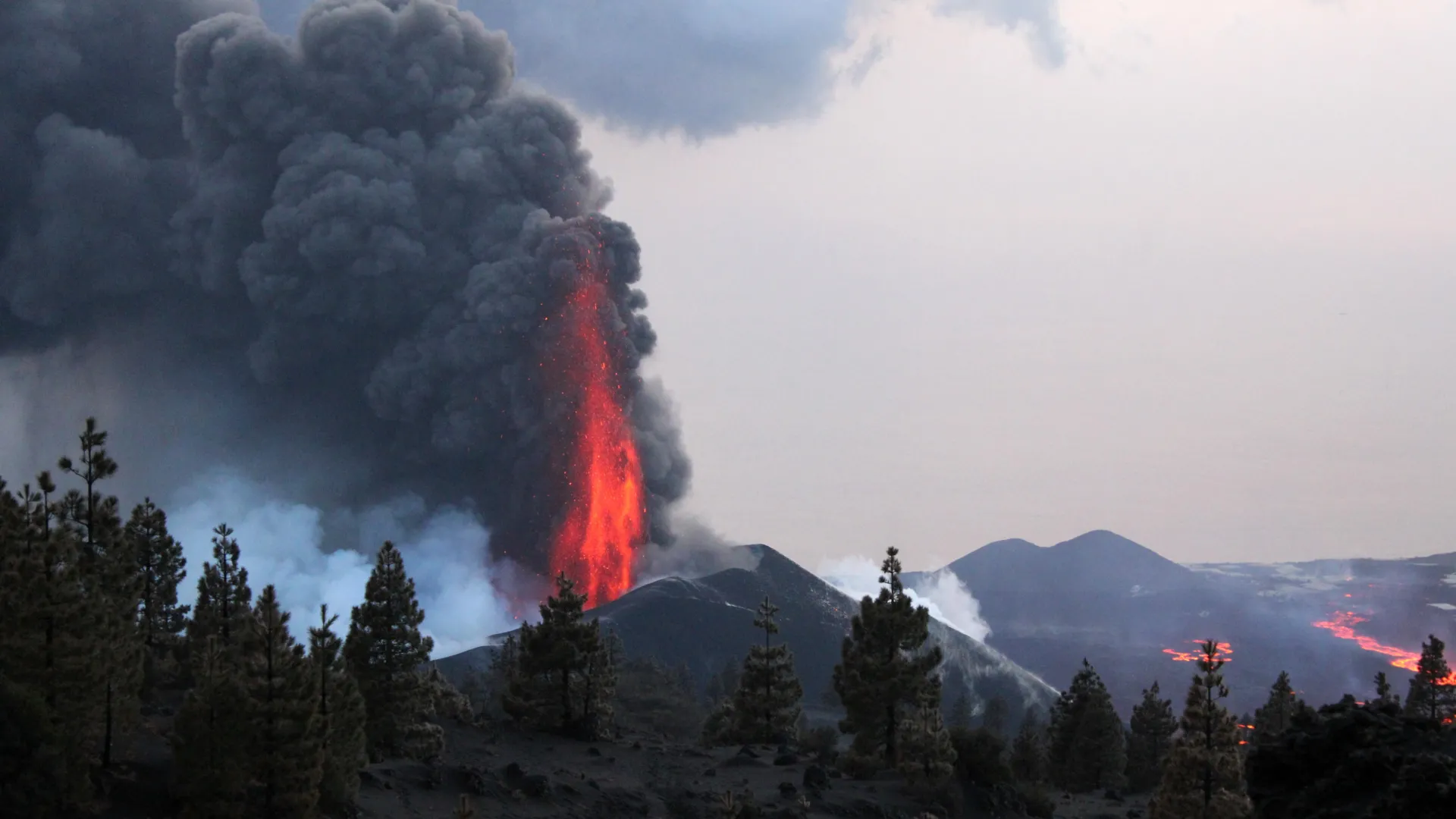
Scientists have identified a heat-driven process inside magma that may explain why volcanoes with similar geological characteristics can produce very different types of eruptions.
An international research team led by The University of Manchester studied magma from the 2021 Tajogaite eruption on La Palma, Spain. The researchers discovered that magma superheating—when magma becomes hotter than the temperature at which its crystals remain stable—can delay crystal formation as magma rises toward Earth’s surface.
Superheating Removes Crystal Seeds
The study, published in Nature Communications, found that extreme heat can dissolve tiny existing crystals that typically act as “seeds” for the formation of new crystals inside magma.
Superheating also changes magma’s microscopic structure, making it more uniform and less suitable for new crystals to form. These changes can influence how quickly magma rises and how easily volcanic gases escape. Together, these factors can help determine whether a volcano produces powerful lava fountains or a slower, more effusive lava eruption.
The findings offer new insight into how magma temperature history affects crystallization before and during a volcanic eruption.
Lead author Dr. Barbara Bonechi, Research Associate at The University of Manchester, said: “The history of crystal and bubble growth can dramatically control how a magma erupts; in particular, as more crystals grow, they eventually have a dramatic effect on magma viscosity. Until now, we did not fully understand the dynamics of crystal growth for magmas that received an injection of superheat just before ascent. But using our exciting and newly developed X-ray transparent pressure vessel combined with synchrotron X-ray microtomography, we can actually observe these processes ‘in situ’.”
Recreating Volcanic Conditions in the Laboratory
To study magma superheating, the researchers recreated volcanic conditions in the laboratory using magma collected during the Tajogaite eruption. The magma may have experienced intense heating before the eruption and as it moved upward through the Earth’s crust.
At Diamond Light Source, the team used synchrotron X-ray microtomography to observe crystal formation inside the magma in real time. They also carried out complementary ex-situ experiments in Prague, allowing the researchers to examine the samples over longer periods.
These experiments enabled the scientists to track magma crystallization under carefully controlled conditions of high temperature and pressure.
Crystal Growth Delayed for More Than Eight Hours
The results revealed a major difference between the samples. Magma that had not been superheated began forming crystals after approximately 20 minutes.
In contrast, intense superheating delayed crystal formation for more than eight hours.
The researchers incorporated these experimentally measured delays in crystal nucleation into numerical models of magma ascent. The simulations showed how magma can move and change as it travels upward through the Earth’s crust.
How Magma Superheating Can Change an Eruption
The models showed that delayed crystallization can keep magma relatively fluid, allowing it to rise quickly toward the surface. This rapid magma ascent may contribute to dramatic lava fountains and more explosive-looking eruptive activity.
When crystals form earlier, however, the magma becomes thicker and more viscous. It rises more slowly, giving volcanic gases more time to escape and increasing the likelihood of a gentler, effusive lava eruption.
The researchers say that recognizing the role of magma superheating could help volcanologists interpret monitoring data more effectively and improve forecasts of volcanic eruption behavior.
Co-author Dr. Margherita Polacci, Senior Lecturer in Volcanology at The University of Manchester, said: “Current volcanic hazard models typically focus on magma chemistry, gas content and pressure changes. This work suggests that pre-eruptive thermal history and crystallization kinetics may also play an important role in controlling magma ascent and eruptive behavior, with implications for volcanic hazard assessment.”
Source: www.sciencedaily.com