


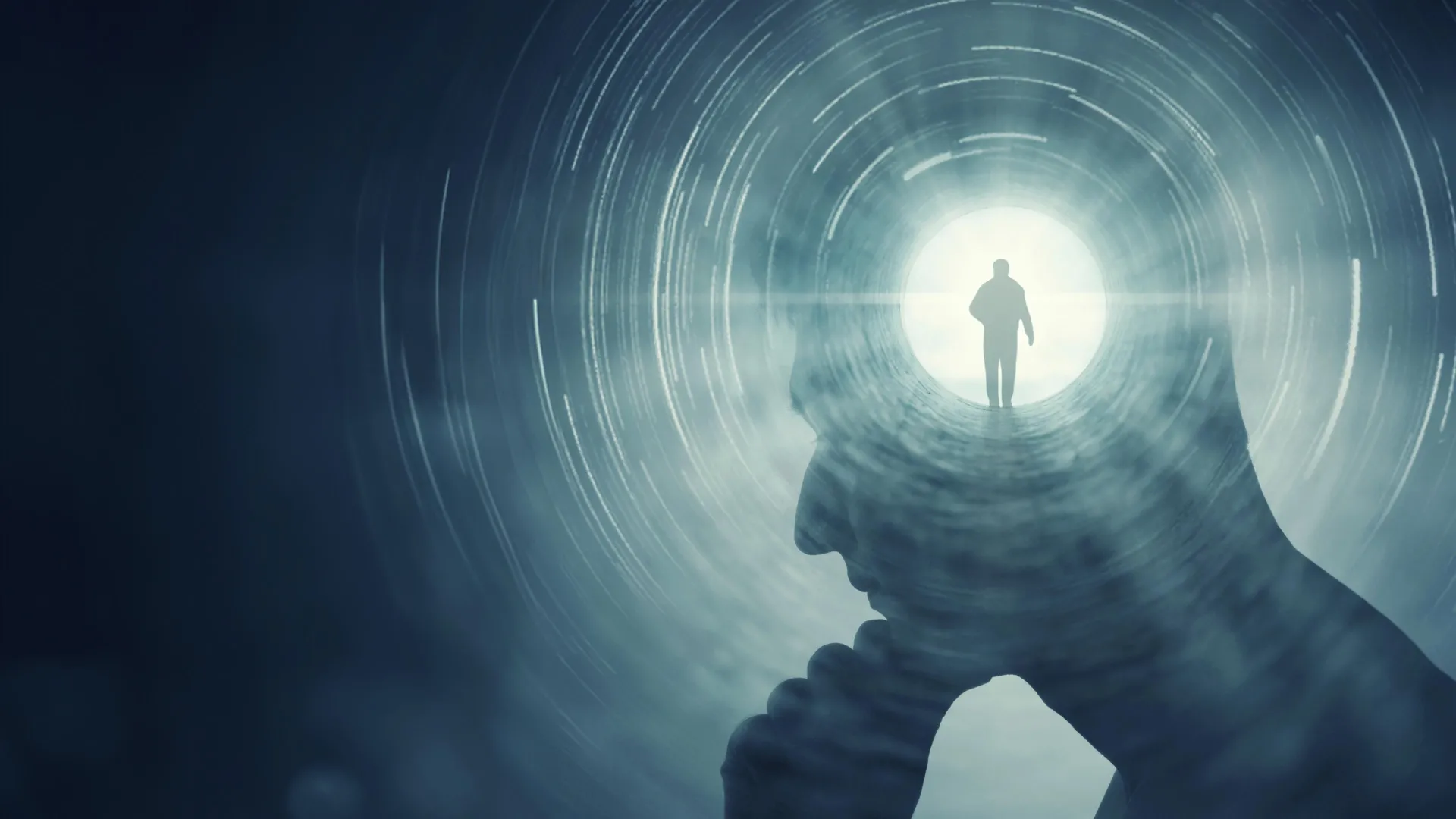
Does the brain create consciousness, or is consciousness a fundamental feature of reality? Christof Koch, one of the world’s leading neuroscientists, explored this enduring mystery at the 15th “Behind and Beyond the Brain” Symposium.
The science of consciousness involves more than understanding how neurons process information. Researchers can identify which areas of the brain become active when people see an object, feel pain, recall a memory, or make a decision. However, they still cannot fully explain why these physical processes produce a private, inner experience.
In short, neuroscience can measure what the brain does, but it has not yet explained how brain activity creates the feeling of awareness, thought, emotion, and personal identity.
The “Hard Problem” of Consciousness
Koch’s presentation examined the limits of materialism, the dominant scientific perspective that reality can ultimately be explained through matter, energy, and physical laws.
Neuroscience has made significant progress in identifying the brain regions and neural networks linked to consciousness. Yet it has not solved what philosophers call the “hard problem” of consciousness: how electrical and chemical activity in the brain produces subjective experience.
Subjective experience includes sensations, emotions, thoughts, memories, and the personal feeling of being alive. A brain scan may show which neural circuits are active when someone sees the color red, for example, but it cannot explain why seeing red feels like anything at all.
Experiences Science Still Struggles to Explain
Koch’s work focuses on several major questions surrounding consciousness. One is whether conscious experience can be completely reduced to physical processes in the brain. Another involves questions raised by modern physics about the nature of reality. A third concerns unusual human experiences that remain difficult to explain through conventional scientific models.
These experiences include near-death experiences, mystical states, and terminal lucidity. Terminal lucidity describes an unexpected return of mental clarity shortly before death, sometimes occurring in people with severe dementia or other neurological conditions that had previously prevented normal communication.
These events do not necessarily prove that consciousness exists independently of the brain. However, Koch argues that they deserve careful scientific study because they may reveal limitations in current theories of consciousness.
Is Consciousness a Fundamental Part of Reality?
Koch believes scientists may need to revisit philosophical ideas such as idealism and panpsychism while continuing to use rigorous scientific methods.
Idealism broadly proposes that consciousness or mind plays a central role in the nature of reality. Panpsychism suggests that consciousness may not be limited to humans and animals, but could instead be a fundamental property of nature that exists in different forms and degrees.
From this perspective, consciousness would not simply emerge when the brain becomes sufficiently complex. Instead, it could be an underlying feature of reality that complex brains organize into rich, unified experiences.
Integrated Information Theory Offers a Radical Possibility
Koch is a prominent supporter of Integrated Information Theory, or IIT, an approach that attempts to describe consciousness mathematically. The theory proposes that subjective experience emerges in systems capable of combining large amounts of information into a unified whole.
According to IIT, consciousness depends not only on how much information a system contains, but also on how deeply its components are interconnected. A system with a high level of integrated information could therefore possess some form of subjective experience.
This possibility has led some researchers to describe IIT as a scientific form of panpsychism because it allows for consciousness in systems beyond the human brain. The theory remains controversial and continues to be debated by neuroscientists, philosophers, and physicists.
Searching for Awareness in Unresponsive Patients
Koch is a researcher at the Allen Institute for Brain Science and previously held professorships at MIT and Caltech. He has played an important role in the modern scientific study of consciousness.
His research has contributed to new methods for detecting possible signs of awareness in patients who appear to be unresponsive. Some people who cannot move or communicate may retain conscious brain activity, making reliable detection techniques important for diagnosis, treatment, rehabilitation, and medical decision-making.
By examining the limits of materialism, the unanswered questions of neuroscience, and unusual experiences that remain difficult to classify, Koch raises a fundamental question: does the brain create consciousness, or is the brain connected to something more basic within reality?
Source: www.sciencedaily.com