


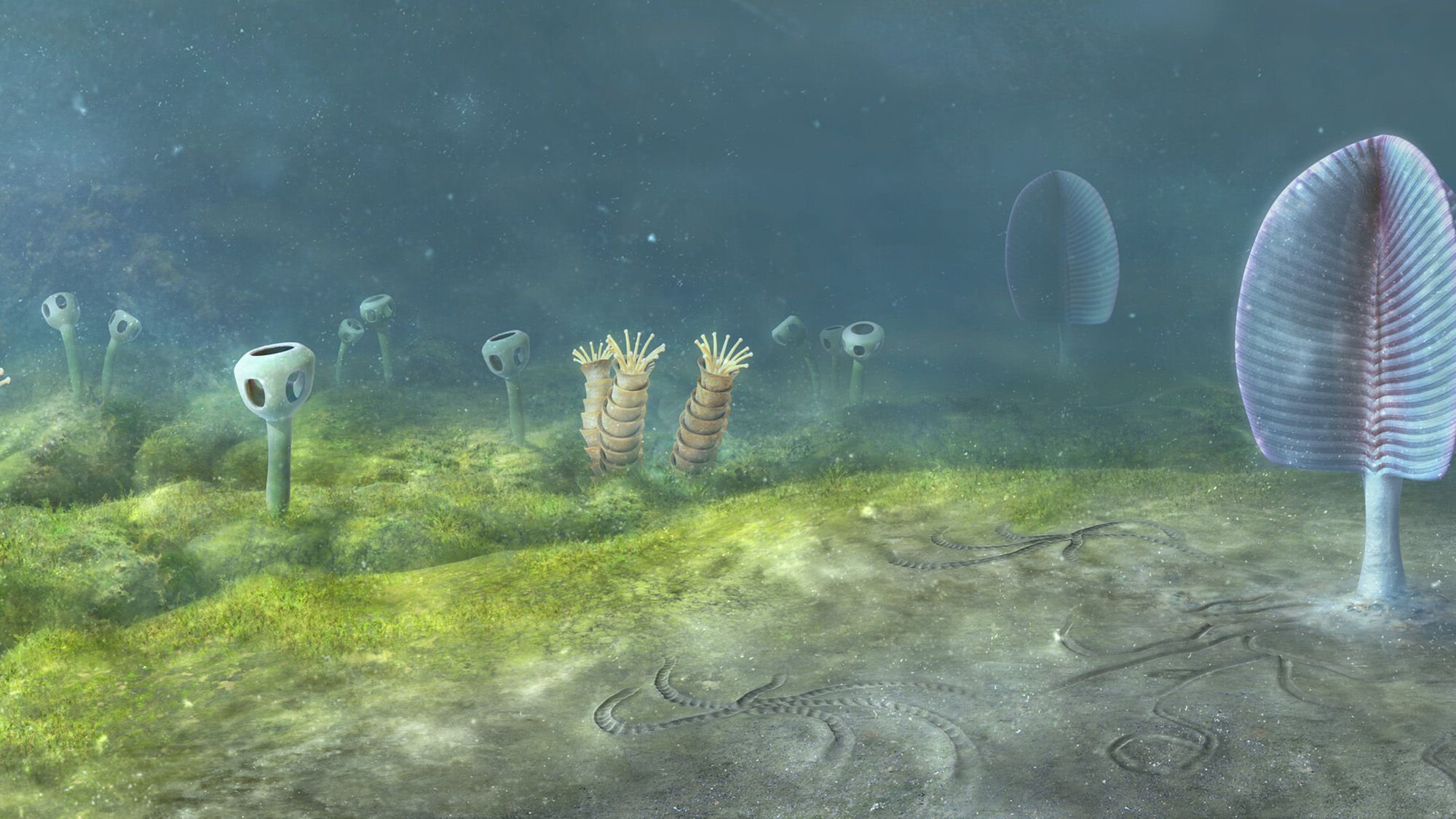
Animals May Have Evolved 200 Million Years Earlier Than Fossils Suggest
New molecular-clock research suggests the first animals may have appeared between 800 million and 700 million years ago—far earlier than the oldest confirmed animal fossils.
The first animals may have appeared on Earth hundreds of millions of years before their earliest known fossils, according to new modeling research.
Until now, the oldest undisputed fossil evidence of animals was dated to about 574 million years ago, during the Ediacaran Period, which lasted from roughly 635 million to 538 million years ago. However, researchers argue that the fossil record is too incomplete to establish the true origin of animals.
Their analysis suggests that animals may have evolved up to 200 million years earlier, during the Neoproterozoic Era. The findings were published in Science Advances.
Why haven’t scientists found older animal fossils?
The absence of animal fossils in ancient rocks does not necessarily mean animals were absent at that time. Early animals may have been difficult to identify, or the environmental conditions may not have been suitable for fossil formation.
Scientists have often relied on exceptionally well-preserved rocks from the Ediacaran Period, including the approximately 590-million-year-old Wen’an biota in China. These deposits contain remarkably preserved microorganisms but no definitive animal remains. As a result, researchers have sometimes treated them as an upper limit for when animals could have evolved.
Ross Anderson, an associate professor of natural history at the University of Oxford and a co-author of the study, said the exact “birth date” of the animal kingdom remains unknown because important parts of the fossil record may be missing.
Ancient microfossils provide a warning
To investigate whether the fossil record might be missing evidence of early animals, Anderson and his colleagues studied more than 140 samples from Mongolia’s Keseen biota.
The researchers used scanning electron microscopy to examine microscopic fossils, including small spherical organisms and embryo-like structures containing internal cells. Although the fossils were exceptionally well preserved, the team could not confidently identify them as animals.
The result is significant because animals were known to exist elsewhere on Earth by the time the Keseen biota formed. The site demonstrates that even rocks with excellent preservation can fail to reveal animal fossils.
“The Keseen biota defeats the argument that Wen’an’s exceptional microfossils mean that if animals existed at the time, their fossils would have been preserved,” Anderson said. “The Keseen microfossils are similarly well preserved, but animals are still missing even though we know they were present at that time.”
How molecular clocks estimate the origin of animals
Because the fossil record is incomplete, the researchers turned to molecular clocks, a method used to estimate when evolutionary lineages diverged.
Molecular-clock analyses compare genetic differences among living organisms and combine those differences with an estimated rate of genetic change. The greater the genetic differences, the longer ago the organisms may have shared a common ancestor.
“Molecular clocks are useful when there isn’t a particularly good fossil record for the group or time period of interest,” said Karma Nangle, an assistant professor of evolutionary paleontology at the University of California, Riverside, who was not involved in the study.
When the researchers used younger geological deposits to constrain their analysis, the estimated origin of animals was relatively recent. But when they incorporated older rock formations from Norway, Australia and Arizona—deposited between about 850 million and 730 million years ago—the estimated origin of animals moved back by roughly 200 million years.
The resulting estimate placed the origin of animals between approximately 800 million and 700 million years ago.
That estimate does not prove that animals existed 800 million years ago. No animal remains from before the Ediacaran Period have been discovered. Instead, the molecular-clock analysis indicates how far back the evolutionary history of animals may extend.
Could animals have lived before “Snowball Earth”?
Other evidence also hints that animals may have a much longer history than the fossil record currently shows. Chemical fossils, or biomarkers, have been interpreted as evidence consistent with the existence of sponges as early as 650 million years ago—tens of millions of years before the oldest known animal fossils.
If animals evolved around 800 million years ago, their emergence would overlap with the Cryogenian Period, which began about 720 million years ago. This interval included some of Earth’s most extreme glacial episodes, often referred to as “Snowball Earth.”
Scientists do not yet know whether animals survived these severe ice ages. The researchers plan to examine more Neoproterozoic rocks from different environments and preservation conditions in search of additional evidence.
“Fossils themselves are, by definition, hidden from public view,” Nangle said. “There’s an even more hidden world beyond them that has a lot of potential to tell us about the origins of animals.”
Study: Lole Durbin, Orin M. Anttila, Elie S. C. Briggs, Derek E. G. Macdonald, Francis A. Anderson and Ross P. Anderson, “Reevaluating the maximum age calibration of molecular clocks restores pre-Ediacaran animal divergence estimates,” Science Advances. doi:10.1126/sciadv.aeg6289
Source: www.livescience.com