


How Wildfires Create Pyrocumulonimbus Clouds—and Why NASA Is Studying Them
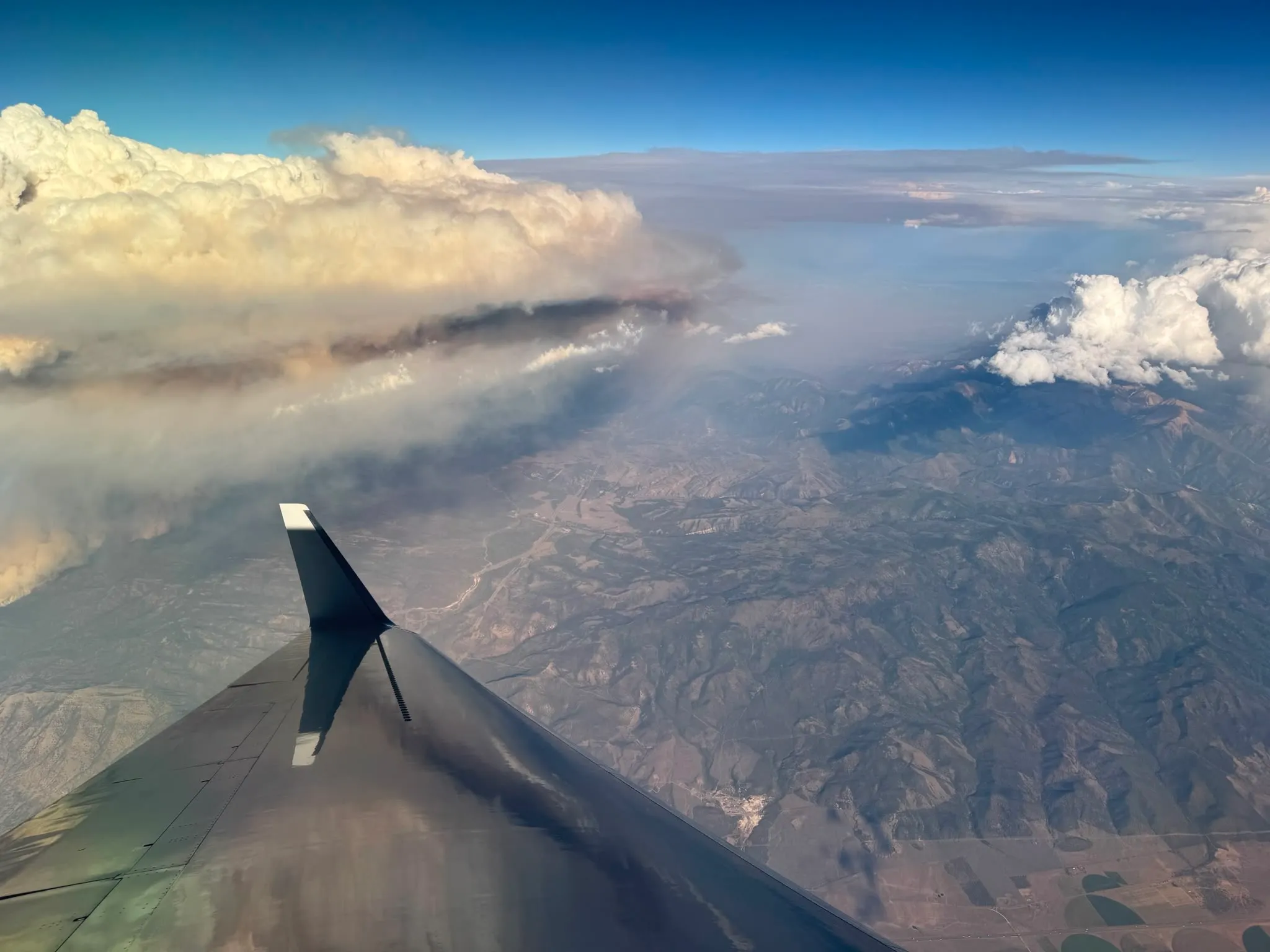
The Wildhorse Grass Fire in eastern Idaho unexpectedly exploded into a powerful plume of smoke. The wildfire also produced a rare and dangerous weather phenomenon: a pyrocumulonimbus cloud, or pyroCb.
PyroCbs are towering thunderstorm clouds generated by intense wildfires. They were the focus of NASA’s INSPYRE campaign—short for Injected Smoke and Smoke Cumulonimbus Experiment—which brought scientists together to study these clouds across western North America during the summer of 2026.
What Are Pyrocumulonimbus Clouds?
Pyrocumulonimbus clouds rise above raging fires and can produce lightning, rain, and powerful winds that spread flames across the ground. In the largest pyroCbs, smoke can rise 30,000 to 50,000 feet—about 10 to 15 kilometers—above the surface. That is as high as the cruising altitude of a commercial jet and, in some cases, high enough to enter the stratosphere.
The importance of pyroCbs became clear in the early 21st century, when satellite observations revealed wildfire smoke reaching altitudes previously associated with major volcanic eruptions. Once smoke enters the stratosphere, it can spread across continents, circle the globe, and remain in the atmosphere much longer than smoke in the lower atmosphere.
Despite their enormous size, pyroCb clouds remain poorly understood. Scientists are working to determine how wildfire smoke forms, how it interacts with the atmosphere, and how it changes as it rises. The answers could help explain how smoke affects weather and climate far from the original fire and long after the flames are extinguished.
PyroCbs can also create dangerous fire-generated winds. “We don’t yet know whether the energy of the fire, the strength of the fire, or the atmospheric conditions above are the cause,” said NASA researcher Olga Kalashnikova, a principal investigator with NASA’s Jet Propulsion Laboratory (JPL) in Southern California.
NASA’s INSPYRE Campaign Tracks Wildfire Smoke
For six weeks during the summer, INSPYRE researchers boarded a Gulfstream jet and conducted flights from their base near Boulder, Colorado, at an airport operated by the National Center for Atmospheric Research (NCAR).
The scientists collected smoke particles, sampled gases, photographed ice crystals, and measured radiation passing through the clouds and reflecting back into space. The aircraft flew above, below, and through pyroCb clouds to examine wildfire weather and smoke at close range.
NASA’s high-altitude ER-2 aircraft carried 14 instruments to measure fire intensity, updraft speed, smoke, and cloud characteristics from above. Ground crews also drove trucks equipped with sensors to observe the same events from the surface.
Researchers will use the data to study how wildfire clouds transport smoke upward, how they alter particles and gases, how much smoke reaches the stratosphere, and what happens after it gets there.
Why PyroCbs Matter to Firefighters
A better understanding of pyroCbs could help firefighters predict sudden changes in fire behavior. These clouds are a form of fire-generated weather: the fire creates its own thunderstorm, which can then produce strong and unpredictable winds.
“What’s unique about pyrocumulonimbus clouds is that they are fire-generated weather, meaning the fire creates its own weather. The fire is creating its own thunderstorm, and in the process it’s also creating wind.”
Neil Lareau, atmospheric scientist at the University of Nevada, Reno
Neil Lareau, who led INSPYRE’s ground observations, hopes the research will eventually support warnings similar to those issued for severe thunderstorms. A forecast indicating that a developing pyroCb could produce dangerous downdrafts or rapidly changing wind directions could give fire managers time to move personnel away from danger.
PyroCb Smoke Could Affect Weather and Climate
INSPYRE could also improve Earth system models. PyroCbs can carry large quantities of smoke into the stratosphere, where particles may persist for months or longer. These particles can influence how much solar energy the atmosphere absorbs and how much reaches Earth’s surface.
Dave Peterson, a meteorologist at the Naval Research Laboratory and a co-principal investigator of INSPYRE, said most numerical prediction models do not explicitly account for pyroCbs or their injection of smoke into the stratosphere.
Measurements of particles, gases, and radiation from pyroCb events will give scientists data to test and improve simulations of how wildfire smoke affects weather and climate.
The Challenge of Finding a Pyrocumulonimbus Cloud
To study wildfire smoke and clouds—and potentially observe an active pyroCb—the INSPYRE team first had to locate one. That was difficult because pyrocumulonimbus clouds can form within minutes and weaken just as quickly. Reaching a fire hundreds of miles away also requires hours of preparation, flight time, and coordination with air traffic controllers.
On August 26, the team got an unexpected opportunity. The Gulfstream was returning from a fire farther west when Sarah Woods, a scientist with NCAR, learned that the Wildhorse Fire had suddenly intensified.
The fire had initially attracted little attention. “We knew there was a grass fire going on there, but everyone was like, ‘It’s just a grass fire, we’re not going to worry about it,’” Peterson said. “And that became the main event.”
As the flight approached the Wildhorse Fire, Woods spotted the fresh remains of a pyroCb from a jump seat behind the pilot. “It just looks like a big thunderstorm, so as you approach it, look for visual indicators that there’s fire on the ground,” Woods said.
The aircraft crew saw the fire far below and confirmed that the cloud had been generated by the wildfire. At Woods’ request, the pilots circled the area and spent the next three hours flying back and forth through the cloud plume and the smoke trail drifting northwest toward Wyoming.
What Scientists Learned From the Wildhorse Fire
The chance encounter allowed the INSPYRE team to measure the pyroCb plume about an hour after the cloud first erupted. Additional flights involving the Gulfstream and ER-2 aircraft will provide observations of atmospheric flow around active fires and help document how wildfire smoke plumes change over the following days and weeks.
Data from the Gulfstream and ER-2 will be combined with satellite observations, ground-based measurements, and computer models.
“When clouds form, chemical changes occur,” Kalashnikova said. The modified smoke can affect radiation differently, making it important to understand both how pyroCbs form and what kind of smoke they release.
During the summer of 2026, the challenge was finding pyrocumulonimbus clouds and collecting measurements. Now, scientists are working to understand what those observations reveal about wildfire weather, smoke, the stratosphere, and Earth’s climate.
Source: science.nasa.gov