


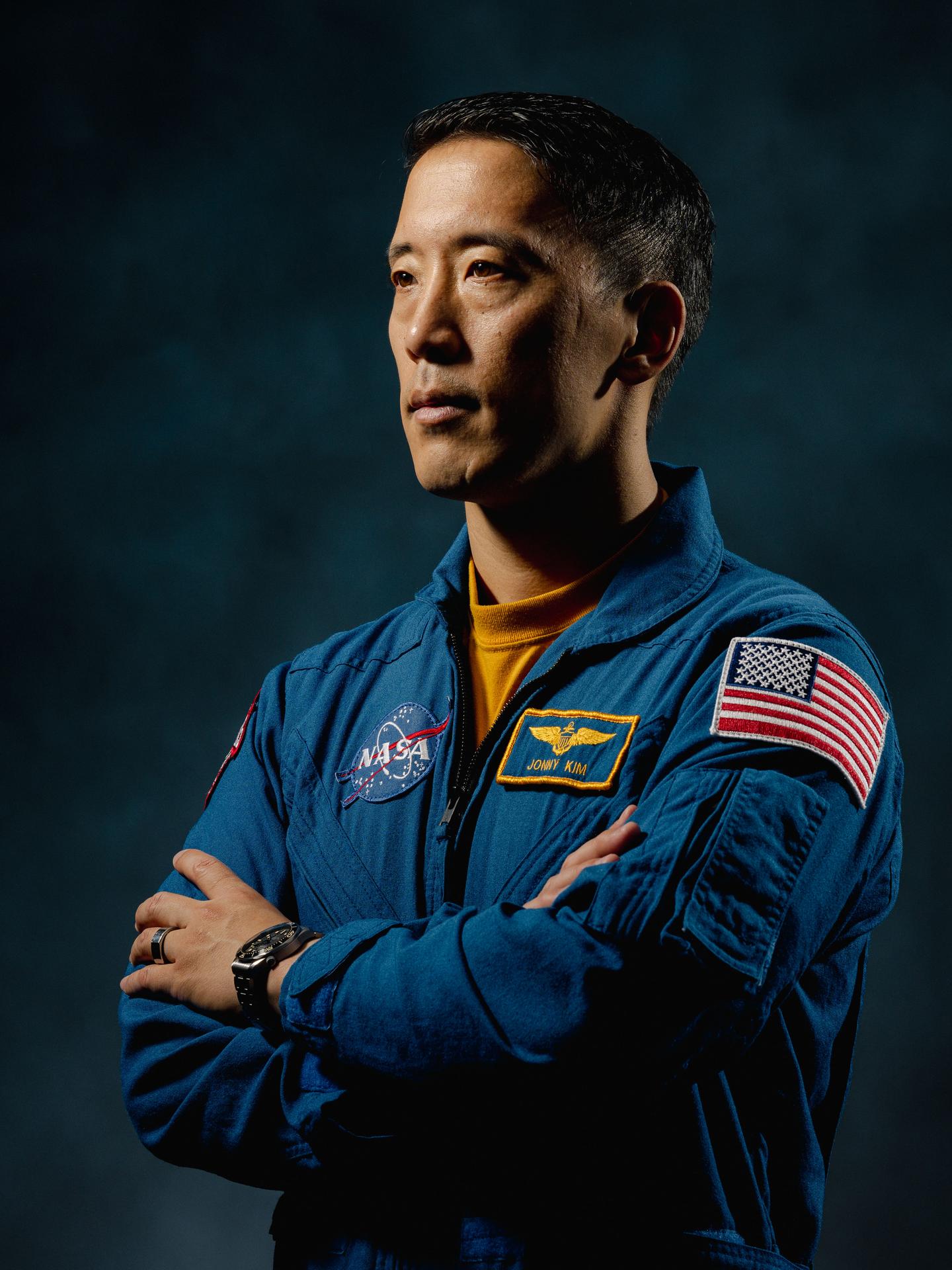
After nearly a decade of service with NASA, including an eight-month mission aboard the International Space Station (ISS), astronaut Johnny Kim will leave NASA on Thursday. He will continue serving the United States as a lieutenant commander in the U.S. Navy.
Johnny Kim launched aboard the Soyuz MS-27 spacecraft in April 2025 for an eight-month scientific mission during Expeditions 72 and 73. Working as an aeronautical engineer, he supported groundbreaking research in technology development, Earth science, biology, and human spaceflight—research that will help prepare NASA for future missions to the Moon, Mars, and beyond.
During his time in orbit, Kim completed 3,920 trips around Earth and traveled nearly 104 million miles while contributing to a wide range of International Space Station experiments and operations.
“Johnny Kim represents the very best of NASA, someone who continues to push the boundaries of exploration while inspiring countless others,” said NASA Administrator Jared Isaacman. “His contributions on the International Space Station contributed to advanced critical science that will shape NASA’s future missions for decades to come. We are grateful for his dedication to our nation and the pursuit of knowledge, and we wish him every success as he continues to serve in the U.S. Navy.”
As head of the U.S. operations segment during the second half of Expedition 73, Kim oversaw activities across the station’s entire international module. During his mission, the ISS reached the historic milestone of having every available docking port occupied for the first time in 25 years.
Kim also operated the station’s Canadarm2 robotic arm during the first capture of Northrop Grumman’s Cygnus XL spacecraft. The uncrewed cargo vehicle delivered approximately 11,000 pounds of supplies and equipment to the International Space Station. Kim and his Roscosmos crewmates returned safely to Earth, landing in Kazakhstan in December 2025.
“Johnny was an integral part of NASA, and his immeasurable impact will be felt for generations to come,” said Vanessa Wich, director of NASA’s Johnson Space Center in Houston. “From groundbreaking scientific advances to inspiring the next generation, Johnny was an incredible source of inspiration for our nation. His extraordinary talent, determination and grit will leave a lasting legacy at NASA.”
NASA selected Kim as an astronaut candidate in 2017. He completed two years of extensive training that covered International Space Station systems, the Russian language, robotics, T-38 flight operations, geology, survival skills, spacewalk preparation, and other essential astronaut duties.
Following his training, Kim supported space station missions as a Capsule Communicator, or Capcom, at NASA’s Mission Control Center at Johnson Space Center. He also helped advance NASA’s Artemis program through his work in the Astronaut Exploration Division, led the Astronaut Crew Operations Division, and served as the Incremental Leader for Expedition 65.
Kim’s background as a U.S. Navy SEAL, physician, and naval aviator gave him a distinctive perspective on astronaut training, mission operations, crew health, and space station support.
“Johnny approached every mission with humility, precision and unwavering commitment to the mission,” said Scott Tingle, director of NASA’s Johnson Astronaut Office. “His combination of medical training, operational experience, and engineering acumen has strengthened our team and contributed to advances in exploration and space station operations.”
Born in Los Angeles, Kim joined the U.S. Navy after graduating from high school in 2002. He trained as a hospital corpsman and completed underwater demolition/SEAL basic training before joining SEAL Team 3. During more than 100 combat operations, he served as a medic, sniper, navigator, and pointsman. His military decorations include the Silver Star, Bronze Star with Combat “V,” and numerous other commendations.
Kim earned a bachelor’s degree in mathematics from the University of San Diego and a medical degree from Harvard Medical School. He completed internships at Massachusetts General Hospital and Brigham and Women’s Hospital in Boston before earning dual designations as a naval aviator and flight surgeon.
He completed flight training at Naval Air Station Corpus Christi in Texas and Whiting Field in Florida, followed by aerospace medicine training at the Naval Aerospace Medical Laboratory at Naval Air Station Pensacola.
After leaving NASA, Kim plans to return to active duty and complete the remainder of his military career in naval aviation training.
“It has been the honor of a lifetime to contribute to space exploration and serve NASA,” Kim said. “Throughout my career, I have learned that beyond missions, training, and hardware, success always comes down to people. People are our greatest asset, and leading with love and empathy is how we achieve the impossible. I look forward to bringing my commitment to service, my abiding love for space and technology, and the hard-earned lessons of this past decade to my next chapter to meaningfully impact the future of humanity.”
Learn more about NASA astronauts, the International Space Station, the Artemis program, and the future of human space exploration below.
-end-
Jimi Russell
NASA Headquarters, Washington
202-358-1100
[email protected]
Anna Schneider
Johnson Space Center, Houston
281-483-5111
[email protected]
Source: www.nasa.gov