


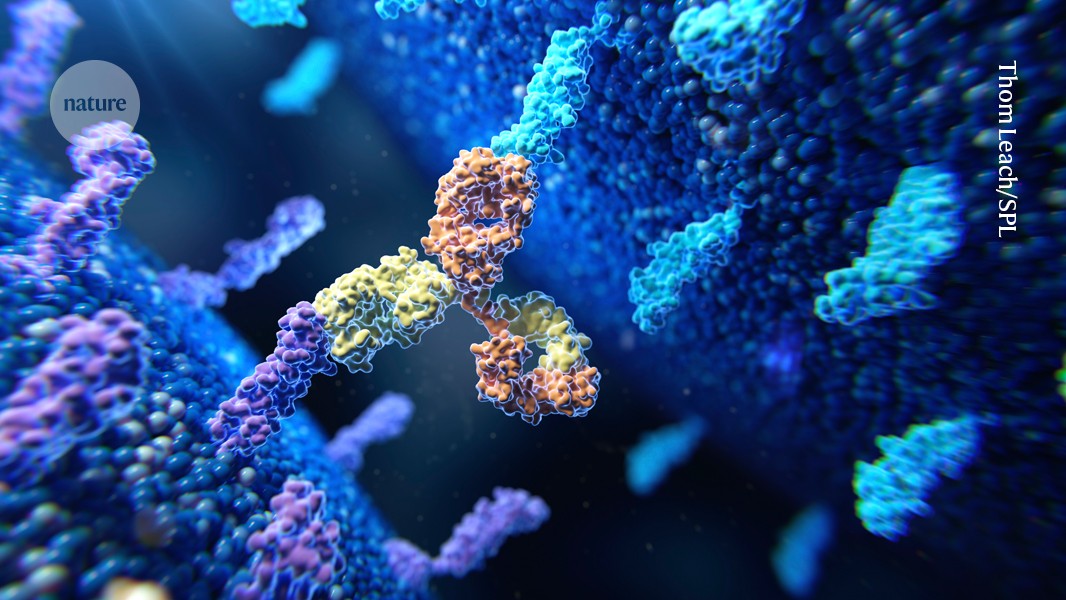
Bispecific antibodies (orange and yellow, artist’s illustration) bind to two different proteins instead of one.Credit: Thom Leach/Science Photo Library
Bispecific antibodies are emerging as a powerful class of cancer-fighting drugs. More of these targeted immunotherapies are entering clinical development, while researchers are designing increasingly sophisticated molecules with the potential to improve cancer treatment.
Over the past five years, the number of bispecific antibodies approved by regulators worldwide has increased from three to more than 20, says Christian Klein, a former drug developer at Roche in Basel, Switzerland, who is now launching a biotechnology company. These medicines generated US$18 billion in sales in 2025, he says.
Landmark cancer trial shows success against ‘undruggable’ cancer — raising hopes for future treatments
“Bispecifics have really kind of exploded,” says Paul Carter, an antibody-therapy researcher at Genentech in South San Francisco, California. “There are more flavours of bispecifics than Ben and Jerry’s ice cream.”
The success of bispecific antibody drugs, combined with advances in protein manufacturing and artificial intelligence, is accelerating the development of ‘multispecific’ antibodies that can bind to three or more targets, says Daniel Chen, co-founder and chief executive of Synthetic Design Lab in San Carlos, California. At the American Association for Cancer Research Drug Discovery and Development meeting in Boston, Massachusetts, researchers presented multispecific cancer therapies designed to reduce toxicity, strengthen anti-tumour responses and overcome cancer’s ability to develop treatment resistance.
Bispecific antibodies as medicinal multitaskers
Scientists first described bispecific antibodies more than 50 years ago, but the first bispecific antibody treatment was not approved until 2009.
One major challenge was learning how to manufacture these complex molecules reliably, says Jamie Spangler, a bioengineer at Johns Hopkins University in Baltimore, Maryland. Early production methods often created antibodies that stuck to themselves or to other antibodies. “They would all come out as aggregated balls of garbage,” Spangler says. “With better tools and resources for protein production, we can dream up these molecules and make them happen.”
Most approved bispecific antibodies target both a protein on cancer cells and immune cells known as T cells. These medicines, called ‘T-cell engagers’, bring T cells into close contact with tumour cells and activate them to destroy the cancer. At least 12 T-cell engager therapies have been approved for cancers including leukaemia and multiple myeloma.
Reducing toxicity with targeted cancer therapies
Despite this progress, bispecific antibodies can still be improved, Carter says. A deeper understanding of tumour proteins and the different cell types within tumours is helping researchers design bispecific and multispecific antibodies that trigger stronger, more precise immune responses. Scientists are also developing molecular ‘switches’ that keep a therapy inactive until it reaches the tumour.
“We’re getting to this point where we’re starting to understand biology at a completely different level,” Chen says. “For the field of multispecifics, it really comes down to being able to understand biological complexity well enough to engineer them.”

CRISPR makes enhanced cancer-fighting immune cells inside mice
Source: www.nature.com