


Simple facts
What is it: The Corona Australis Molecular Cloud, a nearby stellar nursery
Where is it: Approximately 430 light-years away in the constellation Corona Australis
When shared: July 16, 2026
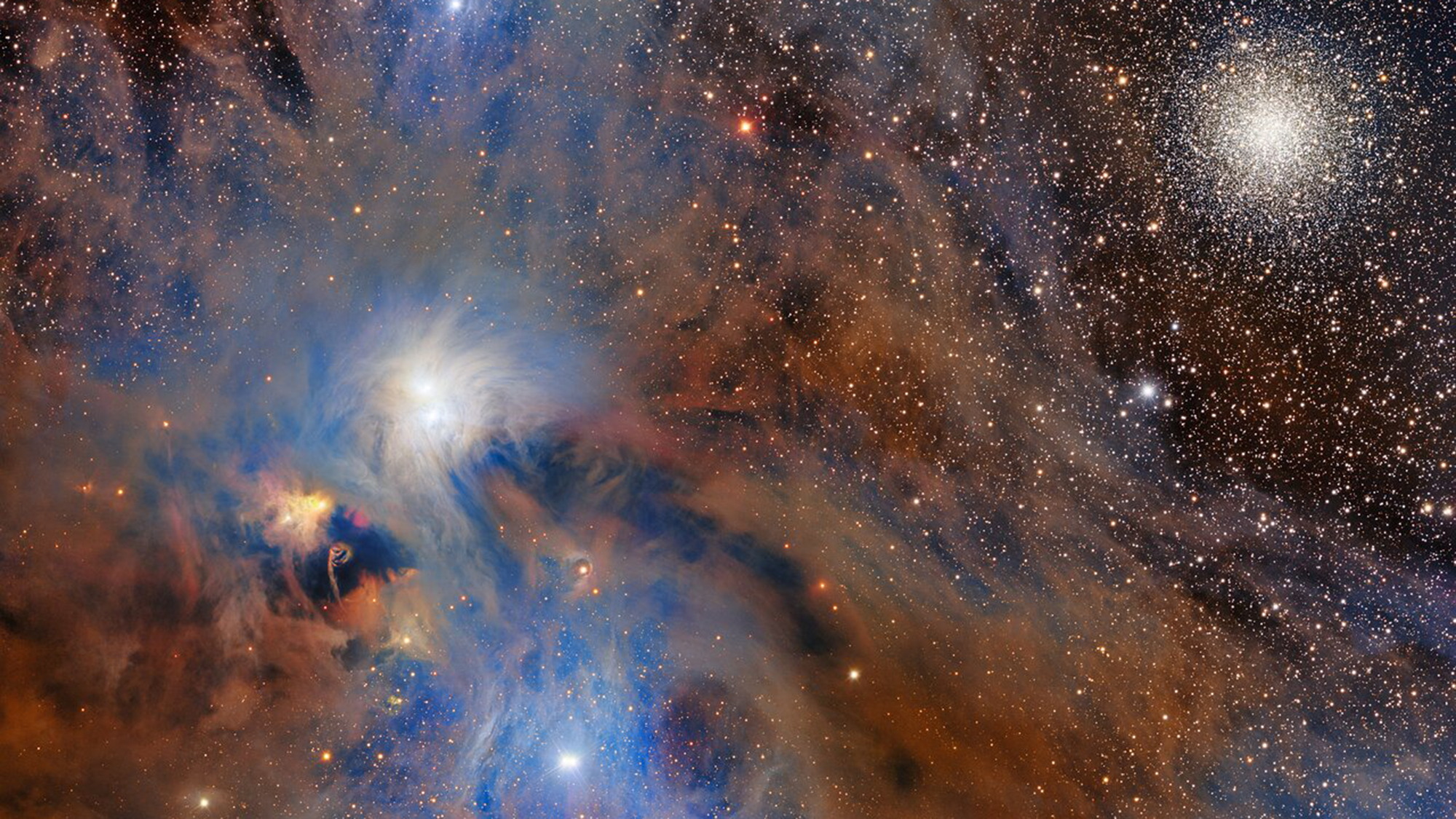
In a cosmic scene reminiscent of Vincent van Gogh’s “Starry Night”, astronomers have captured swirling nebulae, dark lanes of cosmic dust and glowing star clusters in remarkable detail.
The stunning new image, captured by the Dark Energy Camera (DECam) on the National Science Foundation’s Victor M. Blanco 4-meter Telescope in Chile, reveals the Corona Australis Molecular Cloud — one of the closest active star-forming regions to our solar system. Within this frigid cloud, temperatures fall to approximately -440 degrees Fahrenheit (-260 degrees Celsius), allowing dense pockets of gas and dust to collapse and eventually produce new stars.
The wide-field portrait brings together the active star-forming region and distant, ancient globular clusters in a single view. DECam features 74 detectors and a 3-foot (1-meter) wide lens, producing 570-million-pixel images and making it one of the world’s most powerful instruments for surveying the night sky.
Latest videos fromLive Science
On the left side of the image, the glowing nebula NGC 6729 appears embedded within the Corona Australis Molecular Cloud. Blue regions are reflection nebulae, where dust scatters and reflects starlight. Orange areas are emission nebulae, created when intense ultraviolet radiation from young stars ionizes nearby gas.
At the heart of NGC 6729 lies R Coronae Australis, a binary star system whose two stars orbit each other once every 43 to 47 years. In the upper-right portion of the image, the object resembling cosmic fireworks is NGC 6723, a globular cluster located approximately 29,000 light-years from Earth.
Also known as the Chandelier Cluster, NGC 6723 contains hundreds of thousands of stars that formed billions of years ago. Astronomers have found evidence of multiple stellar populations within the cluster, suggesting a complex evolutionary history. Together, NGC 6729 and NGC 6723 are popular targets for astronomers and astrophotographers because they offer a striking view of both young stars and ancient stellar populations.
The Corona Australis region is best observed from the Southern Hemisphere because it lies low in the southern sky, below the constellation Sagittarius. With a good backyard telescope, observers may be able to spot this remarkable region — a chaotic but beautiful cradle of star formation.
Get the world’s most fascinating discoveries delivered straight to your inbox.
Topics
Source: www.livescience.com