


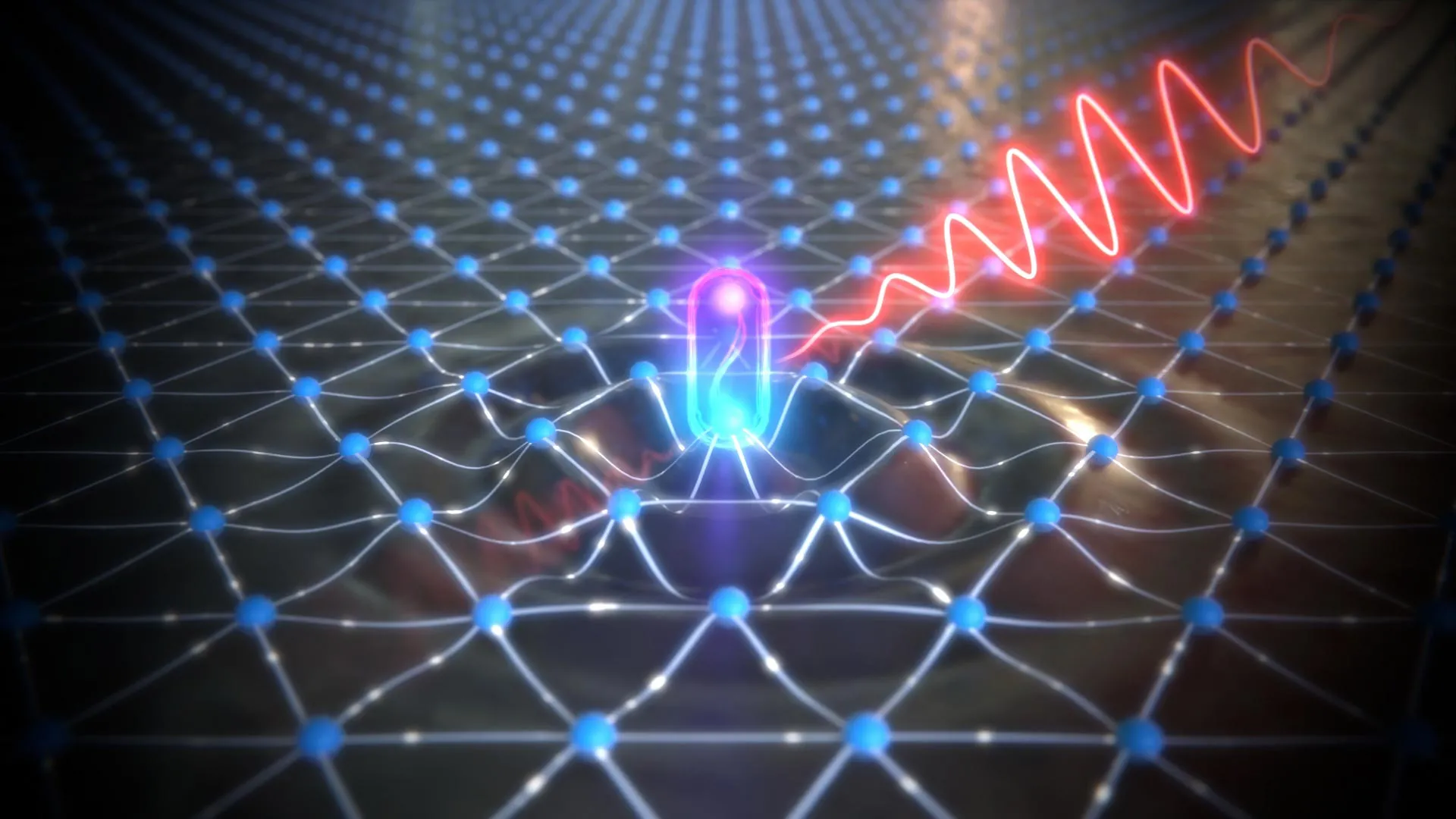
Researchers at the University of Basel and the Technical University of Munich (TUM) have developed a new optical method for studying how electrons move collectively in Wigner crystals, one of the most elusive states of quantum matter. By using light to probe this fragile electronic phase, the physicists identified previously hidden properties of these strongly correlated systems.
When electrons are confined to a two-dimensional layer and interact strongly, they can behave very differently from ordinary electrons. Instead of moving independently, they organize themselves into a repeating pattern, forming a crystal-like structure created entirely by interactions between the electrons.
This unusual state of matter is known as a Wigner crystal. Unlike conventional crystals, whose structure is determined by atoms and their chemical bonds, Wigner crystals are formed when the mutual repulsion between electrons dominates their behavior.
Scientists have observed Wigner crystals in several physical systems, but directly studying their internal dynamics remains challenging. In particular, it has been difficult to determine how electrons collectively move, interact, and respond to external disturbances.
Using light to study Wigner crystals
In a study published in Nature Physics, experimental researchers led by Professor Tomasz Smolenski of the University of Basel investigated a single atomic layer of tungsten diselenide cooled to only a few degrees above absolute zero.
The researchers illuminated the material and analyzed the reflected light with high precision. Their measurements revealed previously unseen optical features that provide information about the collective behavior of electrons inside Wigner crystals.
The signal results from interactions between the ordered electrons and excitations created in the material by light, known as excitons. Together, these components form a hybrid quasiparticle called a Wigner crystal polaron. Because these quasiparticles respond sensitively to the electronic environment, they can act as optical probes of both the crystal structure and the collective motion of its electrons.
“Our measurements show that light can not only detect the presence of this exotic state, but also reveal how it behaves internally,” says lead author Dr. Lujun Wang of the University of Basel, who conducted the experiment with Ferdinand Menzel, a PhD student in Smolenski’s group.
“This gives us a powerful new tool for studying collective excitations in electron crystals, which would otherwise be very difficult to access,” Smolenski adds.
Electron interactions create distinctive optical signals
The team also found that the strength of electron interactions directly affects the optical features observed in the experiment. This relationship could make the signal a valuable tool for investigating strongly correlated materials, in which the properties of the system emerge from interactions among many particles rather than from individual electrons acting independently.
To explain the experimental results, a theoretical team led by Professor Michael Knap of the Technical University of Munich developed a model describing how Wigner crystal polarons form. The model shows how optically generated excitons couple with the collective motion of electrons in the crystal to produce these hybrid quasiparticles.
A new way to explore strongly correlated quantum materials
“What is particularly interesting is that these signals not only convey information about how the electrons are arranged, but also about their quantum mechanics,” explains Fabian Pichler, a PhD student at TUM. “This allows us to directly link experimental observations to the underlying many-body physics.”
The findings suggest that atomically thin materials could provide an ideal platform for observing collective electron motion in ordered quantum states. By making these hidden dynamics easier to study, optical measurements of Wigner crystal polarons could help researchers better understand strongly correlated materials and the complex behavior that emerges when many quantum particles interact.
Source: www.sciencedaily.com