


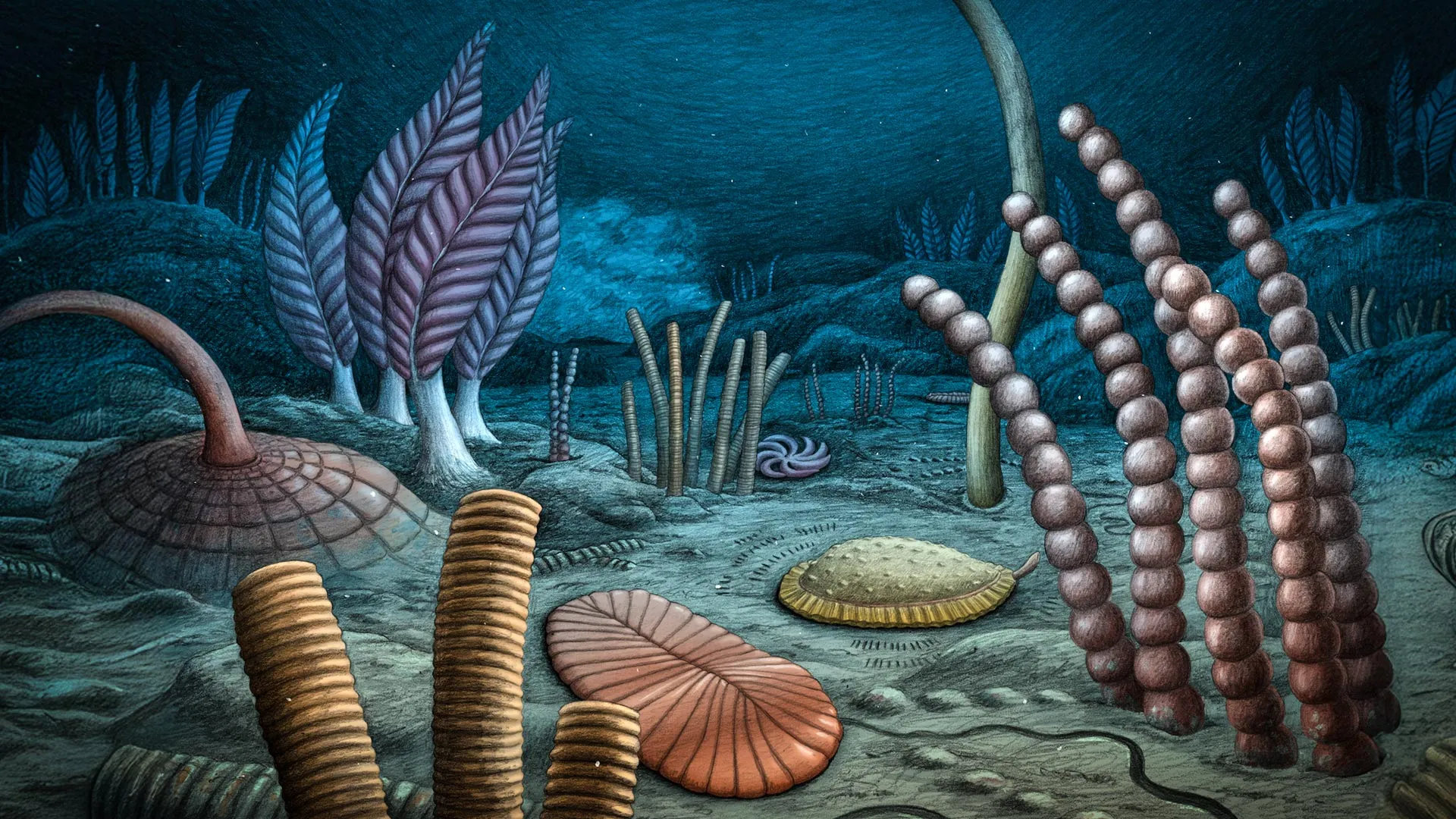
Scientists have discovered an exceptionally diverse fossil site in the remote Mackenzie Mountains of Canada’s Northwest Territories, offering new insight into the evolution of Earth’s earliest complex animals. The fossils belong to the Ediacaran biota, a group of mostly soft-bodied organisms that lived on ancient seafloors more than 500 million years ago.
Some of the fossils are approximately 567 million years old. Their age indicates that animal movement and sexual reproduction may have evolved 5–10 million years earlier than previously documented. The study, led by researchers from the American Museum of Natural History and Dartmouth, was published in Science Advances.
“For 3 billion years, life on Earth was dominated by microbes. Then, all the sudden, we get these strange-looking marine animals big enough to see and capable of behaviors we would find familiar today,” said lead author Scott Evans, assistant curator of invertebrate paleontology at the American Museum of Natural History. “If we want to understand this transition, when life first became large, complex and unmistakably animal, this new site has tremendous potential.”
A Rare Window Into Earth’s First Animals
Ediacaran organisms appeared in a wide variety of unfamiliar forms, including flat discs, leafy structures, and ribbed oval bodies. Their fossils represent the oldest direct evidence of multicellular animal life on Earth.
Some Ediacaran species have been linked to animal groups that survive today, including mollusks, nematodes, comb jellies, and cnidarians, the group that includes jellyfish and corals. Other species have no clear modern counterparts. Even so, Ediacaran fossils include the oldest known animals capable of moving in search of food and reproducing sexually.
Most Ediacaran organisms lived before animals commonly evolved shells, bones, or other hard structures. Because their bodies were soft, they rarely fossilized. Only exceptional environmental conditions could preserve them in the geological record.
Ediacaran fossils have been discovered on every continent except Antarctica, but fossil sites containing more than 10 species are extremely rare. This scarcity has limited scientists’ understanding of a critical period in Earth’s history that lasted approximately 40 million years.
A White Sea Fossil Community Discovered in North America
Scientists classify Ediacaran organisms into three major fossil communities, or assemblages, based on their position in the geologic record: the Avalon assemblage, dating from 575–559 million years ago; the White Sea assemblage, from 559–550 million years ago; and the Nama assemblage, from 550–538 million years ago.
Before this discovery, White Sea fossils had been identified in Europe, Asia, and Australia, but they had not been documented in North America. The newly discovered fossils were found in ancient rock layers within Canada’s Mackenzie Mountains.
The fossil site is located on the traditional lands of the Sahtú Dene and Métis. Members of these communities provided guidance and permission for the researchers to enter and study the area.
The discovery builds on earlier geological research in the region, but its scale and diversity represent a major scientific advance. Researchers identified more than 100 fossils, including six groups that had never previously been recorded in North America.
The fossils’ age was even more unexpected. Some specimens date to about 567 million years ago, making them 5–10 million years older than other known White Sea fossils. Their age places them within the same broad period as the older Avalon assemblage.
The fossil-bearing layers are buried beneath hundreds of feet of rock that could contain additional specimens. This suggests that the site may reveal much more about early animal evolution in the future.
“Not only is this new site highly diverse, but also it is from a part of the rock succession where we have previously lacked fossil remains,” said study co-author Justin Strauss, an associate professor of Earth and Planetary Sciences at Dartmouth, who has explored the region for approximately 15 years. “This is really exciting. Given our understanding of the regional geology in northwestern Canada, there is great potential here to revisit our understanding of Ediacaran Earth history.”
Strange Creatures From an Ancient Seafloor
Several fossils from the site represent organisms never before found in North America.
Dickinsonia was a flat-bodied animal that moved across the seafloor. It had no mouth and likely absorbed nutrients from bacteria and algae through its entire underside. Evans compared its segmented, circular body to a “bathmat” or “pancake.”
Funisia was a stationary, tube-shaped organism that lived in clusters of similarly sized individuals. It provides the oldest known fossil evidence of sexual reproduction. Like modern corals, it may have reproduced by releasing sperm and eggs into the surrounding water at the same time.
Kimberella moved using a muscular foot and scraped food from the seafloor. Scientists generally consider it an early relative of mollusks. The newly identified specimens may also establish Kimberella as the oldest known fossil bilaterian. Bilaterians are animals with distinct front and back, top and bottom, and symmetrical left and right sides; this group includes more than 99% of known animal species.
The fossil site also preserved Eoandromeda, a possible early comb jelly with eight spiral-shaped arms.
Did Early Animal Evolution Begin in Deep Water?
The fossils suggest that these early animals lived in deeper marine environments than scientists had previously associated with the White Sea assemblage.
This finding supports the growing hypothesis that the first animals may have evolved in offshore, deep-water habitats before spreading into shallower coastal environments. That evolutionary pattern is the opposite of what became more common later in animal history.
“These results suggest a pattern where evolutionary innovation begins in deeper environments and later spreads toward the coast,” Evans said. “We think of the deep ocean as a dark, inhospitable place, but it is also relatively stable, with few fluctuations in things like temperature and oxygen essential to most animal life. This stability may have provided key opportunities to support early animal life.”
The relatively stable conditions of the deep ocean may have provided a favorable environment for the earliest stages of animal diversification and evolutionary innovation.
Preserving Canada’s Ediacaran Fossil Record
The newly discovered fossils will eventually join the permanent collection at the Prince of Wales Northern Heritage Centre in Yellowknife, Northwest Territories.
Other coauthors on the study include Erik Sperling of Stanford University and Kimberly Lau of The Pennsylvania State University.
This work was supported by a NASA Exobiology grant (# 80NSSC25K7024); a U.S. National Science Foundation (NSF) grant (# EAR-20 2143164); and NSF Frontier Research in Earth Science grants (# EAR-2021324 and EAR-2021176).
Source: www.sciencedaily.com