


Super El Niño Could Bring Extreme Flooding, Drought and Coastal Erosion
Record tropical Pacific temperatures are fueling a strengthening El Niño, with major consequences expected for weather, food supplies, coastal communities and millions of children worldwide.
“Godzilla,” “wonderful” and “very strong” are among the superlatives being used to describe the El Niño phenomenon developing in the tropical Pacific Ocean.
Significant impacts are expected in many parts of the world, and recent data continues to support concerns about the event’s strength.
El Niño is strengthening in the tropical Pacific
Sea surface temperatures in the tropical Pacific Ocean reached record levels this fall, a sign that the pattern continues to intensify. In the areas typically used to measure El Niño, temperatures were 6.1 degrees Fahrenheit above normal.
The National Oceanic and Atmospheric Administration said in its latest update that there is a 90% chance of a “very strong event” occurring this fall and winter. There is also a 75% chance of a historic event larger than any El Niño recorded since 1950.
According to the metric data NOAA uses to characterize El Niño, this season’s event ranks as the second-largest abnormal situation on record. The same is true for the period from July through September, even though the calculations do not factor in the effects of global warming.
“It feels like a Super El Niño is in order,” said Abby Frazier, a climatologist and geography professor at Clark University.
More than 347 million children could face dangerous conditions
UNICEF said Tuesday that hundreds of millions of children could be exposed to dangerous conditions caused by weather patterns that bring heavy rainfall to some regions while increasing the risk of drought in others.
“With more than 347 million children living in areas where conditions are expected to be drier or wetter as a result of El Niño, we must act now to protect our communities and children,” said UNICEF Executive Director Catherine Russell. She added that El Niño is expected to increase water scarcity, malnutrition and disease incidence.
00:46
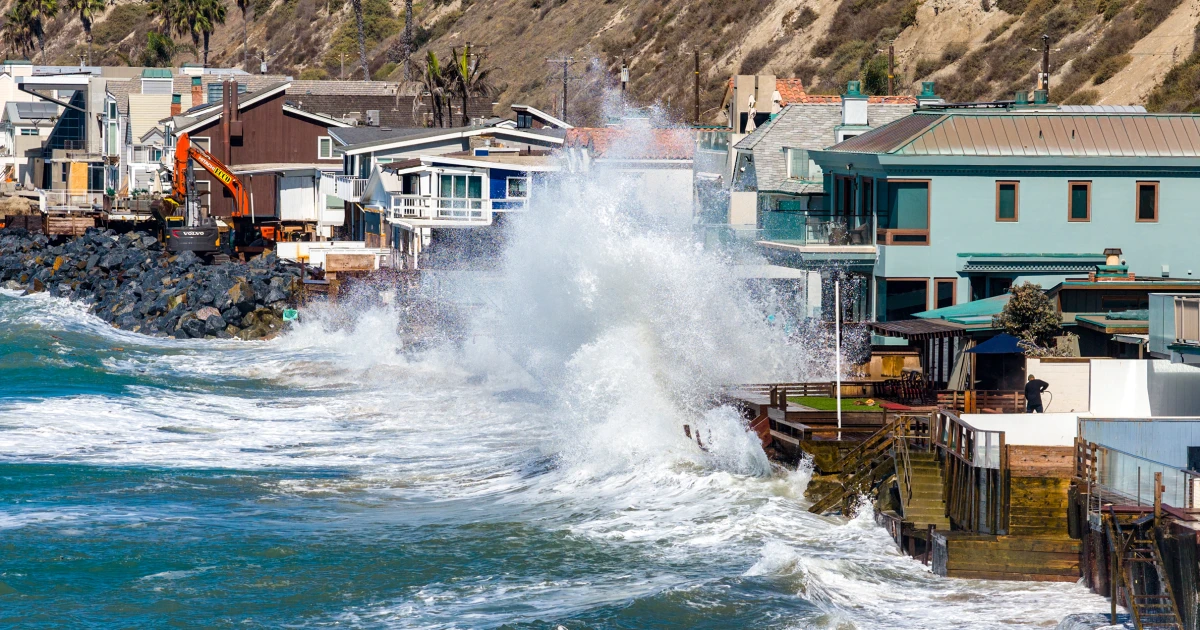
Southern California faces coastal erosion concerns
00:00
00:00
How El Niño affects global temperatures and weather
The University of Chicago’s Climate Impact Laboratory estimates that El Niño increases global average temperatures and causes 451,000 excess heat deaths worldwide.
El Niño is a natural weather pattern that occurs when equatorial winds weaken and the upwelling of cold water to the surface of the eastern Pacific Ocean stagnates. The pattern typically increases average global temperatures, causes marine heatwaves off the U.S. West Coast and slows the Atlantic hurricane season.
El Niño is also associated with heavy rainfall and storms in the Southeast, as well as warmer weather in the Pacific Northwest. Those conditions could reduce snowpack and water supplies in the region.
West Coast faces coastal erosion concerns
Scientists expect El Niño to affect the U.S. West Coast, where extreme coastal erosion is a concern. Sea levels are already rising because storms are sending strong waves toward the coast. Warmer coastal waters also occupy more area than usual.
The effects of El Niño are usually most pronounced in winter because the pattern often changes the normal flow of the jet stream, the high-altitude air current that surrounds the Northern Hemisphere and drives weather patterns.
El Niño typically pushes the jet stream southward, disrupting weather patterns across large areas.
Drought, flooding and food prices
Some areas are likely to experience drought, while others could face extreme rainfall and flooding. Frazier said now is the time to prepare for water restrictions in some areas and monitor rainfall forecasts in others.
The effects could ripple through the agricultural economy. Growing conditions for rice, coffee and chocolate can be affected by changing weather conditions.
“This could have a cascading effect through the supply chain and beyond, potentially impacting the prices we pay for some foods at the grocery store,” Frazier said.
El Niño’s effects are already visible
Signs of El Niño’s presence are becoming more obvious. While the United States has experienced a historically mild Atlantic hurricane season, warmer oceans have contributed to powerful hurricanes in the Pacific Ocean.
“This year in particular, the number of storms that formed and impacted Hawaii was truly incredible,” Frazier said.
Meanwhile, rare marine life—including whale sharks, sea snakes and nesting turtles—has been discovered off the coast of California, far north of its normally permissible water temperatures.
Earlier this summer, NASA satellites confirmed that ocean height had increased near the equator, indicating that ocean water is warming and expanding in volume.
Source: www.nbcnews.com