


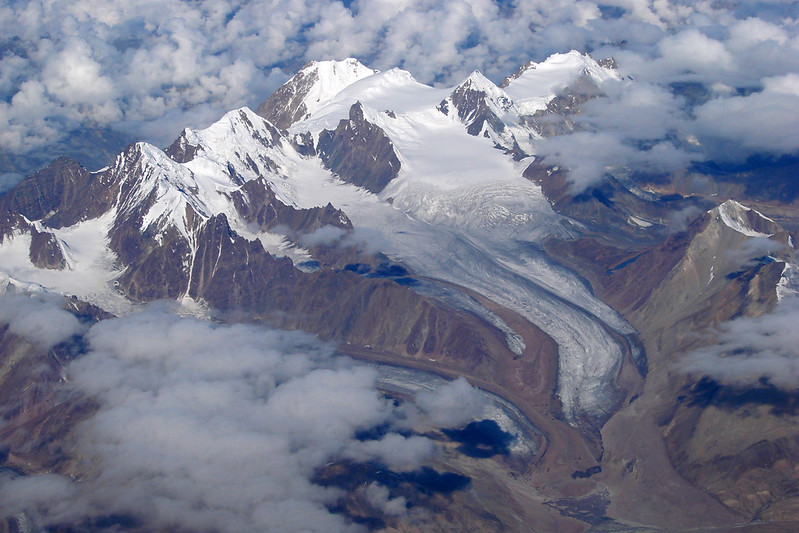
Nearly 1 billion people worldwide live near glaciers and rely on glacial water for drinking, agriculture, and other essential needs. However, rising global temperatures are making some glaciers increasingly unstable and dangerous. Nearby communities may face a series of connected hazards, including ice collapse, flooding, landslides, and debris flows. Scientists refer to these linked events as catastrophic glacier hazard chains, or CGHCs. To better understand how these hazards develop, a team of scientists in China investigated the causes and progression of a major CGHC event in the Himalayas.
The researchers examined a catastrophic glacier hazard chain that occurred in 2018 at Sedongpu Glacier in the Eastern Himalayas. During the event, ice and debris blocked approximately 30 million cubic meters of water from the Yarlung Tsangpo River, one of the region’s most important waterways. The sudden obstruction created serious risks for communities and infrastructure downstream.
To reconstruct the 2018 Sedongpu Glacier disaster, the scientists analyzed satellite images collected over several decades through remote sensing. These observations allowed them to estimate ice volume, glacier speed, and changes in glacier movement between 1961 and 2018. The data showed that Sedongpu Glacier retreated by more than the length of six football fields between 1968 and 2013. During the same period, the glacier lost ice and water volume while its flow speed increased.
The team also analyzed earthquake waves traveling through the Earth’s surface, a process known as seismic monitoring. These measurements helped the researchers identify rock and debris moving downslope as the glacier retreated. Seismic data from 11 monitoring stations located within 580 kilometers, or about 350 miles, of the glacier revealed two distinct stages of the catastrophic glacier hazard chain: an ice-rock avalanche followed by a debris flow.
During the ice-rock avalanche, scientists recorded a sharp increase in seismic activity, indicating that the event lasted for more than 30 seconds. In that brief period, more than 8 million cubic meters of ice fell onto the main glacier. Seismic activity increased even further during the debris flow, which continued for nearly five minutes. Debris from the avalanche struck the main valley glacier at an estimated speed of almost 300 kilometers, or approximately 200 miles, per hour.
By combining satellite observations and seismic measurements, the researchers reconstructed how the 2018 Sedongpu Glacier hazard unfolded. First, glacier retreat and thinning left an unstable ice mass suspended above a steep cliff. Large cracks and the steep terrain triggered an ice-rock avalanche. The falling debris accumulated on the main glacier and accelerated its movement. As the glacier traveled downslope, it collected additional rocks, soil, and ice from the floor and sides of the valley. Melting beneath the glacier further increased its speed, eventually transforming the moving mass into a debris flow that blocked the Yarlung Tsangpo River.
Overall, the catastrophic glacier hazard chain traveled more than 10 kilometers, or about 6 miles, while descending more than 3 kilometers, or roughly 2 miles, in elevation. It moved at an estimated speed of approximately 100 kilometers, or about 70 miles, per hour. The combined ice and debris volume was large enough to fill thousands of Olympic-sized swimming pools, demonstrating the potentially devastating impact of glacier-related hazards on nearby villages and infrastructure.
Although predicting the exact timing of catastrophic glacier hazard chains remains difficult, the researchers identified several warning factors. These include the size of an ice-rock avalanche, changes in glacier speed, earthquakes, temperature fluctuations, and melting beneath the glacier. Working together, these conditions can create a domino effect that accelerates glacier collapse, flooding, and debris movement. The scientists recommended continuous glacier monitoring in the Himalayas and other mountain regions as global temperatures continue to rise.
The researchers concluded that studying catastrophic glacier hazard chains can help improve glacier monitoring, hazard forecasting, and emergency planning. A better understanding of events such as the 2018 Sedongpu Glacier disaster may help protect communities in the Eastern Himalayas and other areas at risk from glacial flooding and landslides. However, additional research is needed to accurately assess how glacier retreat, climate change, earthquakes, and melting ice interact to produce these dangerous events.
Post Views: 212
Source: sciworthy.com