


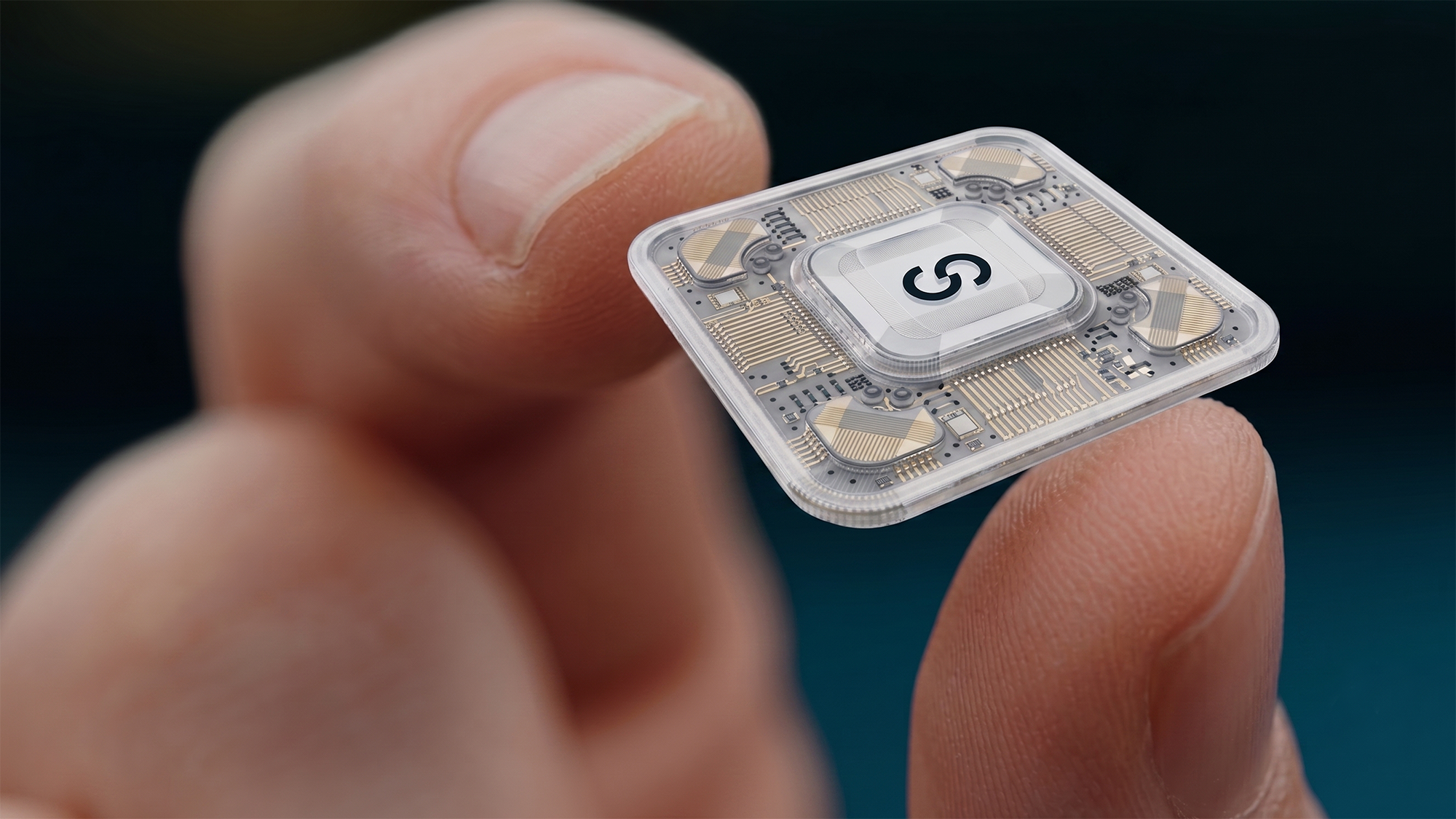
Saxon Q Unveils Diamond-Based Quantum Computer With More Than 10 Qubits
A German startup says it has developed the world’s first diamond-based quantum computer to surpass the 10-qubit milestone. Saxon Q’s system uses nitrogen-vacancy defects in synthetic diamonds to process quantum information and is designed to operate at room temperature.
The company’s technology could offer a more accessible alternative to quantum computers based on superconducting qubits, which generally require complex cryogenic cooling systems. Saxon Q says its rack-mounted quantum computers are already available with configurations of up to 128 qubits, while 512-qubit systems are expected to become available next year.
Saxon Q’s road map outlines plans to scale its diamond quantum computing platform to 10,000 qubits and beyond after 2030.
Latest Videos FromLive Science
Although nitrogen-vacancy technology has been studied for years, building a functional quantum computer with more than 10 NV qubits has proved challenging. Researchers have had to overcome difficulties involving qubit creation, control, connectivity and error correction.
Live Science reviewed a technical white paper describing Saxon Q’s approach. However, before the company’s announcement, there appeared to be little publicly available research demonstrating a working nitrogen-vacancy quantum computer with more than 10 qubits. The system’s performance compared with other quantum computing architectures has not yet been independently verified.
How nitrogen-vacancy diamonds work
Scientists discovered in the 1970s that some diamonds could emit a vivid red glow when exposed to specific types of light. Later research showed that the effect was linked to defects in the diamond’s crystal lattice, where a nitrogen atom replaces a carbon atom next to an empty space known as a vacancy.
These nitrogen-vacancy centers are rare in natural diamonds, but researchers can manufacture them in laboratories using synthetic diamond materials. The nitrogen atom becomes trapped beside the vacancy, and its electrons can be controlled independently from the surrounding carbon atoms.
Quantum computers use qubits, which can represent 0 and 1 as well as quantum states that are superpositions of both values. In an NV quantum computer, lasers place the electrons in a known starting state, while microwave pulses manipulate their spin into different quantum configurations.
Unlike conventional computer bits, qubits can also become entangled. These properties allow quantum processors to handle certain calculations in ways that conventional computers cannot efficiently reproduce.
We have a fully functioning quantum computer.
Marius Grundmann, professor of experimental physics at Leipzig University and co-founder of Saxon Q
Marius Grundmann, a professor of experimental physics at Leipzig University and co-founder of Saxon Q, said a materials breakthrough helped the company move beyond the 10-qubit barrier.
When Saxon Q creates vacancies in its lab-grown diamonds, it also implants sulfur atoms. According to Grundmann, sulfur helps shift the chemical potential so the vacancy becomes negatively charged. The sulfur provides an additional electron and increases the likelihood that the vacancy will remain attached to the nitrogen atom.
This process gives researchers greater control over the individual NV qubits. After the qubits are initialized with lasers and manipulated with microwave pulses, the system can apply quantum error-correction techniques to reduce the impact of unwanted errors.
In a statement, Saxon Q said its qubits achieved 99.92% fidelity before error correction, equivalent to fewer than one error per 1,000 operations.
Grundmann later told Live Science that updated results from July 22 showed 99.98% fidelity for single-qubit operations. That figure is comparable with some results reported by other quantum computing laboratories, including IBM and MIT. The claims have not been independently confirmed.
Room-temperature quantum computing
Comparing Saxon Q’s diamond-based quantum computers with more established systems is difficult because each platform has different strengths and limitations. Superconducting qubits are widely used in quantum computing research, while nitrogen-vacancy systems have traditionally attracted attention for quantum sensing applications.
At least one preprint study has examined hybrid systems that combine nitrogen-vacancy and superconducting technologies. However, more research is needed to determine how Saxon Q’s commercial platform compares with competing quantum architectures.
Grundmann said Saxon Q’s machines can execute quantum code through a network and support multiple users, tasks and processing cores. If the company’s performance claims hold up, its systems could become part of an emerging class of room-temperature quantum computers capable of competing with some cryogenically cooled machines.
One of the biggest advantages is the hardware’s relatively simple installation. Saxon Q says its quantum computers can be installed in a standard server rack and connected to ordinary alternating-current power, rather than requiring a specialized cryogenic facility.
This design could appeal to organizations that want direct access to quantum hardware instead of relying entirely on cloud-based services. Local quantum processing may be especially useful in edge-computing applications, including autonomous vehicles, industrial automation and robotics, where delays caused by cloud communication could affect performance.
Research comparing solid-state quantum systems suggests that superconducting quantum computers may operate faster than diamond-based NV processors. The trade-off between processing speed, cooling requirements and cloud latency remains unclear, particularly as the different technologies scale.
Scaling diamond quantum computers beyond 512 qubits
The main obstacle to scaling diamond-based NV quantum computers is the size and density of the chips. Saxon Q’s current chips support eight or 16 qubits, meaning larger systems require multiple chips or more densely packed arrays.
To build processors capable of handling practical quantum algorithms, researchers may eventually need to place hundreds or thousands of controllable qubits on a single array. Such systems could require hundreds of thousands or even millions of physical qubits once the overhead for quantum error correction is included.
Saxon Q’s planned expansion from 128 qubits to 512 qubits will provide an important test of whether diamond-based quantum computing can scale beyond laboratory demonstrations. The company’s longer-term goal of reaching 10,000 qubits after 2030 remains ambitious, but room-temperature operation could make the technology easier to deploy if its performance can be independently validated.
Can you match these ancient devices to their pictures? Find out with our computing quiz!
Source: www.livescience.com