


Astronomers, utilizing NSF’s Very Large Array (VLA), have achieved the groundbreaking feat of wireless detection of polarization and Faraday rotation in the afterglow of a gamma-ray burst (GRB), unveiling crucial insights into the magnetic fields surrounding one of the universe’s most extraordinary explosions.
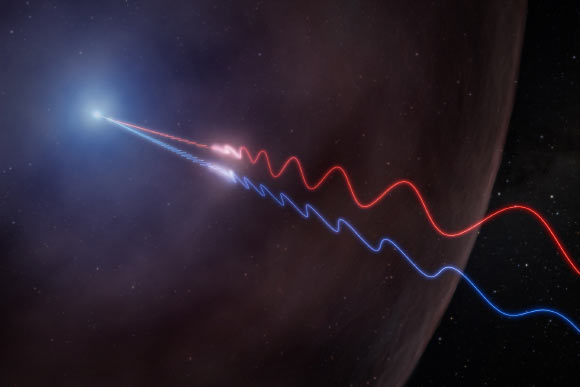
This graphic illustrates Faraday rotation occurring in the afterglow of gamma-ray burst GRB 260310A. The powerful jet (top left) emits polarized radio waves that traverse the walls of a surrounding ionized gas bubble, known as the HII region. As the light travels through this magnetized region, the polarization angle is distorted by the magnetic field. This distortion varies with different wavelengths, causing red and blue waves to exit the bubble oscillating in differing orientations. Astronomers successfully mapped the magnetic environment encircling GRB 260310A for the first time. Image credit: NSF / AUI / NRAO / M. Weiss
Gamma-ray bursts (GRBs) are the universe’s most powerful explosions, releasing energy equivalent to the entire sun’s output over its lifetime within mere seconds.
These astronomical events are believed to emit thin jets of particles accelerating close to light speed, creating radio afterglows that can persist for months.
Despite extensive research, measuring the magnetic fields that typically associate with these jets remains a significant challenge for scientists.
The gamma-ray burst in focus, GRB 260310A, is noteworthy for being relatively close to Earth by cosmic standards, with one of the brightest radio afterglows observed in decades, presenting astronomers with a unique opportunity.
When the VLA was directed at this fading explosion, astronomer Tanmoy Laskar and his colleagues from the University of Utah discovered that the emitted radio waves were polarized. This polarization signifies that the light waves oscillate in a specific direction, akin to how polarized sunglasses filter sunlight reflecting off water.
Additionally, they observed the polarized signal varying by wavelength—a phenomenon termed Faraday rotation.
This unprecedented effect in GRBs acts as a magnetic fingerprint, providing vital information on the magnetic field’s strength and structure encountered by the light.
Just as a prism separates visible light into discernible colors, a magnetized plasma can alter the polarization angle of radio waves.
The extent of rotation changes based on wavelength signifies the strength of the magnetic field through which the light travels.
“Gamma-ray bursts are the most powerful explosions in the universe, and magnetic fields play a crucial role in their dynamics, yet studying these fields has been extremely challenging,” stated Laskar.
“By detecting polarized radio emissions, we are now able to directly measure the magnetic environment surrounding one of the universe’s most violent events.”
“Our observations of this gamma-ray burst enable us to utilize space as a laboratory for testing our understanding of physics under extreme conditions.”
The VLA data indicated that the magnetic field along the light’s path is thousands of times stronger than what could be accounted for by our Milky Way galaxy and intergalactic space.
This measurement reveals a dense, magnetized cloud of gas enveloping the progenitor star of GRB 260310A.
This cloud, referred to as the HII region, is a bubble of ionized hydrogen gas shaped by intense ultraviolet radiation and stellar winds from massive young stars.
The observation that GRB 260310A exploded within such a region aligns with theories suggesting that gamma-ray bursts originate from the explosion of the most massive stars, aiding scientists in unraveling the conditions leading to these extreme phenomena.
“Previous attempts to detect polarization in GRBs utilized facilities such as the Atacama Large Millimeter/Submillimeter Array (ALMA), which operate at shorter wavelengths and needed to be conducted before the afterglow dissipates,” explained Colin Christie, a graduate student at the University of Arizona.
“Now, with the VLA, we have advanced into the centimeter band, successfully measuring Faraday rotation in a gamma-ray burst for the first time.”
“Each observation uncovers another layer of the magnetic narrative these cosmic explosions convey.”
“In future studies, monitoring GRB afterglows using the VLA and additional radio telescopes will enable scientists to observe real-time evolution of the magnetic field structure,” added Kate Denham Alexander from the University of Arizona.
“This capability has the potential to transform our understanding of how relativistic jets form, how they are energized, and how their magnetic energy is disseminated in the universe’s most extreme environments.”
Source: www.sci.news