


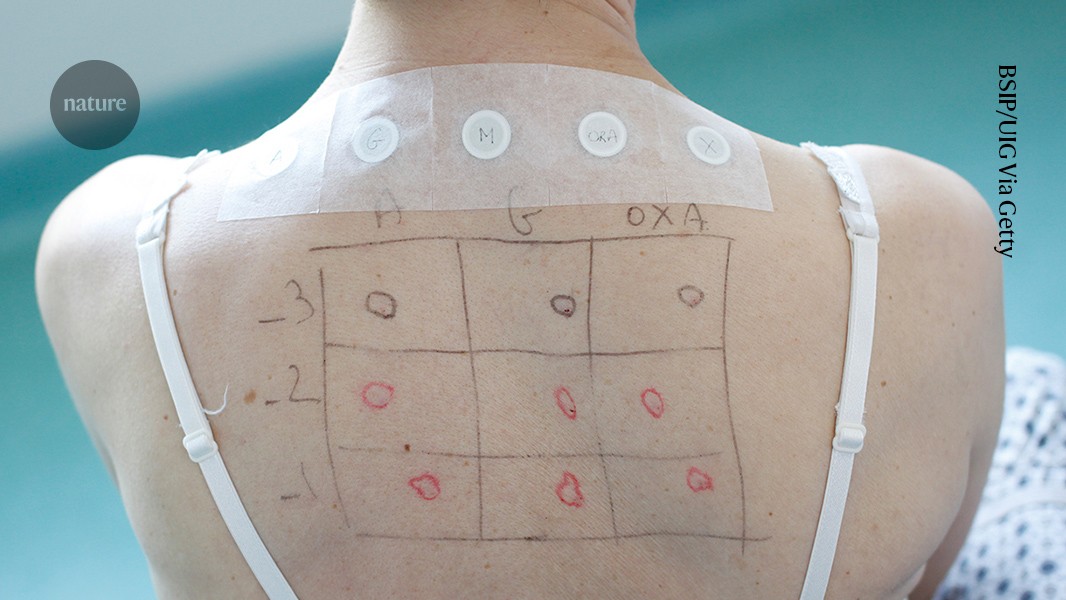
People with food allergies are advised to avoid allergens because effective treatments remain limited.Credit: BSIP/UIG Via Getty
Six people with severe peanut allergies were able to tolerate the nut after receiving a faecal microbiota transplant, according to a study published on 5 August in Science Translational Medicine.
The small clinical trial1, involving 15 participants, provides the first evidence that faecal transplants could help treat food allergies in people. The procedure transfers gut bacteria collected from healthy donors. “Up until now, it’s been in mouse models. Now we have people. And that’s exciting,” says Cathryn Nagler, an immunology researcher at the University of Chicago in Illinois.
Before treatment, participants could not consume more than 100 milligrams of peanut protein — less than half a peanut — without experiencing an allergic reaction. Four months after the transplant, one participant tolerated 300 milligrams of peanut protein, while five others tolerated at least 600 milligrams, roughly equivalent to two and a half peanuts. “Seeing any kind of efficacy in people” is remarkable, says Nagler.
Current food-allergy treatment options are limited. People with peanut allergies are generally advised to avoid the allergen and carry an adrenaline injection in case accidental exposure triggers a severe immune reaction.
Allergists say the lasting benefit observed in some participants is especially significant. “The potential of this type of therapy to have a lasting benefit is really, really exciting,” says Edwin Kim, an allergist at the University of North Carolina at Chapel Hill. Existing treatments can lose effectiveness and often require ongoing treatment or repeated exposure to maintain protection.
Early evidence linking gut bacteria and food allergies
Previous research2 has linked food allergies to reduced levels of certain gut bacteria. Studies in mice3 have also found that mixtures of several bacterial species can help control allergic reactions. These findings led researchers to investigate whether faecal transplants from people without food allergies could regulate the immune system and reduce allergic sensitivity.
For the new trial, participants swallowed odourless, tasteless capsules containing gut bacteria from healthy donors without peanut allergies. Most participants took 36 capsules in a single day, and the treatment did not cause severe side effects. Five participants also received antibiotics for four days before the faecal microbiota transplant.
The researchers suggest that the treatment may not have successfully established new bacteria in the nine participants who did not respond. Possible explanations include sex-related differences — five of the six responders were men — the delivery of the bacteria on a single day, or the fact that most non-responders did not receive antibiotics before the transplant.
The team also transferred gut bacteria from participants’ stool samples into mice. Bacteria from people who responded to the treatment protected the mice from developing an allergy to egg protein. In contrast, mice given bacteria from participants who remained highly sensitive developed egg allergies.
Because the animal experiments involved a different allergen, the researchers say faecal microbiota transplantation could potentially help treat allergies beyond peanut allergy. However, larger clinical trials are needed to confirm the safety, effectiveness and long-term benefits of the approach, says study co-author Talal Chatila, an immunologist at Harvard Medical School in Boston, Massachusetts.
Source: www.nature.com