


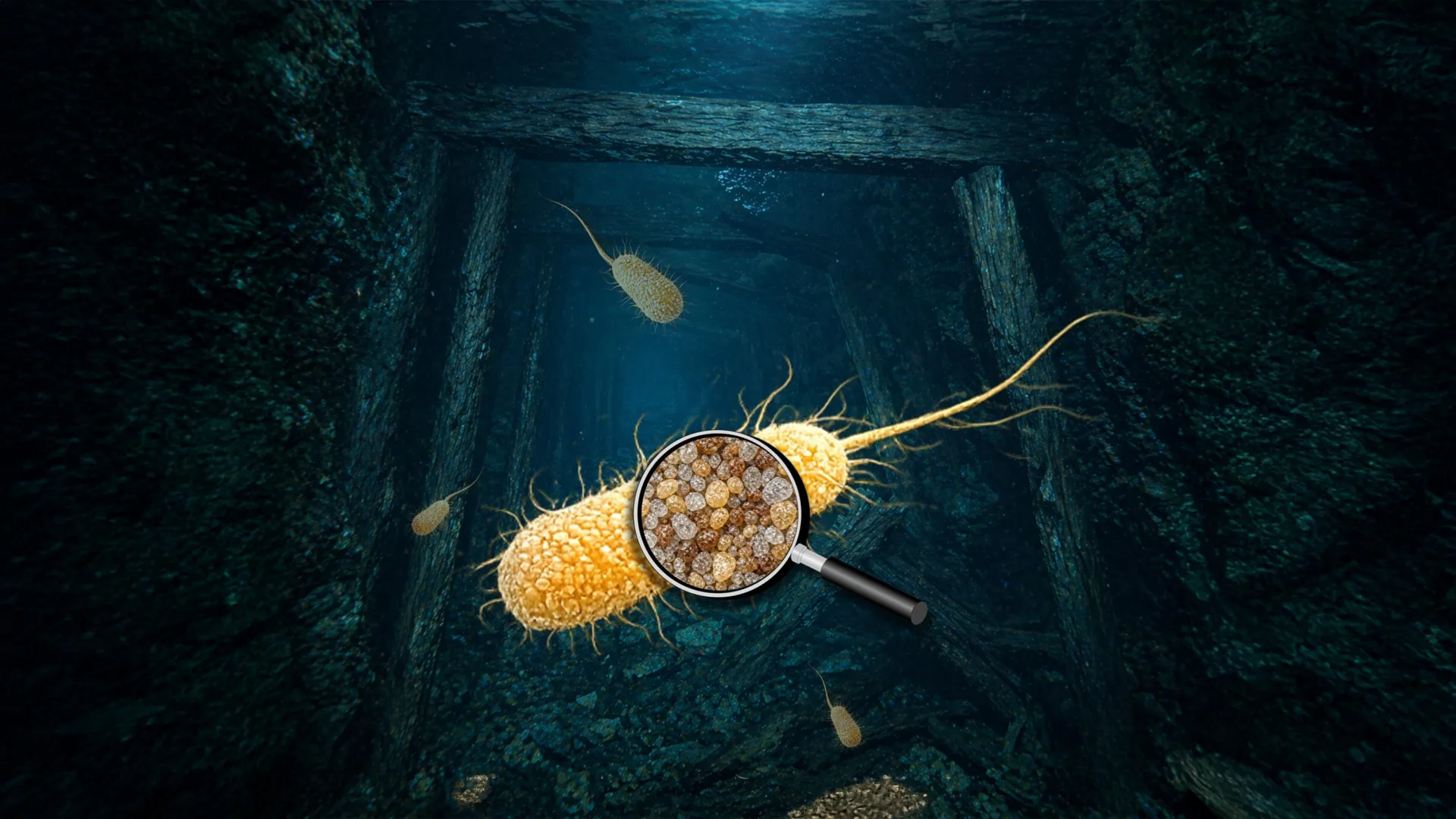
Uranium is a radioactive heavy metal usually trapped inside soil minerals. Mining, weathering, and other environmental processes can make uranium dissolve in water, allowing it to move through groundwater and surrounding ecosystems. Because dissolved uranium is toxic, its mobility can create serious environmental and health concerns.
Researchers at the Helmholtz-Zentrum Dresden-Rossendorf (HZDR), in collaboration with Wismut GmbH and the University of Granada, have shown for the first time that bacteria can transform dissolved uranium into a stable chemical compound when glycerol is available as a food source. During this bacterial process, uranium enters a chemical state previously considered rare, unstable, and short-lived.
The findings, published in Nature Communications, could support future research into bacteria-based strategies for remediating uranium-contaminated soil and groundwater.
How Bacteria Process Dissolved Uranium
Bacteria living in soil and water are vital to natural ecosystems. Some microbial species can also break down, transform, or immobilize substances that may be harmful to humans and other organisms.
“There are bacteria that can metabolically utilize the heavy metal uranium, which is toxic for humans,” says Dr. Evelyn Krawczyk-Bärsch, a scientist in HZDR’s Terrestrial Microbiology research group and co-author of the study. “Our group’s earlier investigations had already shown that bacteria can use uranium dissolved in water for their metabolism when glycerol is available as a food source.”
Glycerol is a natural component of plant and animal fats. It can also be produced naturally, including when fungi decompose wood.
The researchers set out to determine how efficiently bacteria could remove uranium from water and which uranium compounds would form during microbial processing.
Uranium Builds Up in Bacterial Cell Walls
For the experiment, the research team collected mine water from a flooded uranium mine in the Ore Mountains operated by Wismut GmbH. In the laboratory, they added a controlled amount of glycerol to the water samples and stored them under oxygen-free conditions.
“We wanted to recreate the natural conditions of the bacterial community already present in the mine water because at a depth of approximately 2,000 meters, there is usually little or no oxygen,” explains Dr. Antonio M. Newman-Portela, a former doctoral researcher at HZDR and the Microbiology Department at the University of Granada in Spain. He is also the study’s lead author.
Once conditions supported bacterial growth, the microorganisms began consuming glycerol. As the experiment continued, the concentration of uranium dissolved in the water fell sharply.
“After 130 days, only around five percent of the uranium dissolved in the water remained in the samples,” says Newman-Portela. “We suspected that the bacteria had incorporated the uranium into their cell walls, based on accumulation processes previously described in scientific literature.”
Further analysis confirmed that uranium had accumulated within the bacterial cell walls.
Researchers Detect a Rare Uranium Oxidation State
The next step was to identify the precise chemical form of the uranium produced by the bacteria. The researchers used advanced microscopy and spectroscopy to examine the microbial biomass.
The investigation included experiments at the Rossendorf Beamline (ROBL), operated by HZDR at the European Synchrotron Radiation Facility (ESRF) in Grenoble, France. Additional analyses were conducted at the University of Granada.
The scientists examined the bacterial membranes to determine the oxidation states of the uranium. In chemistry, the term “valency” describes how many chemical bonds an atom can form within a compound.
“Uranium usually occurs with a valency of 4 or 6. Pentavalent uranium does exist, but it is rare or transient. Until now, it had generally been associated with an unstable oxidation state,” explains Newman-Portela. “We were therefore surprised to find that an unusually large proportion of the uranium in the biomass from our experiments was pentavalent uranium.”
The result was unexpected because pentavalent uranium has traditionally been regarded as unstable and short-lived under environmental conditions.
A Stable Iron-Uranium Compound Forms
The researchers determined that the pentavalent uranium combined with iron and oxygen to form FeU(V)O4.
“This uranium compound does not yet have a name because it is relatively new. It was first identified in a 2020 study of soil samples from areas of Croatia contaminated by uranium ammunition,” explains Krawczyk-Bärsch. “Even after exposure to atmospheric oxygen, the compound remained stable for more than 25 years. However, until now, we did not know how it forms in nature or that bacteria could contribute to its formation.”
Additional experiments revealed another unexpected result. When the researchers exposed dried bacterial biomass to oxygen, the quantity of FeU(V)O4 increased instead of declining.
This observation suggests that the compound can remain stable in oxygen-rich conditions. It also provides further evidence that bacterial activity may help convert mobile, dissolved uranium into a less mobile form that is less likely to spread through groundwater.
Could Bacteria Help Clean Up Uranium Contamination?
“Our study has shown for the first time that bacteria supplied with glycerol as a carbon source can convert toxic, dissolved uranium into a stable chemical compound,” says Krawczyk-Bärsch. “We still need to determine how effectively bacteria could help reduce uranium mobility during environmental remediation.”
The researchers plan to examine uranium-binding bacteria in greater detail and investigate the biochemical and geochemical mechanisms behind this transformation. A better understanding of these processes could help scientists assess whether microbial remediation can be used to manage uranium-contaminated soil, mine water, and groundwater.
Source: www.sciencedaily.com