


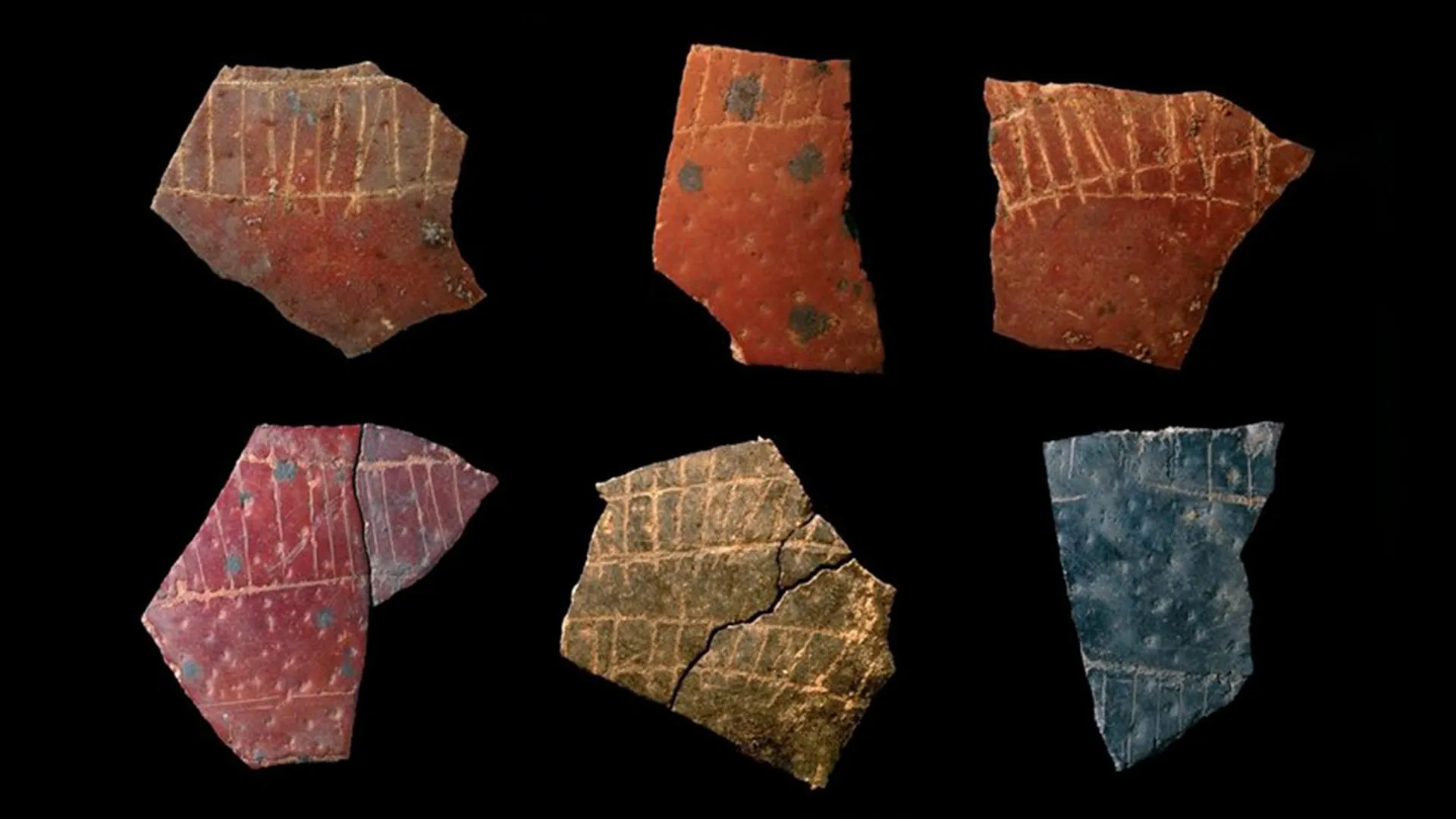
Archaeologists have discovered hundreds of engraved ostrich eggshell fragments in southern Africa, offering new evidence of early human creativity and abstract thinking. Dating back more than 60,000 years, the fragments were made by groups of Homo sapiens living in the region.
A study led by researchers at the University of Bologna suggests that these ancient engravings were not random scratches or simple decorations. Published in PLOS One, the research shows that the markings followed recurring geometric principles, including parallel lines, right angles, rotations, and carefully repeated patterns.
“These signs reveal a surprisingly structured, geometric way of thinking,” says Silvia Ferrara, Professor in the University of Bologna’s Department of Classical Philology and Italian Studies and coordinator of the study. “These people did not simply draw lines. They organized them according to recurring principles, including parallelisms, grids, rotations, and systematic repetitions—a visual grammar in embryo.”
Ancient Ostrich Eggshells Reveal Geometric Patterns
The engraved ostrich eggshells were likely used as containers for transporting or storing water. Researchers carried out a detailed quantitative analysis of 112 fragments discovered at three archaeological sites: Diepkloof and Klipdrift in South Africa, and Apollo 11 in Namibia.
Using geometric and statistical methods not previously applied to these artifacts, the team reconstructed the direction, angles, and paths of the engraved lines. This approach allowed them to identify recurring design rules across the ancient fragments.
The analysis found that more than 80% of the engravings contained consistent spatial patterns. Angles close to 90 degrees appeared repeatedly, along with groups of parallel lines. More complex motifs—including hatched bands, grids, and diamond-shaped designs—also displayed evidence of rotation, translation, repetition, and “embedding.” This process involves creating hierarchical levels of signs within the same engraved surface.
“These engravings are organized and consistent, and show mastery of geometric relationships,” Ferrara explains. “There is not only a process of repeating signs; there is genuine visual-spatial planning, as though the creators had an overall image of the design in mind before they began engraving it.”
Engraved Eggshells Offer Clues to Early Abstract Thought
The researchers say the importance of the engravings extends beyond the possible meaning of individual symbols. Their significance also lies in the cognitive abilities needed to create visual designs based on consistent and repeatable rules.
The ability to arrange lines and shapes into organized configurations may represent an important milestone in the development of abstract thought and early human cognition.
“Our analysis shows that Homo sapiens living 60,000 years ago already had a remarkable ability to organize visual space according to abstract principles,” says Valentina Decembrini, a PhD student in the University of Bologna’s Department of Classical Philology and Italian Studies and first author of the study. “Transforming simple forms into complex systems by following defined rules is a deeply human trait. It has shaped our history for millennia, from decorative art and symbolic systems to the eventual development of writing.”
Research Examines Humanity’s Earliest Geometric Designs
The study, published in PLOS One, is titled “Earliest Geometries. A Cognitive Investigation of Howiesons Poort Engraved Ostrich Eggshells.” Its authors are Valentina Decembrini, Ludovica Ottaviano, Mattia Cartolano, Enza Elena Spinapolice, and Silvia Ferrara.
The research was conducted through the FIS Advanced project SAPIENCE—Symbols, Preliteracy and Code Evolution—directed by Professor Silvia Ferrara in collaboration with Professor Enza Spinapolice of Sapienza University of Rome.
Source: www.sciencedaily.com