


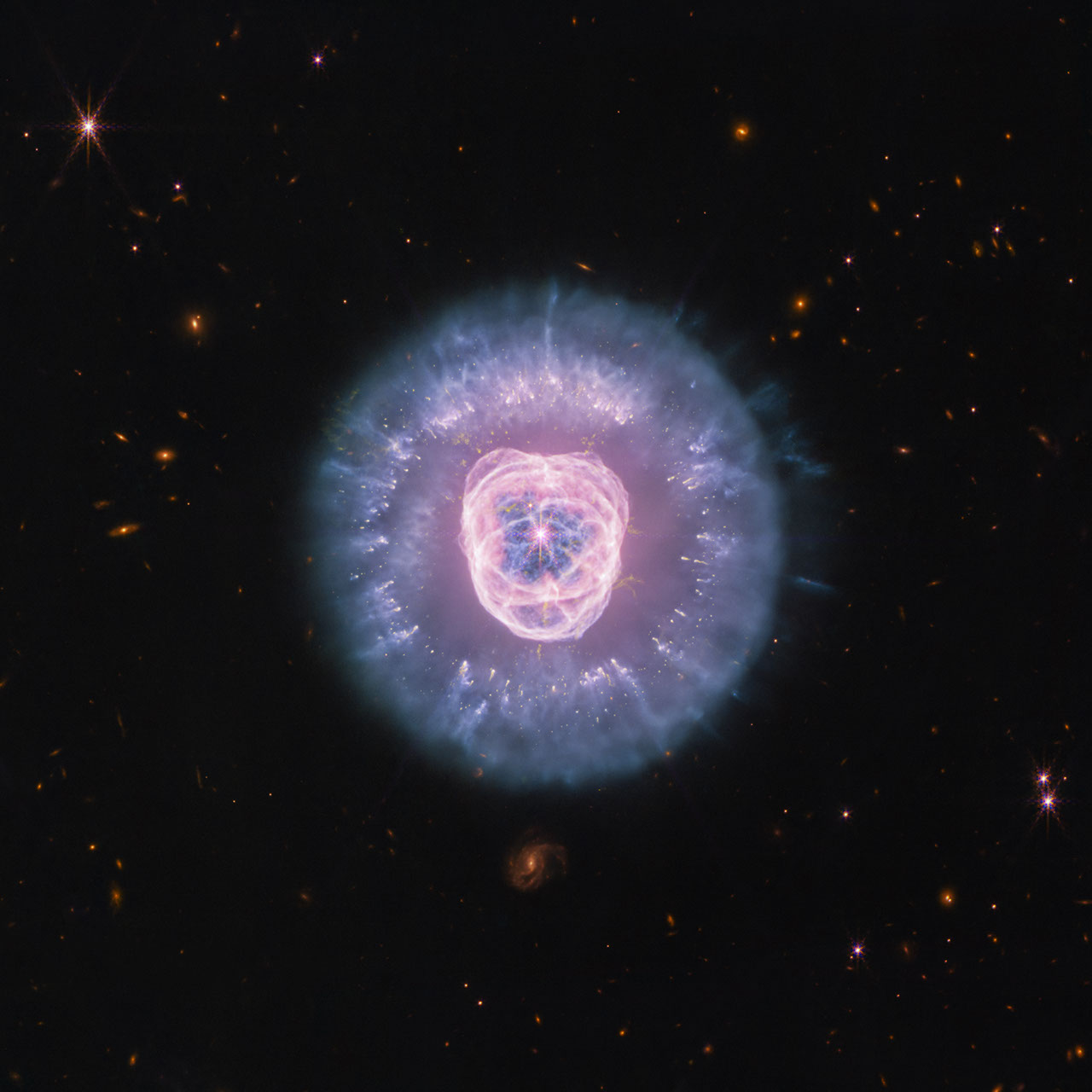
James Webb Space Telescope Reveals Stunning New Details of the Lion Nebula
NASA’s James Webb Space Telescope has captured an exceptionally detailed infrared view of NGC 2392, a planetary nebula commonly known as the Lion Nebula. Located thousands of light-years away, the colorful cosmic cloud resembles the face of a lion surrounded by a glowing mane.
NASA’s Hubble Space Telescope previously photographed NGC 2392 in visible light in 2000. Webb’s powerful infrared instruments now reveal previously hidden details, including intricate dust clumps, ionized gas, and layered shells surrounding the nebula’s dying central star.
NASA’s James Webb Space Telescope used its NIRCam and MIRI instruments to image the planetary nebula NGC 2392, also called the Lion Nebula. The central white dwarf is shaping a bubble of ionized gas and a surrounding dust shell that resembles a lion’s mane.
Image: NASA, ESA, CSA, STScI; Image Processing: Alyssa Pagan (STScI)
Webb’s Infrared View Shows Hidden Dust and Gas
Although the overall shape of NGC 2392 is similar to Hubble’s earlier visible-light image, Webb’s infrared observations expose a wealth of additional structure. The telescope’s Near Infrared Camera (NIRCam) and Mid-Infrared Instrument (MIRI) show compact dust clumps, glowing gas, and delicate layers within the nebula.
These clouds and shells formed over several thousand years as the star expelled material into space. The gas and dust continue to evolve as radiation from the star’s exposed core reshapes the planetary nebula.
A Dying Star Creates the Lion Nebula
At the center of the Lion Nebula is the remnant of a dying, oxygen-rich star. Although it appears as a small, bright point resembling the lion’s nose, this extremely hot stellar core is responsible for the nebula’s striking appearance.
Unlike massive stars, which end their lives in powerful supernova explosions, lower-mass stars such as the progenitor of NGC 2392 gradually shed their outer layers. As the star’s nuclear fuel runs out, it becomes unstable and releases shells of gas and dust. The remaining hot core becomes a white dwarf, whose intense radiation illuminates and energizes the expelled material.
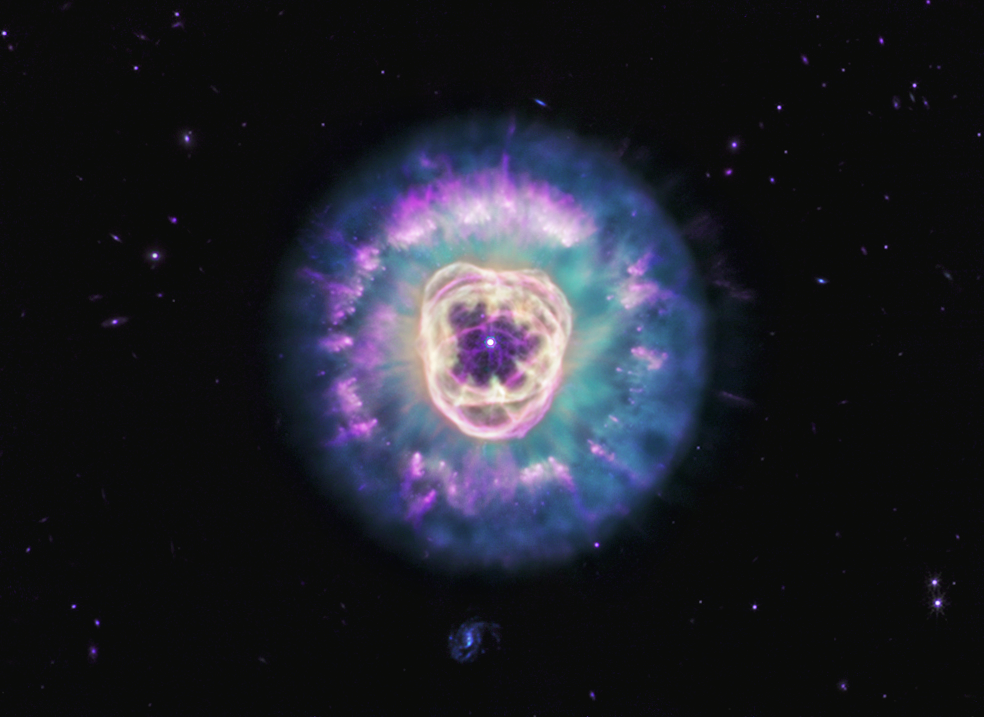
Webb’s mid-infrared image of NGC 2392 highlights the nebula’s complex dust structures. Some dust is being destroyed by radiation from the central white dwarf, while dense filaments survive and shield material behind them.
Image: NASA, ESA, CSA, STScI; Image Processing: Alyssa Pagan (STScI)
How the Lion Nebula’s Mane Formed
The lion-like face is an expanding bubble of ionized gas. As the white dwarf’s radiation moves outward, it heats and destroys dust in its path. The surrounding mane is formed by the inner part of a dust shell illuminated by the central star.
The mane’s tufted edges contain dense clumps of dust that have resisted the white dwarf’s powerful radiation. These clumps create structures that resemble cometary tails. By surviving longer than the surrounding material, they provide astronomers with important clues about how planetary nebulae develop.
The series of rings and shells surrounding NGC 2392 is common among planetary nebulae, but the precise mechanisms that create such intricate patterns remain an active area of astronomical research.
A Brief Cosmic Moment
Webb’s image captures the Lion Nebula at a single moment in its ongoing transformation. NGC 2392 will continue expanding as its gas and dust move away from the white dwarf. Astronomers estimate that the nebula will disperse in roughly 10,000 years—a brief interval on the astronomical timescale.
The James Webb Space Telescope is the world’s leading space science observatory. It studies objects within our solar system, examines planets orbiting other stars, and investigates the origins and evolution of the universe. Webb is an international mission led by NASA in partnership with the European Space Agency and the Canadian Space Agency.
To learn more about the James Webb Space Telescope and its observations of the Lion Nebula, visit:
The following sections contain links to download this article’s images and videos in available resolutions, along with related information, media contacts, research paper links, and Spanish translation resources when available.
Source: science.nasa.gov