


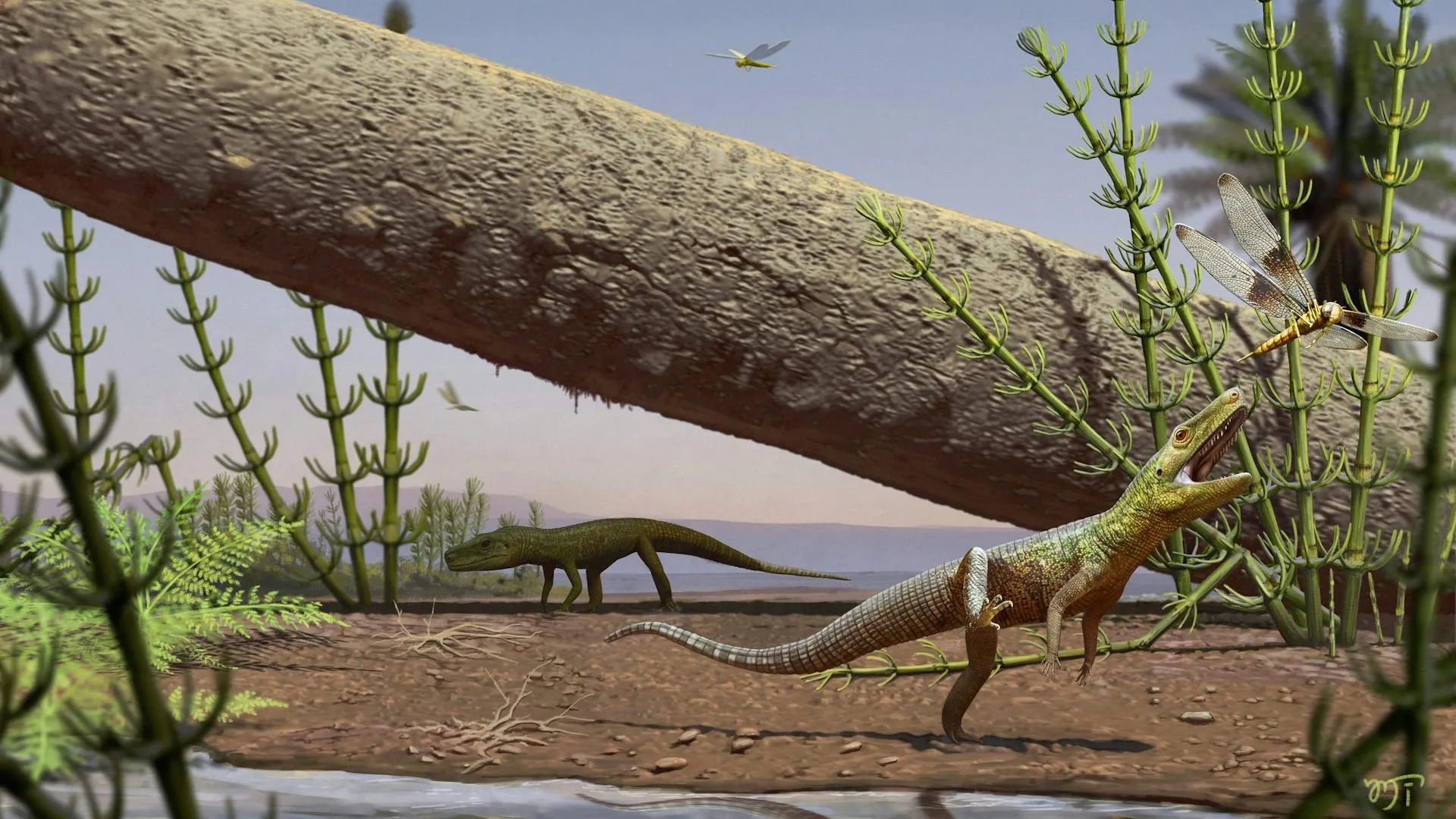
Silescelida acristata was a small archosauriform reptile that lived approximately 240 million years ago during the Middle Triassic Period. Its fossil was discovered in Dona Francisca, central Rio Grande do Sul, Brazil, in rocks belonging to the UNESCO Quarta Colônia Geopark.
The discovery provides important new evidence about the early evolution of archosauriforms, a group of reptiles that includes the ancestors and close relatives of archosaurs. Archosaurs later gave rise to two major groups of terrestrial vertebrates: crocodilians and dinosaurs, including modern birds.
The study was carried out by researchers from the Quarta Colônia Center for Paleontological Research at the Federal University of Santa Maria (CAPPA/UFSM), in partnership with scientists from the Federal University of Rio Grande do Sul (UFRGS) and the Pontifical Catholic University of Rio Grande do Sul (PUCRS). The findings were published in the scientific journal Scientific Reports.
A small Triassic reptile in a recovering ecosystem
When Silescelida acristata lived, terrestrial ecosystems were still recovering from the Permian–Triassic extinction event. Occurring around 252 million years ago, this was the most severe mass extinction in Earth’s history and eliminated a large proportion of life on the planet.
The environmental changes that followed created opportunities for new animal groups to evolve and diversify. During this period, several reptile lineages began occupying new ecological roles, including the archosauriforms that would eventually lead to crocodiles and dinosaurs.
Silescelida acristata was a relatively small, slender, four-legged animal. Its body size was comparable to that of a small alligator. Although it was neither a dinosaur nor a crocodile, it belonged to a lineage closely related to the reptiles that preceded the origin of both groups.
Its diet probably included small animals, indicating that it likely acted as a small predator in the Triassic ecosystems of southern Brazil.
Why is the Silescelida acristata fossil important?
The fossil primarily preserves portions of the limbs. Although fragmentary remains may appear less informative than complete skeletons, limb bones can reveal valuable details about an animal’s movement, anatomy, and evolutionary relationships.
One of the most important features of Silescelida acristata is its femur, or thigh bone. Like some closely related archosauriforms, the animal appears to have held its legs in a more semi-erect position, beneath the body rather than extending them fully to the sides.
This posture may have supported more efficient locomotion by reducing resistance as the animal moved across the ground. These anatomical changes were part of a broader evolutionary transition that later became important in the success of archosaurs.
The fossil therefore offers a glimpse into an evolutionary stage that preceded the rise of dinosaurs and crocodiles. During this period, their close relatives were experimenting with different body shapes, leg positions, and methods of movement.
A rare evolutionary relationship
Phylogenetic analyses suggest that Silescelida acristata may be related to the Euparkeriidae, a rare and poorly understood group of Triassic archosauriforms.
Before this discovery, fossils linked to the group were known mainly from Africa, Asia, and Europe. The identification of a possible euparkeriid relative in South America significantly expands the known geographic range of these early reptiles.
The finding suggests that these animals may have been more widely distributed across the Triassic world than the fossil record previously indicated. It also highlights the importance of South American fossil sites for understanding the origin and early diversification of major terrestrial vertebrate groups.
The rediscovery of a forgotten fossil
The history of Silescelida acristata is unusual. Part of the fossil, including material essential for confirming its geological origin, was accidentally lost for more than 20 years.
Researchers finally located the missing fragment in 2022 during a technical visit to the scientific collection at the Pontifical Catholic University of Rio Grande do Sul (PUCRS). Recovering this piece allowed scientists to confirm the specimen’s provenance and formally describe it as a new species.
The species name reflects this unusual history. Silescelida combines terms associated with “silence” and “leg.” The reference to “silence” describes the long period during which part of the fossil remained forgotten, while “leg” refers to the limb bones preserved in the specimen.
The second part of the name, acristata, means “without a crest.” It refers to the absence of a raised bony structure, or trochanter, on the femur. This structure served as an attachment site for part of the tail musculature in many related reptiles. Its absence helps distinguish Silescelida acristata from nearly all of its close relatives.
What does this Brazilian fossil discovery reveal?
The presence of Silescelida acristata in Middle Triassic rocks from Brazil shows that the evolutionary history of archosauriforms was more diverse and geographically complex than previously recognized. The fossil indicates that reptiles closely related to the Euparkeriidae also lived in South America.
The discovery further reinforces Rio Grande do Sul’s reputation as one of the world’s most important regions for studying Triassic fauna. The region’s rocks preserve fossils from several stages in the evolution of terrestrial vertebrates, including some of the oldest known dinosaurs and large predators that lived before the Age of Dinosaurs.
Each new fossil from this region helps scientists reconstruct how terrestrial ecosystems changed after the Permian–Triassic extinction and how the reptile groups that later dominated the continents began to emerge.
How small bones can reveal major evolutionary changes
Fragmentary fossils are often considered less valuable than nearly complete skeletons. However, most fossils recovered during excavations are incomplete. The discovery of Silescelida acristata demonstrates how even isolated bones can provide essential information about prehistoric life and evolution.
In this case, the limb bones were sufficient to identify a new species, reconstruct aspects of its locomotion, examine its phylogenetic relationships, and expand the known distribution of a rare group of Triassic reptiles.
Beyond describing a new animal, the study demonstrates how Brazilian paleontology continues to illuminate important chapters in the history of life on Earth. In the rocks of inland Rio Grande do Sul, fossils that are approximately 240 million years old continue to reveal clues about the origins of the animal groups that would later transform terrestrial ecosystems forever.
Source: www.sciencedaily.com