


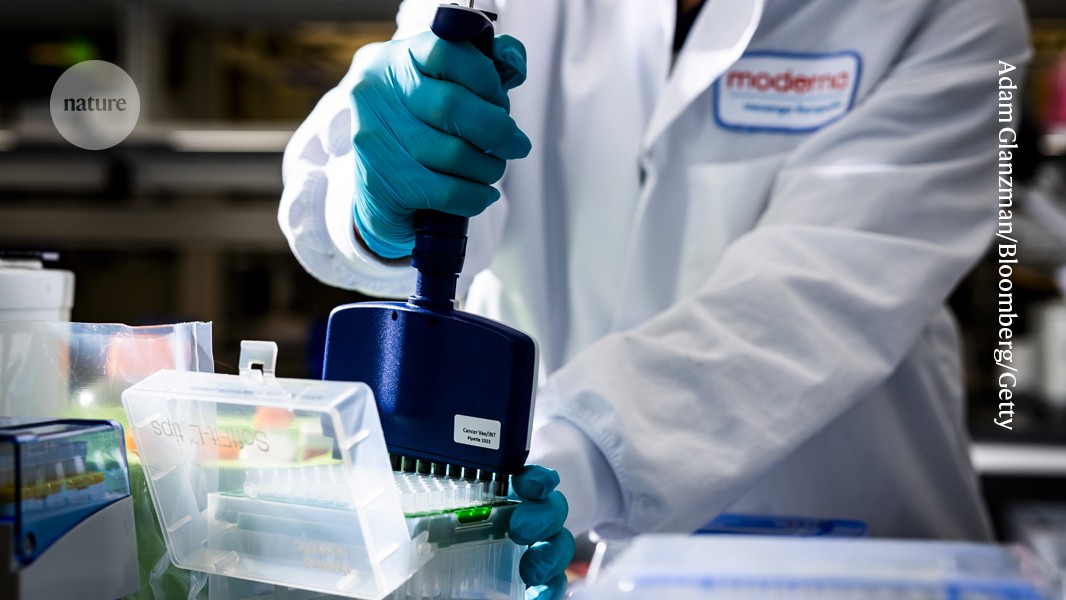
Personalized cancer vaccines developed by Moderna and Merck reduced the risk of melanoma recurrence.Credit: Adam Glanzman/Bloomberg/Getty
A personalized mRNA vaccine for melanoma reduced the risk of cancer recurrence in a Phase III clinical trial, according to the companies behind the study. The vaccine uses the same messenger RNA technology that powered COVID-19 vaccines and is among the first personalized mRNA cancer treatments to show positive results in a late-stage clinical trial.
The findings could represent an important advance for personalized cancer immunotherapy. “It’s incredibly exciting,” says Seth Cheatham, an mRNA scientist at the University of Queensland in Brisbane, Australia. He described the study as the first large-scale trial of a personalized mRNA cancer vaccine and said the results could help move the technology closer to regulatory approval.
Researchers say the results provide proof of principle that vaccines designed around an individual patient’s tumor can help prevent cancer from returning. Because the approach targets mutations unique to cancer cells, it could eventually be adapted for several types of cancer, says Gerlinger, principal investigator on a cancer vaccine trial being developed by BioNTech in Mainz, Germany.
The implications could extend beyond oncology, says Sam Burrell, chief executive of London-based medical research charity LifeArc. Demonstrating that treatments can be tailored to an individual’s genetic mutations could increase confidence in personalized approaches for rare diseases and other conditions caused by unique genetic changes.
How does the personalized melanoma vaccine work?
The vaccine, called Intismeran, is not designed to prevent cancer from developing in healthy people. Instead, it is intended to reduce the risk of melanoma returning after a tumor has been surgically removed.
The Phase III study enrolled approximately 1,100 people with advanced melanoma whose tumors had been completely removed through surgery. Participants received either the personalized vaccine combined with pembrolizumab, an immunotherapy drug used to treat cancer, or pembrolizumab alone. Merck & Co. of Rahway, New Jersey, and Moderna of Cambridge, Massachusetts, announced that patients who received the combination remained free of recurrence for longer than those treated with pembrolizumab alone. The companies plan to present more detailed results at an upcoming medical conference.
To produce Intismeran, researchers sequence a sample of the patient’s tumor to identify mutations found in the cancer cells. These mutations can cause tumors to produce abnormal proteins called neoantigens. Because neoantigens are not normally found in healthy tissue, they can act as molecular flags that help the immune system distinguish cancer cells from normal cells.
The personalized mRNA vaccine is designed around each patient’s neoantigens. After it is injected, the mRNA instructs the body to produce these tumor-specific targets, helping train immune cells to recognize and attack cancer cells if they return. “Until now, it has not been possible to train individual patients to fight their own tumors,” says Adnan Khattak, a medical oncologist and trial investigator at Hollywood Private Hospital in Nedlands, Australia.
Personalized cancer treatment has traditionally involved matching known abnormalities in a tumor with existing medicines. For example, drugs that target BRAF mutations can be used in people whose melanomas carry these genetic changes. The mRNA vaccine approach is different: it creates a new treatment tailored to the mutations and neoantigens found in each patient’s tumor.
Although the trial results indicate that Intismeran reduced the risk of melanoma recurrence, participants will need to be monitored for many years to determine whether the vaccine also improves overall survival.
What are the challenges of producing a personalized cancer vaccine?
The individualized nature of the treatment is one of the main challenges to making personalized mRNA cancer vaccines widely available, Cheatham says. After a tumor sample is collected, researchers must sequence it, identify suitable neoantigens and manufacture a vaccine for that specific patient. The process can take several months, which may be too long for some people with rapidly progressing cancer.
Moderna is using artificial intelligence to help predict which neoantigens are most likely to trigger a strong immune response. Researchers then test the most promising targets and use a selected group of neoantigens in the final personalized vaccine. Faster manufacturing, improved prediction tools and long-term clinical data will be essential before this approach can become a routine treatment for melanoma and other cancers.
Source: www.nature.com