


Ol Doinyo Lengai: Tanzania’s Active “Mountain of God” and Its Rare Black Lava
QUICK FACTS
Where is it? Ol Doinyo Lengai, Tanzania [-2.7734503796, 35.91519798]
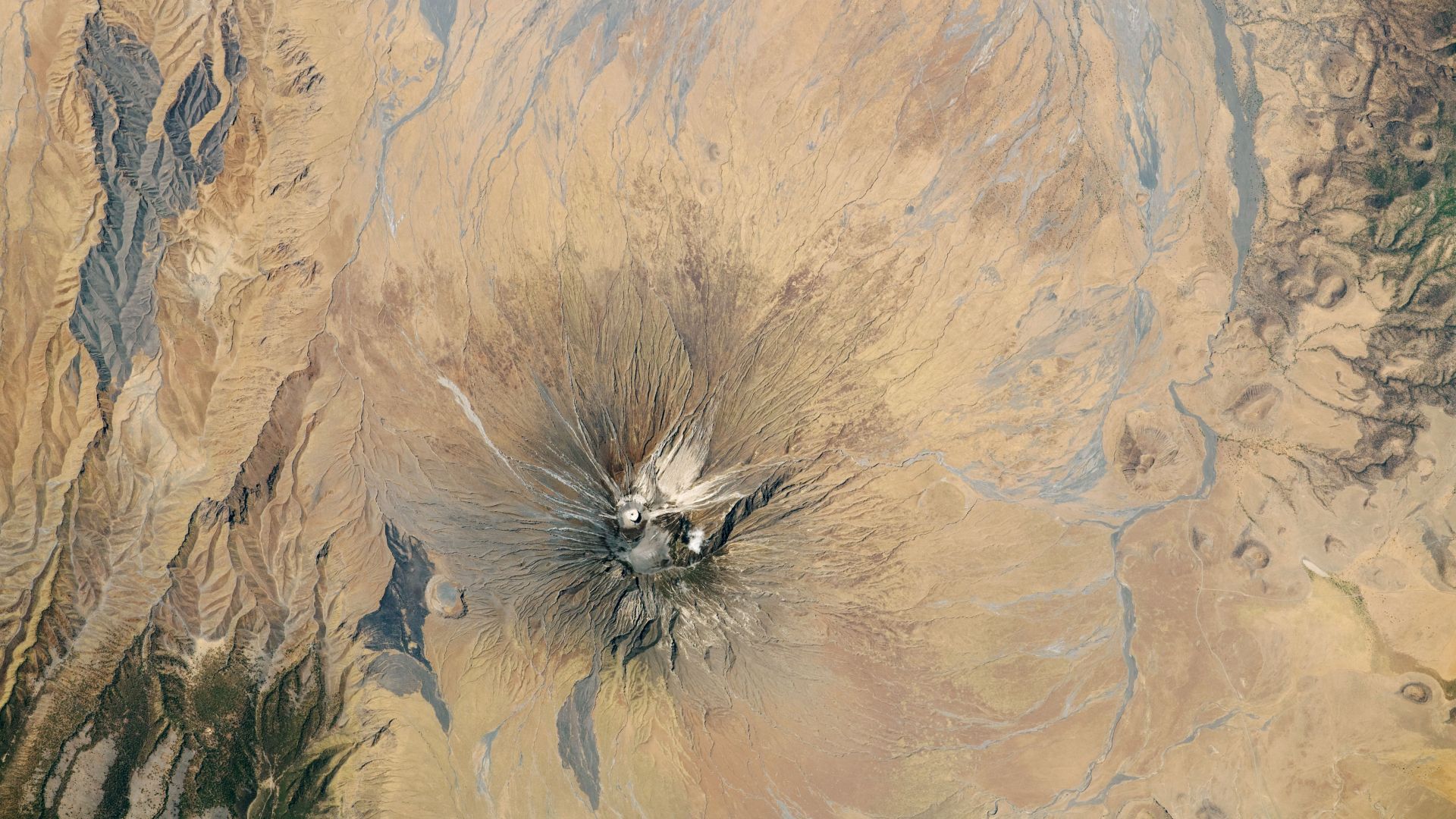
What is in the photo? The lava-streaked slopes and ash cone of one of Tanzania’s most active volcanoes
Who took the photo? An unnamed astronaut aboard the International Space Station
When was it taken? Oct. 6, 2020
This striking astronaut photograph reveals Ol Doinyo Lengai, an active stratovolcano in northern Tanzania. The volcano is famous for producing an exceptionally rare lava called natrocarbonatite — a cool, unusually fluid lava that can travel faster than almost any other lava on Earth.
Ol Doinyo Lengai rises as high as 9,718 feet (2,692 meters) above the grassy plains of Tanzania’s Arusha region. The Maasai people call the volcano the “Mountain of God” because they traditionally believe it is the home of Ngai, also known as Engai or Enkai, the supreme creator deity. The name and cultural significance of the volcano are discussed in Sacred Mountains of the World (Cambridge University Press, 2022).
One of Africa’s most active volcanoes
Ol Doinyo Lengai has erupted intermittently for roughly 15,000 years, making it one of Africa’s most active volcanoes. Its activity alternates between effusive eruptions, in which lava pours or seeps from vents, and powerful explosive events that can reshape the summit.
The volcano’s latest known eruption began in April 2017 and has been classified as effusive, according to the Smithsonian Institution’s Global Volcanism Program.
Latest Videos FromLive Science
What makes Ol Doinyo Lengai’s lava unique?
Ol Doinyo Lengai is the only volcano known to erupt natrocarbonatite lava. This unusual rock is rich in sodium, potassium and calcium carbonate but contains relatively little silica. That chemistry makes the lava much cooler than typical basaltic lava, with temperatures sometimes falling below 1,100 degrees Fahrenheit (600 degrees Celsius).
Natrocarbonatite lava is also remarkably fluid. Its low viscosity allows it to move rapidly across the volcano’s slopes, leading NASA’s Earth Observatory to describe it as some of the fastest-flowing lava on Earth.
Fresh natrocarbonatite lava is typically dark, but it becomes pale after solidifying. Rainwater and moisture in the air trigger chemical reactions that alter the lava’s surface. Several light-colored lava channels can be seen winding down Ol Doinyo Lengai’s flank in the astronaut image. The youngest visible flow formed during an eruption in 1998.
How explosive eruptions changed the volcano’s summit
For much of the 20th century, Ol Doinyo Lengai’s summit was dominated by a bowl-shaped depression that slowly filled with lava. A sequence of major explosive eruptions between 2007 and 2008 dramatically changed that landscape.
Those eruptions created an ash cone about 330 feet (100 meters) high in the center of the summit. From space, the cone gives Ol Doinyo Lengai a distinctive appearance. In the featured astronaut photograph, a dark patch of newly erupted lava sits at the cone’s center, creating what looks like a volcanic crown. Additional images from NASA’s Earth Observatory show how the volcano has evolved.
Get the world’s most fascinating discoveries delivered straight to your inbox.
Lake Natron, near Ol Doinyo Lengai, is home to large flamingo populations.
(Image credit: TONY KARUMBA/AFP via Getty Images)
Ol Doinyo Lengai and the East African Rift
The volcano lies within the East African Rift System, a roughly 2,000-mile-long (3,500-kilometer) zone formed by a divergent boundary. Here, the African Plate is gradually pulling apart as it separates into the Somali and Nubian plates.
This tectonically active region has been developing for more than 25 million years. The rift has produced some of East Africa’s most dramatic landscapes, including Mount Kilimanjaro and Mount Kenya, which rise on either side of Ol Doinyo Lengai.
The volcano stands about 10 miles (16 kilometers) south of Lake Natron, a highly alkaline red salt lake known for its large flamingo colonies. Photographers often capture Ol Doinyo Lengai and Lake Natron together, creating a striking combination of volcanic terrain, colorful water and wildlife.
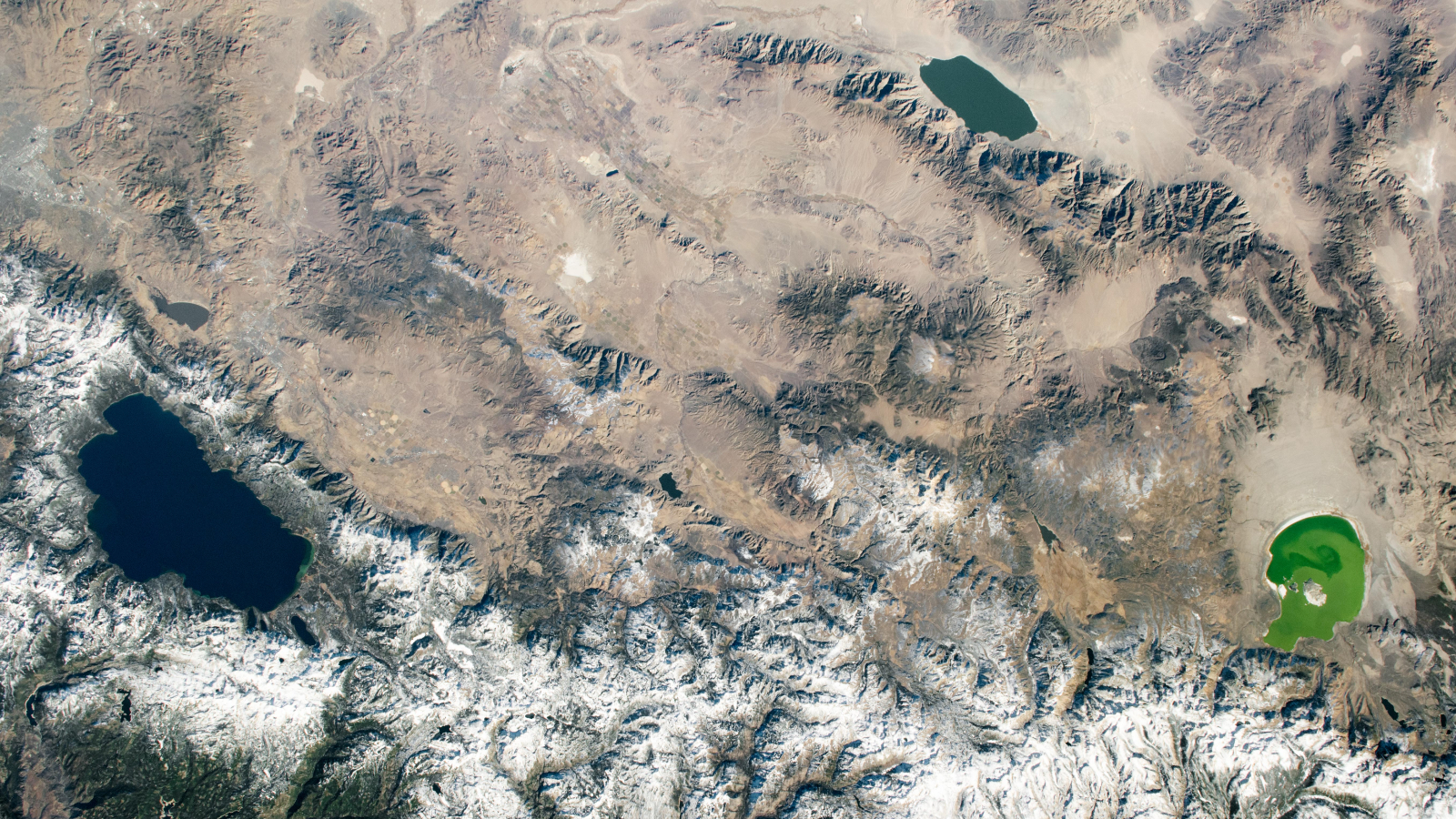
A 2020 astronaut photograph shows Lake Tahoe, Walker Lake and Mono Lake, three distinctively colored lakes near the California-Nevada border.
Source: www.livescience.com